
Paper: GS-III | Subject: Science & Technology | Topic: Space Technology | Issue: ISRO’s Resource and Institutional Constraints
Context
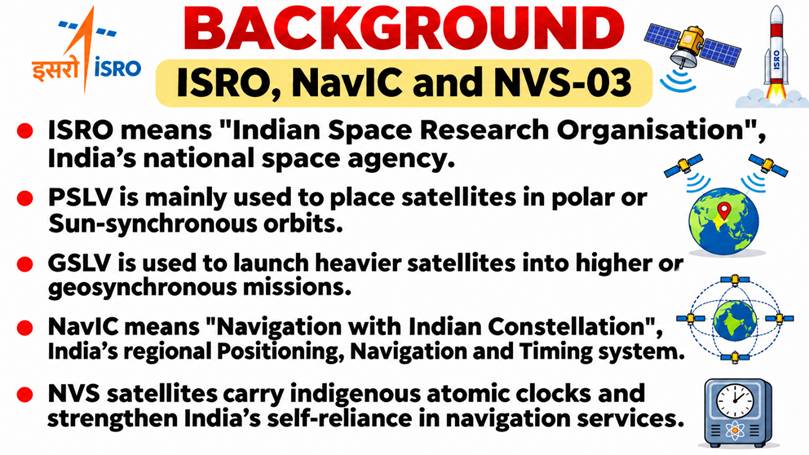
The successful GSLV-F18 launch of NVS-03 on October 30, 2026, has brought relief to the Indian Space Research Organisation (ISRO) after two PSLV failures. However, these setbacks, alongside delays in NavIC and Gaganyaan, highlight deeper challenges involving manpower, procurement and institutional capacity, threatening India’s expanding space ambitions.
Challenges Facing ISRO: Why ISRO Needs Greater Institutional Capacity
1. Launch Failures and Operational Setbacks
- Despite decades of technological progress, two recent PSLV failures disrupted ISRO’s launch schedule and raised concerns about mission reliability.
- Against this backdrop, GSLV-F18’s success offers relief, but represents only the second successful launch of 2026.
- Such setbacks become particularly serious when satellites providing essential services require timely replacement.
2. NavIC’s Operational Vulnerabilities
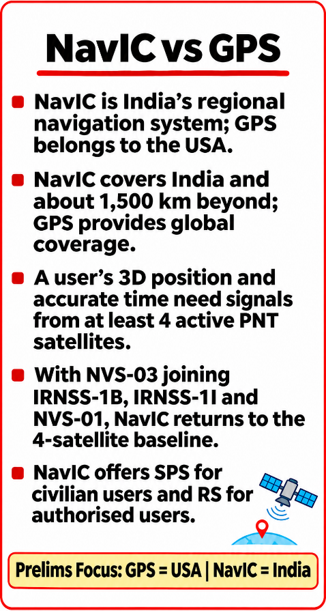
- Although 11 Satellites launched, NavIC had only three active PNT satellites, namely IRNSS-1B, IRNSS-1I and NVS-01, limiting standalone positioning services.
- To independently calculate latitude, longitude, altitude and time, a navigation receiver requires signals from at least four satellites.
- Following orbital commissioning, NVS-03 could restore this four-satellite minimum, strengthening NavIC’s independent positioning capability.
- However, maintaining reliable services requires timely satellite replacements, functioning atomic clocks and dependable launch capabilities.
3. Procurement and Manufacturing Bottlenecks
- Unfortunately, ISRO faces difficulties procuring specialised components and obtaining timely deliveries from vendors.
- A 2025 procurement proposal indicated nearly two years between contract commencement and delivery of initial flight models.
- Such delays expose weaknesses in vendor readiness, indigenous manufacturing and component qualification, slowing multiple space programmes.
4. Manpower and Resource Constraints
- These bottlenecks become harder to overcome as ISRO simultaneously pursues navigation satellites, launch vehicles and human spaceflight.
- Gaganyaan, India’s human spaceflight programme, has also experienced scheduling delays amid extensive testing and crew-safety requirements.
- Consequently, inadequate technical manpower and resources risk overstretching ISRO and delaying future missions.
Way Forward
- Strengthen manufacturing: Modernise the Semiconductor Laboratory and promote indigenous production through the Electronics Component Manufacturing Scheme.
- Improve procurement: Develop reliable domestic vendors and establish long-term component testing and qualification programmes.
- Expand institutional capacity: Recruit skilled personnel and establish a dedicated NavIC operator to reduce ISRO’s operational burden.
- Ensure financial support: Increase allocations for satellite replacements, launch infrastructure and indigenous component development.
- Regulatory clarity: Enact comprehensive space legislation governing private participation, liability and accountability.
Conclusion
India’s space ambitions require more than successful launches. Reliable execution depends on adequate funding, skilled manpower, resilient supply chains and institutional reforms, enabling ISRO to sustain existing services while pursuing future missions.
Source: (The Hindu)
La Excellence IAS Academy, the best IAS coaching in Hyderabad, known for delivering quality content and conceptual clarity for UPSC 2026 preparation.
FOLLOW US ON:
◉ YouTube: https://www.youtube.com/@CivilsPrepTeam
◉ Facebook: https://www.facebook.com/LaExcellenceIAS
◉ Instagram: https://www.instagram.com/laexcellenceiasacademy/
GET IN TOUCH:
Contact us at info@laex.in, https://laex.in/contact-us/
or Call us @ +91 9052 29 2929, +91 9052 99 2929, +91 9154 24 2140
OUR BRANCHES:
Head Office: H No: 1-10-225A, Beside AEVA Fertility Center, Ashok Nagar Extension, VV Giri Nagar, Ashok Nagar, Hyderabad, 500020
Madhapur: Flat no: 301, survey no 58-60, Guttala begumpet Madhapur metro pillar: 1524, Rangareddy Hyderabad, Telangana 500081
Bangalore: Plot No: 99, 2nd floor, 80 Feet Road, Beside Poorvika Mobiles, Chandra Layout, Attiguppe, Near Vijaya Nagara, Bengaluru, 560040