
Paper: GS-II | Subject: Polity | Topic: Judiciary | Issue: Sentencing Disparities and Need for a Sentencing Council
Context
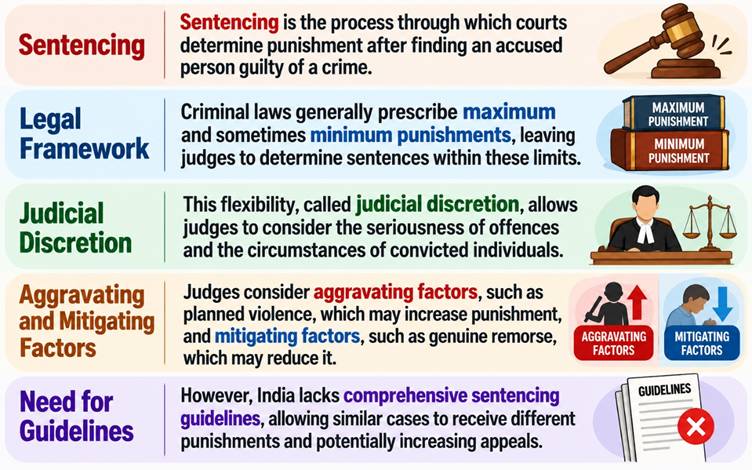
India’s courts sometimes award different punishments for similar crimes, raising concerns about fairness and unnecessary appeals. The Supreme Court has called for a national sentencing policy, prompting discussions about establishing a Sentencing Council.
Explanation
Why is the Existing Sentencing System Controversial?
- Imagine two individuals convicted of similar crimes receiving different prison sentences because judges assess their circumstances differently.
- Such differences may be justified by individual circumstances, but inconsistent judicial reasoning can create sentencing disparities and undermine public confidence.
- Article 14 guarantees equality before the law, while Article 21 requires fair and reasonable procedures when personal liberty is restricted.
- In Sunita Devi v. State of Bihar (2024), the Supreme Court observed that sentencing should not resemble a lottery.
- It urged the government to examine a comprehensive sentencing policy, and the Law Commission of India was tasked with studying the issue.
What Does the Existing Law Provide?
- Section 258(2) of the Bharatiya Nagarik Suraksha Sanhita (BNSS), 2023, generally requires Sessions Judges to hear convicted persons before determining punishment.
- This hearing allows courts to examine circumstances that may justify increasing or reducing the sentence.
- Sections 401 and 402 of the BNSS, alongside the Probation of Offenders Act, 1958, provide for probation and require special reasons when eligible offenders are denied its benefit.
- Probation allows eligible offenders to remain outside prison under prescribed conditions, encouraging rehabilitation instead of immediate imprisonment.
- However, no comprehensive framework guides courts in balancing deterrence (discouraging crime), rehabilitation (reforming offenders) and proportionality (punishment matching the offence).
How Would a Sentencing Council Improve the System?
- A proposed Sentencing Council, established through legislation, could develop offence-specific guidelines identifying appropriate punishment ranges and relevant circumstances.
- In England and Wales, sentencing guidelines assess culpability (degree of responsibility) and harm caused before adjusting punishment for aggravating and mitigating factors.
- India could adopt similar guidelines while allowing judges to consider individual circumstances and explain departures from recommended sentences.
- A National Sentencing Database, using the National Judicial Data Grid (NJDG), could identify sentencing disparities and support evidence-based reforms.
- Greater consistency could reduce avoidable sentencing appeals and judicial pendency, while preserving judicial independence and necessary discretion.
Conclusion
India needs sentencing reforms that ensure consistent treatment without ignoring individual circumstances. A Sentencing Council could strengthen equality, judicial accountability and public confidence while reducing unnecessary litigation.
Source: (The Indian Express)
La Excellence IAS Academy, the best IAS coaching in Hyderabad, known for delivering quality content and conceptual clarity for UPSC 2026 preparation.
FOLLOW US ON:
◉ YouTube: https://www.youtube.com/@CivilsPrepTeam
◉ Facebook: https://www.facebook.com/LaExcellenceIAS
◉ Instagram: https://www.instagram.com/laexcellenceiasacademy/
GET IN TOUCH:
Contact us at info@laex.in, https://laex.in/contact-us/
or Call us @ +91 9052 29 2929, +91 9052 99 2929, +91 9154 24 2140
OUR BRANCHES:
Head Office: H No: 1-10-225A, Beside AEVA Fertility Center, Ashok Nagar Extension, VV Giri Nagar, Ashok Nagar, Hyderabad, 500020
Madhapur: Flat no: 301, survey no 58-60, Guttala begumpet Madhapur metro pillar: 1524, Rangareddy Hyderabad, Telangana 500081
Bangalore: Plot No: 99, 2nd floor, 80 Feet Road, Beside Poorvika Mobiles, Chandra Layout, Attiguppe, Near Vijaya Nagara, Bengaluru, 560040