
Paper: GS Paper III, Subject: Environment, Ecology and Disaster Management, Topic: Climate Change and Environmental Governance, Issue: Climate Litigation, Corporate Liability and Climate Justice
Context: Climate Litigation
The devastating floods in Nepal in August 2026 have renewed questions about accountability for climate-related disasters. Although Nepal contributes relatively little to global emissions, Himalayan communities face increasing risks from glacier retreat and extreme rainfall. Can victims seek compensation from corporations operating thousands of kilometres away?
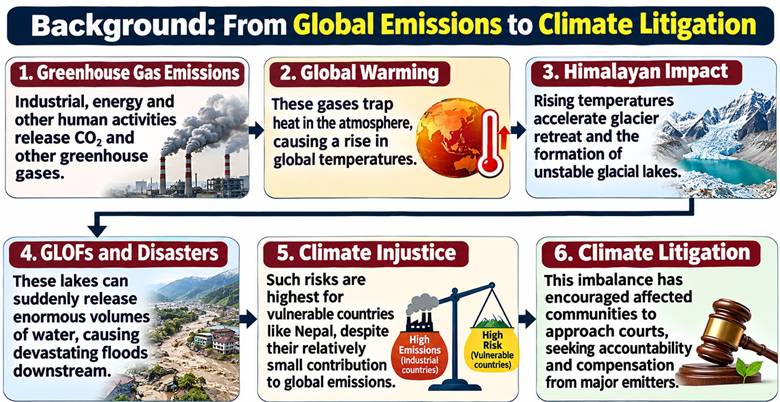
How Can Victims Hold Major Emitters Accountable?
- Since global warming results from cumulative emissions, victims cannot easily attribute a particular disaster to one company.
- Therefore, litigants identify defendants through their historical emissions, scientific evidence, legal jurisdiction and potential liability.
- Recent European cases demonstrate how this approach is gradually developing.
Major Climate Litigation Cases
Lliuya v. RWE (Germany, 2025)
- A Peruvian farmer sued German energy company RWE, arguing that its emissions contributed to glacial melting and flood risks near his home.
- RWE was selected because research attributed approximately 0.38% of historical industrial emissions to it. The farmer sought a corresponding contribution towards flood-protection costs.
- In May 2025, the Higher Regional Court of Hamm recognised that major emitters could, in principle, face proportional liability under German civil law.
- However, it dismissed the claim because the estimated flood risk to his property was insufficient to establish an imminent threat.
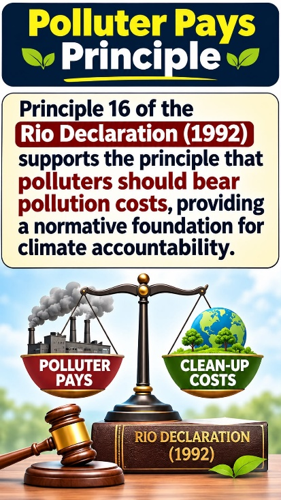
Milieudefensie v. Shell (Netherlands, 2024)
- Similarly, environmental organisations targeted Shell for its substantial emissions, seeking a 45% reduction by 2030.
- The appellate court recognised corporate climate obligations but rejected imposing that specific reduction target, demonstrating the difficulty of enforcing such duties.
Indonesian Islanders v. Holcim (Switzerland)
- Building upon similar principles, Indonesian islanders sued Swiss cement producer Holcim, seeking compensation, flood protection and emission reductions.
- In December 2025, a Swiss court permitted the case to proceed without determining corporate liability.
Implications for Nepal
- These developments could encourage Nepalese victims to identify major emitters and seek proportionate compensation.
- Nevertheless, successful litigation requires credible scientific attribution, proof of legally significant harm and an appropriate jurisdiction.
Conclusion
Climate litigation is gradually transforming corporate climate responsibility into a potential legal obligation. Although significant evidentiary barriers remain, emerging judicial principles offer new possibilities for climate justice.
Source: (The Hindu)
La Excellence IAS Academy, the best IAS coaching in Hyderabad, known for delivering quality content and conceptual clarity for UPSC 2026 preparation.
FOLLOW US ON:
◉ YouTube: https://www.youtube.com/@CivilsPrepTeam
◉ Facebook: https://www.facebook.com/LaExcellenceIAS
◉ Instagram: https://www.instagram.com/laexcellenceiasacademy/
GET IN TOUCH:
Contact us at info@laex.in, https://laex.in/contact-us/
or Call us @ +91 9052 29 2929, +91 9052 99 2929, +91 9154 24 2140
OUR BRANCHES:
Head Office: H No: 1-10-225A, Beside AEVA Fertility Center, Ashok Nagar Extension, VV Giri Nagar, Ashok Nagar, Hyderabad, 500020
Madhapur: Flat no: 301, survey no 58-60, Guttala begumpet Madhapur metro pillar: 1524, Rangareddy Hyderabad, Telangana 500081
Bangalore: Plot No: 99, 2nd floor, 80 Feet Road, Beside Poorvika Mobiles, Chandra Layout, Attiguppe, Near Vijaya Nagara, Bengaluru, 560040