
Paper: GS Paper II; Subject: Polity; Topic: Rights Issues; Issue: OBC Reservation, Creamy Layer Exclusion and Social Justice
Context: Balancing Caste and Class Inequalities
The Supreme Court, in Union of India v. Rohith Nathan (2026), reaffirmed that parental salary alone cannot determine the creamy-layer status of OBC candidates. The ruling highlights the challenge of distinguishing economic advancement from social advancement, while ensuring reservation benefits reach genuinely disadvantaged communities.
What Is the Core Controversy?
1. Caste Disadvantage vs Economic Advancement
- Reservation addresses historical social backwardness, which cannot always be measured through present income.
- For instance, an OBC employee earning a high salary may still experience caste discrimination and lack inherited social advantages.
- Therefore, higher income does not automatically establish higher social status, making creamy-layer identification more complex.
2. Discriminatory Application of Creamy-Layer Rules
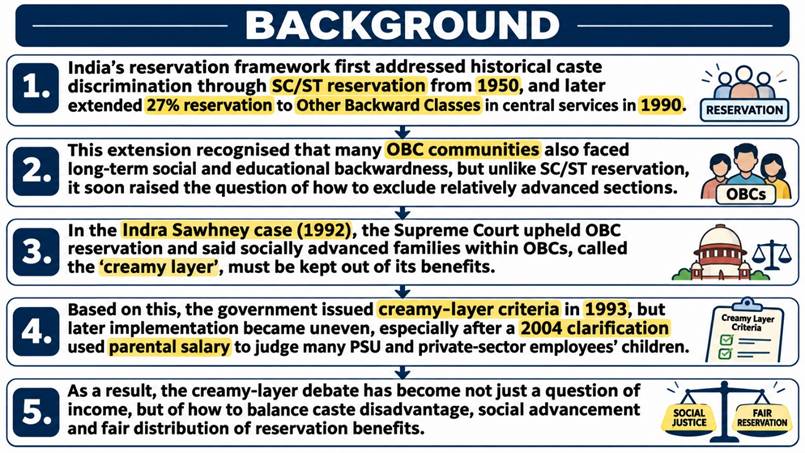
- The 1993 framework considered parental occupational status and excluded salary and agricultural income from its income/wealth test.
- However, a 2004 DoPT clarification allowed parental salaries to determine the eligibility of children of PSU and private-sector employees where equivalent government posts had not been identified.
- Consequently, their children could lose reservation eligibility upon crossing the prescribed income threshold, while children of Group C/D government employees could retain eligibility despite comparable or higher salaries.
- This created unequal treatment based on the parent’s employment sector rather than comparable social advancement.
What Did the Supreme Court Clarify?
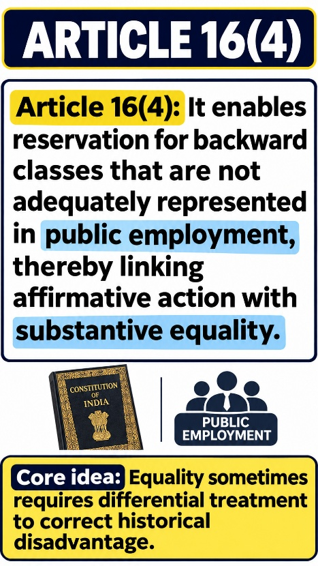
- In March 2026, the Court held that parental salary alone cannot determine creamy-layer status. Parental occupational status and post category must also be considered.
- It ruled that the 2004 clarification could not override the 1993 framework, rejecting its discriminatory application.
- In November 2026, it clarified that completed selections need not be reopened, while pending CSE 2025 service allocations must follow the ruling.
Larger Challenges and Way Forward
- Unequal Representation: OBC representation declines at higher levels of central government employment.
- Unequal Distribution: The Justice G. Rohini Commission, which submitted its report on July 31, 2023, examined sub-categorisation within the 27% OBC quota. Its recommendations remain unpublished and unimplemented.
- Policy Reforms: Establish uniform occupational equivalence, transparent creamy-layer criteria and reliable caste-wise socioeconomic data.
Conclusion:
Creamy-layer exclusion promotes equitable reservation, but its implementation must recognise that economic prosperity does not necessarily eliminate caste disadvantages. Transparent, evidence-based criteria are essential for substantive social justice.
Source: (The Hindu)
La Excellence IAS Academy, the best IAS coaching in Hyderabad, known for delivering quality content and conceptual clarity for UPSC 2026 preparation.
FOLLOW US ON:
◉ YouTube: https://www.youtube.com/@CivilsPrepTeam
◉ Facebook: https://www.facebook.com/LaExcellenceIAS
◉ Instagram: https://www.instagram.com/laexcellenceiasacademy/
GET IN TOUCH:
Contact us at info@laex.in, https://laex.in/contact-us/
or Call us @ +91 9052 29 2929, +91 9052 99 2929, +91 9154 24 2140
OUR BRANCHES:
Head Office: H No: 1-10-225A, Beside AEVA Fertility Center, Ashok Nagar Extension, VV Giri Nagar, Ashok Nagar, Hyderabad, 500020
Madhapur: Flat no: 301, survey no 58-60, Guttala begumpet Madhapur metro pillar: 1524, Rangareddy Hyderabad, Telangana 500081
Bangalore: Plot No: 99, 2nd floor, 80 Feet Road, Beside Poorvika Mobiles, Chandra Layout, Attiguppe, Near Vijaya Nagara, Bengaluru, 560040