
Paper: GS Paper III, Subject: Environment, Ecology and Disaster Management, Topic: Biodiversity Conservation and Climate Change, Issue: Arctic Warming, Sea Ice Loss and Threatened Marine Species
Context: Arctic Seal
The October 2025 IUCN Red List update revealed increasing extinction risks for three Arctic seal species due to rapidly disappearing sea ice. The assessment highlights how climate change threatens not only individual species but also Arctic marine ecosystems, food chains and Indigenous communities dependent on them.
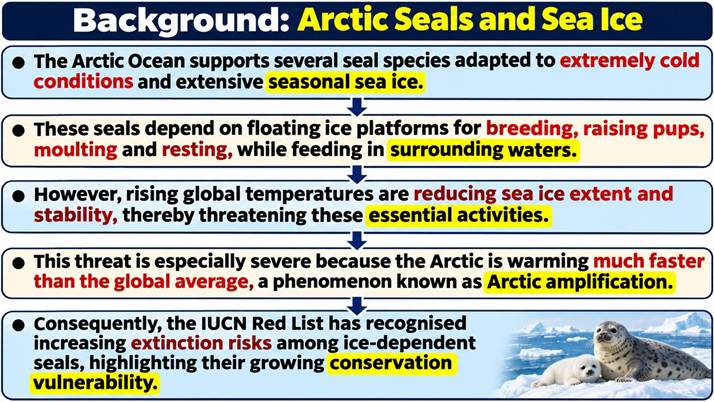
Which Arctic Seal Species Are at Risk?
- The hooded seal (Cystophora cristata) has moved from Vulnerable to Endangered, indicating a higher risk of extinction.
- Similarly, the bearded seal (Erignathus barbatus) and harp seal (Pagophilus groenlandicus) have shifted from Least Concern to Near Threatened.
- These deteriorating assessments reflect the growing difficulty of surviving and reproducing as their essential ice habitats disappear.
Why Is Arctic Sea Ice Disappearing Rapidly?
- The underlying cause is Arctic amplification, where warming melts reflective snow and ice, exposing darker surfaces that absorb more solar radiation.
- This reduction in albedo accelerates warming and further melting, creating a self-reinforcing feedback cycle.
- Consequently, March 2025 recorded the lowest annual maximum Arctic sea ice extent in the satellite record.
- Meanwhile, Atlantification introduces warmer Atlantic waters into the Arctic Ocean, increasing ocean mixing and accelerating ice loss.
- Together, these processes reduce suitable habitats for seals while transforming the broader Arctic marine environment.
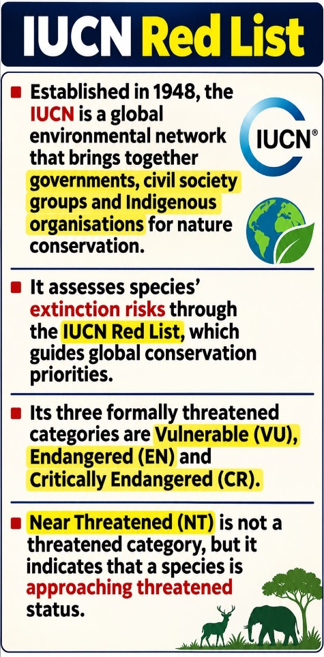
Why Does Their Decline Threaten Arctic Ecosystems?
- Arctic seals occupy an important position in marine food webs, consuming fish and invertebrates while serving as prey for polar bears.
- Therefore, declining seal populations can disrupt predator-prey relationships, nutrient cycling and Indigenous communities dependent on marine resources.
- Furthermore, retreating ice increases access for shipping, fishing and resource extraction, exposing already vulnerable populations to additional disturbances.
What Measures Are Necessary?
- Addressing these interconnected threats requires reducing global greenhouse gas emissions to slow Arctic warming.
- Simultaneously, protecting critical habitats, regulating shipping, preventing accidental fishing captures and ensuring sustainable hunting can reduce additional pressures.
- Indigenous participation and scientific monitoring must support these conservation efforts.
Conclusion
The declining status of Arctic seals illustrates how climate change triggers cascading ecological consequences. Protecting these species requires addressing both the underlying warming and the growing human pressures on Arctic ecosystems.
Source: (The Indian Express)
La Excellence IAS Academy, the best IAS coaching in Hyderabad, known for delivering quality content and conceptual clarity for UPSC 2026 preparation.
FOLLOW US ON:
◉ YouTube: https://www.youtube.com/@CivilsPrepTeam
◉ Facebook: https://www.facebook.com/LaExcellenceIAS
◉ Instagram: https://www.instagram.com/laexcellenceiasacademy/
GET IN TOUCH:
Contact us at info@laex.in, https://laex.in/contact-us/
or Call us @ +91 9052 29 2929, +91 9052 99 2929, +91 9154 24 2140
OUR BRANCHES:
Head Office: H No: 1-10-225A, Beside AEVA Fertility Center, Ashok Nagar Extension, VV Giri Nagar, Ashok Nagar, Hyderabad, 500020
Madhapur: Flat no: 301, survey no 58-60, Guttala begumpet Madhapur metro pillar: 1524, Rangareddy Hyderabad, Telangana 500081
Bangalore: Plot No: 99, 2nd floor, 80 Feet Road, Beside Poorvika Mobiles, Chandra Layout, Attiguppe, Near Vijaya Nagara, Bengaluru, 560040