
Paper: GS II | Subject: Society and Social Justice | Topic: Issues of Women | Issue: App-Based Domestic Workers and Gig Economy Regulations
Context: Gig
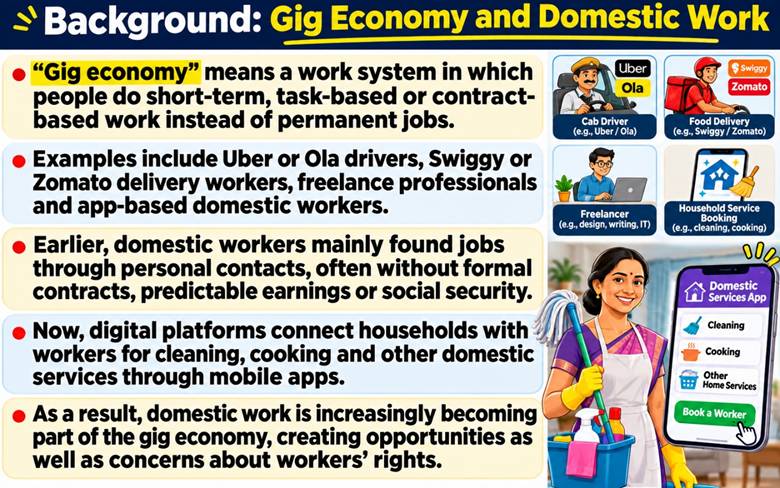
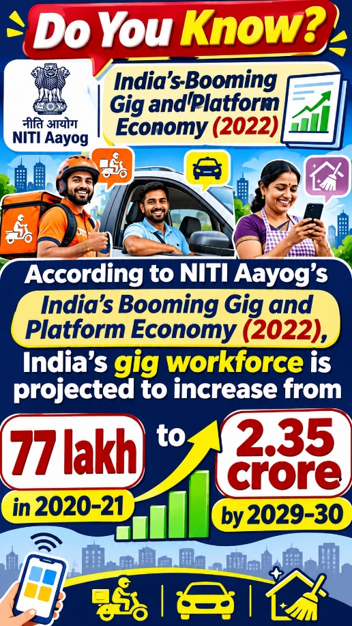
App-based platforms such as Pronto, Snabbit and InstaHelp are transforming domestic work in Indian cities. While offering women better earning opportunities and financial independence, these platforms also raise concerns regarding long working hours, workplace safety, digital monitoring and social security.
How Do These Platforms Operate?
- Workers register, receive basic training and accept bookings through mobile applications.
- Earnings depend on completed tasks, working hours, customer ratings and performance incentives.
- Some platforms offer shift-based payments and safety features such as emergency assistance.
Opportunities for Women Workers
- Better earnings: Regular bookings and incentives can improve income compared to traditional informal employment.
- Financial independence: Greater earnings strengthen women’s economic autonomy and household decision-making.
- Organised employment: Training, digital payments and structured bookings improve work organisation.
- Employment access: Digital platforms connect women with more potential customers.
Major Challenges
- Long working hours: Workers may face extended shifts with inadequate rest.
- Income insecurity: Earnings fluctuate with bookings, ratings and platform policies.
- Digital exclusion: Limited digital literacy complicates app-based employment.
- Workplace safety: Harassment, discrimination and inadequate grievance mechanisms remain concerns.
- Limited social security: Access to insurance, maternity benefits and pensions remains inadequate.
Legal Framework in India
Central Government
- Code on Social Security, 2020: Recognises gig and platform workers and provides for social-security schemes, including insurance and maternity benefits. It came into force in November 2025.
- Social Security (Central) Rules, 2026: Provide for worker registration and implementation of social-security measures.
State Governments
- Rajasthan (2023), Karnataka (2025), Bihar (2025), Jharkhand (2025) and Telangana (2026) have enacted dedicated gig-worker welfare laws.
- These laws provide frameworks for worker registration, welfare funds, social security and grievance redressal. Implementation varies across States.
Way Forward
- Ensure fair wages, reasonable working hours and transparent platform policies.
- Strengthen insurance, maternity benefits, grievance redressal and workplace safety.
- Promote digital literacy and worker representation.
Conclusion
The gig economy can promote women’s economic empowerment, but digital employment must ensure dignity, fair working conditions and effective social protection.
Source: (The Hindu)
La Excellence IAS Academy, the best IAS coaching in Hyderabad, known for delivering quality content and conceptual clarity for UPSC 2026 preparation.
FOLLOW US ON:
◉ YouTube: https://www.youtube.com/@CivilsPrepTeam
◉ Facebook: https://www.facebook.com/LaExcellenceIAS
◉ Instagram: https://www.instagram.com/laexcellenceiasacademy/
GET IN TOUCH:
Contact us at info@laex.in, https://laex.in/contact-us/
or Call us @ +91 9052 29 2929, +91 9052 99 2929, +91 9154 24 2140
OUR BRANCHES:
Head Office: H No: 1-10-225A, Beside AEVA Fertility Center, Ashok Nagar Extension, VV Giri Nagar, Ashok Nagar, Hyderabad, 500020
Madhapur: Flat no: 301, survey no 58-60, Guttala begumpet Madhapur metro pillar: 1524, Rangareddy Hyderabad, Telangana 500081
Bangalore: Plot No: 99, 2nd floor, 80 Feet Road, Beside Poorvika Mobiles, Chandra Layout, Attiguppe, Near Vijaya Nagara, Bengaluru, 560040