
Paper: GS – I, Subject: World History, Topic: Revolutions – American, French, Russia, Issue: 250 Years of American Independence and the Rise of the United States (American Revolution).
Context:
July 4, 2026 marks 250 years since the adoption of the American Declaration of Independence. The anniversary recalls how the American colonies ended British rule and how the United States later transformed its economy and global influence.
Key Takeaways:
Background:
- Native American communities had lived across North America long before Europeans arrived. European colonisation expanded from the late fifteenth century as Spain, France, the Netherlands and Britain established settlements and competed for land and trade.
- Europeans who settled permanently in British-controlled North America, along with their descendants, came to be known as colonists. Their settlements gradually developed local governments, commercial networks and a distinct political identity.
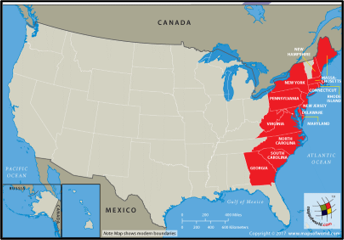
- The United States emerged from 13 British colonies on the Atlantic coast. Britain had initially allowed these colonies considerable freedom to manage their own internal affairs.
- The Seven Years’ War of 1756–1763 placed Britain under severe financial pressure. The British Parliament then imposed new taxes and strengthened its control over the colonies.
- The central dispute concerned political authority. The colonists rejected taxation without representation, while Britain claimed that Parliament possessed supreme authority throughout the empire.
Explanation:
Growing Conflict with Britain:
- Britain introduced the Sugar Act of 1764, the Stamp Act of 1765, the Townshend Acts of 1767 and the Tea Act of 1773. The colonists regarded these measures as attacks on their economic interests, political rights and local authority.
- “No taxation without representation” became the main slogan of resistance. Organisations such as the Sons of Liberty and Daughters of Liberty promoted protests, boycotts and opposition to British imports.
- On December 16, 1773, in a famous event known as the Boston Tea Party, colonists dumped more than 300 tea chests into Boston Harbour, causing an estimated loss of £10,000 to Britain.
- Britain responded with the Intolerable Acts of 1774. These punitive measures strengthened unity among the colonies and pushed them towards organised resistance.
Declaration, War and Independence:
- The First Continental Congress met in 1774 to coordinate colonial resistance. The Second Continental Congress created an army in 1775, appointed George Washington as commander and made a final unsuccessful attempt at reconciliation through the Olive Branch Petition.
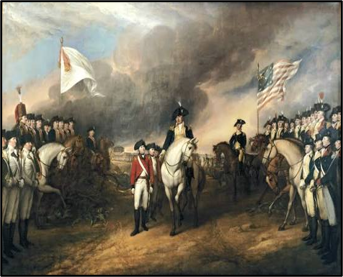
- Thomas Jefferson principally drafted the Declaration of Independence, which Congress revised and 56 delegates signed on July 4, 1776. The colonies declared independence and fought Britain during the American Revolutionary War from 1775 to 1783. France, Spain and the Dutch Republic supported them. British forces surrendered at Yorktown in 1781, and Britain formally recognised the United States through the Treaty of Paris in 1783.
Political Ideas and Achievements:
- The Declaration stated that all people possessed natural rights, including life, liberty and the pursuit of happiness.
- It declared that governments received their legitimate authority from the consent of the governed. It also recognised the people’s right to change a government that violated their rights.
- The Revolution weakened loyalist elites, ended many mercantilist restrictions and created new commercial opportunities.
- The Constitution established a federal democratic republic, while the Bill of Rights later protected important civil freedoms. The American example spread ideas of constitutional government, federalism and anti-colonial nationalism.
Limits of American Freedom:
- Native American communities lost large areas of land and declined in number as European settlers and the new American state continued to expand.
- Women lacked political rights and could not participate equally in the new republic.
- Enslaved Africans had been brought from Africa and forced to work in the colonies. Their slavery continued after independence and ended formally only in 1865, following the American Civil War.
- Thomas Jefferson himself owned more than 100 enslaved people, although the Declaration proclaimed liberty and equality.
Economic Reinvention:
- Over the years, industrialisation transformed the United States from an agrarian republic into an industrial powerhouse through factories, railways and mechanised production.
- Scientific management and Ford’s assembly line later connected mass production with mass consumption.
- Globalisation shifted much manufacturing to lower-cost Asian locations, while American firms retained control over finance, technology, brands and intellectual property.
- Artificial intelligence, semiconductors, cloud computing, biotechnology and robotics now drive another transformation. These technologies raise new concerns about employment, inequality, monopoly and ownership.
Conclusion:
The American Revolution created a republic based on liberty and popular government, but it excluded many communities. The United States later expanded its power through repeated economic and technological reinvention. Its continuing challenge is to balance innovation and global influence with equality and democratic control.
Source: (The Indian Express, The Hindu)
La Excellence IAS Academy, the best IAS coaching in Hyderabad, known for delivering quality content and conceptual clarity for UPSC 2026 preparation.
FOLLOW US ON:
◉ YouTube : https://www.youtube.com/@CivilsPrepTeam
◉ Facebook: https://www.facebook.com/LaExcellenceIAS
◉ Instagram: https://www.instagram.com/laexcellenceiasacademy/
GET IN TOUCH:
Contact us at info@laex.in, https://laex.in/contact-us/
or Call us @ +91 9052 29 2929, +91 9052 99 2929, +91 9154 24 2140
OUR BRANCHES:
Head Office: H No: 1-10-225A, Beside AEVA Fertility Center, Ashok Nagar Extension, VV Giri Nagar, Ashok Nagar, Hyderabad, 500020
Madhapur: Flat no: 301, survey no 58-60, Guttala begumpet Madhapur metro pillar: 1524, Rangareddy Hyderabad, Telangana 500081
Bangalore: Plot No: 99, 2nd floor, 80 Feet Road, Beside Poorvika Mobiles, Chandra Layout, Attiguppe, Near Vijaya Nagara, Bengaluru, 560040