
Paper: GS – II, Subject: International Relations, Topic: Agreements involving India and/or affecting India’s interests, Issue: US on Frontier AI Restrictions: Two Possible Outcomes.
Context:
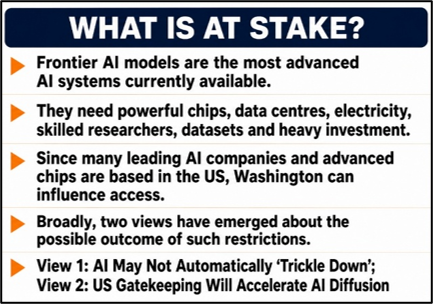
Recently, the US company Anthropic developed advanced AI models such as Claude Fable and Claude Mythos. The US government temporarily directed the company to restrict access outside America, affecting users worldwide, including India. This showed that one government can influence global access to an important technology. It raised a concern: can advanced AI become a geopolitical weapon, and should India depend on foreign-controlled models?
Key Takeaways:
Explanation:
View 1: AI May Not Automatically “Trickle Down”
A Lasting Technology Gap May Develop:
- Some assume that every new technology eventually becomes cheaper and reaches all countries.
- However, AI improves rapidly. By the time India receives an older model, advanced countries may already be several generations ahead.
- Temporary restrictions can therefore create a long-term technological disadvantage.
AI Can Become a Strategic Weapon:
- Countries already use control over vaccines, energy, critical minerals and semiconductor chips as leverage.
- AI is especially important because it affects defence, governance, healthcare, finance, education and scientific research.
- Access may be withdrawn, made expensive or linked to political conditions.
Risks for India:
- India has strong software talent but lacks sufficient advanced chips, computing power, research funding and university–industry cooperation.
- Dependence on American models creates the risk of sudden denial of access.
- Chinese open models may be cheaper, but they raise concerns about security, data control and political influence.
View 2: US Gatekeeping Will Accelerate AI Diffusion:
Restrictions Will Create Alternatives:
- Countries denied access will invest in their own AI models, chips and computing systems.
- US chip controls have already pushed China to strengthen domestic production.
- Similar AI restrictions may encourage China, Europe, Japan and developing countries to build independent systems.
Open Models May Spread Faster:
- Chinese companies are promoting cheaper open or open-weight AI models.
- Countries may adopt them if American models become restricted or unreliable.
- Thus, US controls may unintentionally increase China’s technological influence.
America May Lose Trust:
- Even US allies may feel that American technology cannot be treated as permanently reliable.
- They may diversify towards domestic, European, Japanese or Chinese systems.
- Software, knowledge and skilled workers are also harder to control than physical goods.
Common Conclusion: What Should India Do?
Both views agree that India should not depend entirely on foreign AI companies. India must build a sovereign AI ecosystem through:
- Advanced chips and national computing capacity;
- Data centres, reliable electricity and secure cloud systems;
- Indian-language datasets and indigenous foundation models;
- Skilled researchers, long-term finance and strong research institutions;
- Cybersecurity, data protection and diversified international partnerships.
India can cooperate internationally, but its essential systems should not stop functioning because of a decision taken abroad.
Conclusion:
The two views differ on whether US restrictions will preserve American dominance or create new AI centres. For India, the lesson is clear: foreign technology can support development, but indigenous capability is essential for technological security and strategic autonomy.
Source: (The Indian Express)
La Excellence IAS Academy, the best IAS coaching in Hyderabad, known for delivering quality content and conceptual clarity for UPSC 2026 preparation.
FOLLOW US ON:
◉ YouTube : https://www.youtube.com/@CivilsPrepTeam
◉ Facebook: https://www.facebook.com/LaExcellenceIAS
◉ Instagram: https://www.instagram.com/laexcellenceiasacademy/
GET IN TOUCH:
Contact us at info@laex.in, https://laex.in/contact-us/
or Call us @ +91 9052 29 2929, +91 9052 99 2929, +91 9154 24 2140
OUR BRANCHES:
Head Office: H No: 1-10-225A, Beside AEVA Fertility Center, Ashok Nagar Extension, VV Giri Nagar, Ashok Nagar, Hyderabad, 500020
Madhapur: Flat no: 301, survey no 58-60, Guttala begumpet Madhapur metro pillar: 1524, Rangareddy Hyderabad, Telangana 500081
Bangalore: Plot No: 99, 2nd floor, 80 Feet Road, Beside Poorvika Mobiles, Chandra Layout, Attiguppe, Near Vijaya Nagara, Bengaluru, 560040