
Paper: GS-III, Subject: Economy, Topic: Growth and Development, Issue: India Growth Quality
Context
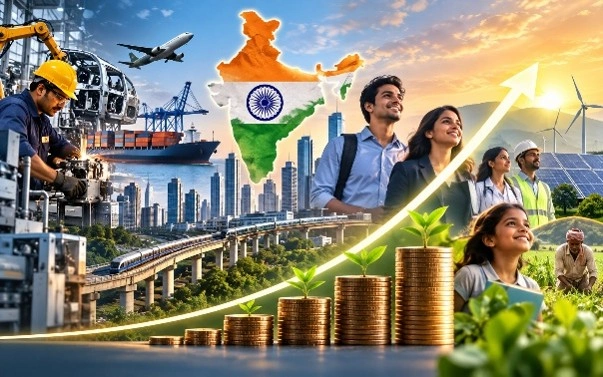
India’s real GDP grew by 7.8% in April-June 2026, reflecting strong economic momentum despite global uncertainty. The key question, however, is whether this growth is translating into productive employment, stronger private investment, higher incomes and long-term economic resilience.
Background
- Real GDP measures the actual increase in goods and services after removing the effect of inflation.
- Growth was supported by strong expansion in manufacturing, construction and services, while agriculture grew more moderately.
- Consumption, exports and investment also contributed to demand.
Why is the growth significant?
- Broad-based growth: Expansion across manufacturing, construction and services is healthier than growth driven by a single sector.
- Strong investment: Gross Fixed Capital Formation rose sharply, indicating greater spending on factories, machinery, infrastructure and other productive assets.
- Global importance: Sustained high growth increases India’s attractiveness as a large market, production base and investment destination.
- However, becoming one of the world’s largest economies in aggregate GDP does not automatically mean equally high per-capita income or living standards.
The next challenge: Private investment
- Government capital expenditure on roads, railways and other infrastructure has played an important role in supporting recent investment.
- Public investment can create infrastructure and demand, but sustained expansion ultimately requires businesses to invest more of their own capital.
- Firms need confidence in future demand before building factories, purchasing machinery and expanding capacity.
- Predictable regulation, stable taxation, easier credit and reliable infrastructure can help crowd in private investment.
Employment is the real test
- GDP can rise rapidly even when employment creation remains limited, particularly in highly automated or capital-intensive sectors.
- Therefore, the quality of growth should be judged by whether it creates productive jobs with higher wages, skills, formalisation and social security.
- Women’s participation can rise further if barriers such as unsafe transport, inadequate childcare, limited access to credit and inflexible workplaces are reduced.
Manufacturing must move up the value chain
- India needs to move beyond primarily assembling imported components.
- Greater domestic value can come from design, components, machinery, electronics, advanced manufacturing and clean technologies.
- This would improve productivity, technological capability and the quality of employment while reducing dependence on imported inputs.
Services, AI and trade
- Services growth needs to spread beyond major metropolitan centres into tourism, health, education, finance, logistics and digital services.
- In artificial intelligence, India should move from simply adopting foreign technologies towards building domestic computing capacity, Indian-language datasets, research talent and trusted applications.
- Free Trade Agreements create opportunities, but firms must actually use them. MSMEs often need support with quality standards, certification, customs procedures and non-tariff barriers.
Building economic resilience
- Faster growth increases demand for energy, technology and imported raw materials.
- India therefore needs diversified suppliers, strategic reserves, long-term contracts, renewable energy, domestic exploration and greater efficiency to reduce vulnerability to external shocks.
Way Forward
The next phase should convert public investment into private investment, GDP growth into productive employment, and expanding markets into stronger domestic manufacturing, technology and MSME competitiveness.
Conclusion
The significance of 7.8% growth lies not merely in the headline number. Its real success will depend on whether India converts rapid expansion into higher productivity, better jobs, stronger household incomes and broad-based prosperity.
Source: (The Hindu)
La Excellence IAS Academy, the best IAS coaching in Hyderabad, known for delivering quality content and conceptual clarity for UPSC 2026 preparation.
FOLLOW US ON:
◉ YouTube : https://www.youtube.com/@CivilsPrepTeam
◉ Facebook: https://www.facebook.com/LaExcellenceIAS
◉ Instagram: https://www.instagram.com/laexcellenceiasacademy/
GET IN TOUCH:
Contact us at info@laex.in, https://laex.in/contact-us/
or Call us @ +91 9052 29 2929, +91 9052 99 2929, +91 9154 24 2140
OUR BRANCHES:
Head Office: H No: 1-10-225A, Beside AEVA Fertility Center, Ashok Nagar Extension, VV Giri Nagar, Ashok Nagar, Hyderabad, 500020
Madhapur: Flat no: 301, survey no 58-60, Guttala begumpet Madhapur metro pillar: 1524, Rangareddy Hyderabad, Telangana 500081
Bangalore: Plot No: 99, 2nd floor, 80 Feet Road, Beside Poorvika Mobiles, Chandra Layout, Attiguppe, Near Vijaya Nagara, Bengaluru, 560040