
Paper: GS – II, Subject: International Relations, Topic: India and Its Neighbourhood, Issue: Revamping India’s Neighbourhood Policy.
Context:
India’s neighbourhood policy is witnessing a strategic inflection point due to political transitions in key neighbouring countries and shifts in the global economic order. The article argues that instead of viewing recent developments as setbacks, India should leverage them to reset regional ties through trade-led integration, pragmatic diplomacy, and a shift from hierarchical to partnership-based engagement.
Key Takeaways:
BACKGROUND:
- India’s regional engagement has historically been shaped by a mix of strategic dominance, political sensitivities, and economic underperformance in South Asia.
- Despite geographical proximity and shared history, South Asia remains one of the least economically integrated regions globally.
- India’s “Neighbourhood First” policy aimed to correct this but has been constrained by India’s own protectionist trade practices and inconsistent execution.
- Regional institutions like SAARC have stagnated, while sub-regional initiatives like BBIN have shown limited but promising progress.
- Globally, the post-Cold War trade order is weakening, with rising tariffs, sanctions, and geopolitical competition reshaping economic relations.
RARE OPPORTUNITY TO RE-IMAGINE NEIGHBOURHOOD POLICY:
- India’s neighbourhood discourse has shifted from pessimism about “losing the Subcontinent” to recognising a fresh opportunity created by political change across the region.
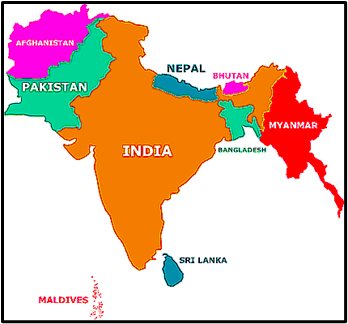
- In Bangladesh, the rise of Tarique Rahman and a strong electoral mandate for the Bangladesh Nationalist Party signal a move toward interest-based engagement. The earlier decade of deep economic interdependence provides a stable base, but political momentum must now be rebuilt.
- Nepal is witnessing a generational political shift with new actors challenging entrenched elites. This creates space for India to move away from outdated notions of “special relations” and instead engage on the basis of equality and respect for sovereignty.
- Sri Lanka’s post-crisis political transition has already pushed Colombo toward pragmatic engagement with India, moving beyond past political mistrust.
- These parallel transitions across the neighbourhood collectively offer a rare strategic opening. The most effective instrument to utilise this opportunity is trade.
- India has recently shown flexibility in negotiating major trade agreements with global partners like UK, USA and EU etc. However, this reformist approach has not been extended to neighbouring countries.
- Regional trade has been undermined by India’s own protectionist policies, which contradict its natural advantages of geography. Despite proximity, neighbours continue to depend more on distant markets for exports and on China for imports.
- India’s trade behaviour is inconsistent. While it criticises trade deficits with China, it maintains surpluses with neighbours but hesitates to open its market to them.
- Energy and economic linkages with the Gulf create vulnerabilities that can be mitigated through regional cooperation.
- Connectivity gaps, poor infrastructure, and non-tariff barriers continue to restrict trade flows.
- A hierarchical approach to diplomacy has created political resentment, necessitating a shift toward equal partnerships.
- Current Global trade fragmentation is pushing countries toward regional economic blocs, making neighbourhood engagement more critical.
- The solution lies not in restricting exports but in expanding imports from neighbouring countries, supported by investment, trade facilitation, and modern border infrastructure.
- Enhanced connectivity, especially in the eastern subcontinent linking India, Bangladesh, and Nepal, can unlock economic growth in some of the poorest regions of South Asia.
- This transformation requires both unilateral policy shifts by India and negotiated arrangements, including safeguards like rules of origin. Trade must be driven by mutual benefit and political ownership, not one-sided concessions.
- External conditions reinforce urgency. The fragmentation of the global trading system makes regional markets more important for smaller economies. India offers scale and proximity that no distant partner can match.
- Instability in the Gulf region is affecting energy flows, remittances, and economic stability in South Asia. India’s role in supporting neighbours through energy supplies opens avenues for deeper cooperation in energy and economic security.
- A meaningful reset does not require revival of large regional groupings but depends on political will, policy innovation, and institutional agility.
- The biggest barrier is mindset. India has often approached neighbours with a sense of entitlement, expecting deference in return for engagement. This has generated resentment.
- New political leaderships in neighbouring countries represent electorates that reject dependency. They seek partnerships based on equality and tangible benefits.
- Future cooperation must deliver visible outcomes such as improved connectivity, open markets, job creation, and shared economic growth.
KEY FACTS TO REMEMBER:
- South Asia is among the least integrated economic regions globally.
- India runs trade surpluses with Bangladesh, Nepal, and Sri Lanka.
- China is a major source of imports for South Asian countries.
- Eastern South Asia holds high potential for economic transformation through connectivity.
- Gulf region instability affects South Asia’s energy and remittance flows.
WAY FORWARD:
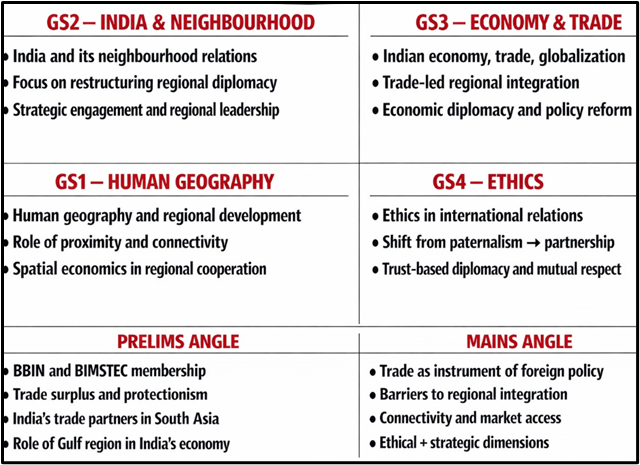
- Recast neighbourhood policy around trade-led integration and economic interdependence.
- Open Indian markets to neighbours while strengthening domestic competitiveness.
- Invest in border infrastructure, logistics, and seamless connectivity.
- Promote sub-regional cooperation where broader regional platforms are ineffective.
- Build relationships based on equality, mutual benefit, and respect for sovereignty.
- Align foreign policy with economic priorities to secure long-term regional stability and growth.
Source: (The Indian Express, The Hindu, Live Mint)
La Excellence IAS Academy, the best IAS coaching in Hyderabad, known for delivering quality content and conceptual clarity for UPSC 2026 preparation.
FOLLOW US ON:
◉ YouTube : https://www.youtube.com/@CivilsPrepTeam
◉ Facebook: https://www.facebook.com/LaExcellenceIAS
◉ Instagram: https://www.instagram.com/laexcellenceiasacademy/
GET IN TOUCH:
Contact us at info@laex.in, https://laex.in/contact-us/
or Call us @ +91 9052 29 2929, +91 9052 99 2929, +91 9154 24 2140
OUR BRANCHES:
Head Office: H No: 1-10-225A, Beside AEVA Fertility Center, Ashok Nagar Extension, VV Giri Nagar, Ashok Nagar, Hyderabad, 500020
Madhapur: Flat no: 301, survey no 58-60, Guttala begumpet Madhapur metro pillar: 1524, Rangareddy Hyderabad, Telangana 500081
Bangalore: Plot No: 99, 2nd floor, 80 Feet Road, Beside Poorvika Mobiles, Chandra Layout, Attiguppe, Near Vijaya Nagara, Bengaluru, 560040