
Paper: GS – III, Subject: Economy, Topic: Industry and Industrial policies, Issue: Industrial Policy 2.0: Scaling Manufacturing through PLI Strategy.
Context:
India’s success in smartphone manufacturing under the Production Linked Incentive (PLI) scheme offers a replicable model for industrial policy, demonstrating how targeted incentives, scale integration, and ecosystem development can boost exports and domestic manufacturing competitiveness.
Key Takeaways:
BACKGROUND:
- Industrial policy refers to government measures to promote specific sectors for economic growth.
- PLI scheme (2020) incentivises incremental production in key sectors.
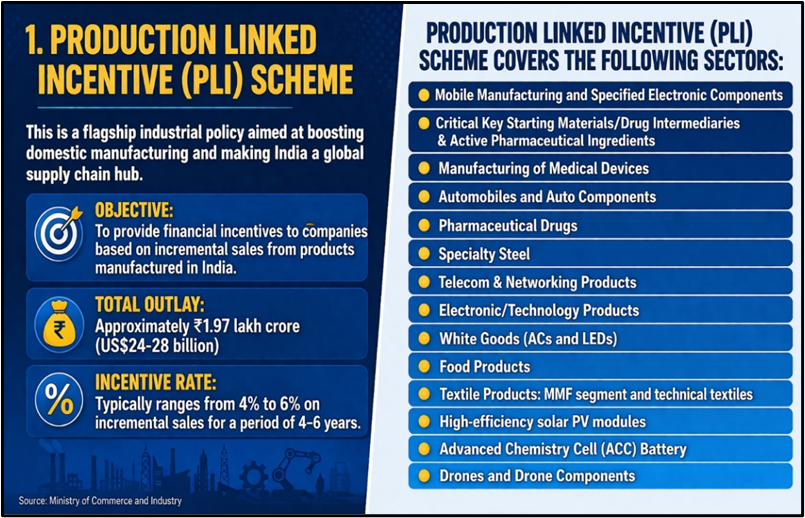
INDIA’S SUCCESS IN SMARTPHONE MANUFACTURING:
- Smartphone production in India increased from $30 billion (2020) to $64 billion (FY2025).
- Exports rose sharply from $3.1 billion to $24 billion.
- India’s share in global smartphone exports increased from 1% to 8%.
- Total ecosystem investment reached around $8 billion.
- Employment generation estimated between 1.5 lakh to 2 lakh jobs.
KEY REASONS FOR SUCCESS OF SMARTPHONE PLI:
1. Clear Export Orientation:
- Policy focused on integrating India into global value chains.
- Differentiated strategy for high-value export phones and low-cost domestic phones.
- Export growth became the primary driver of scale.
- Avoided inward-looking import substitution bias.
2. Focus on Downstream Assembly First:
- Targeted global firms such as Foxconn, Pegatron, and Wistron.
- Assembly acts as a “locomotive” for the ecosystem:
- Generates large-scale employment
- Creates demand for components
- Anchors supplier networks (including MSMEs)
- Followed successful East Asian model (China, Vietnam).
3. Leveraging India’s Labour Advantage:
- Smartphone assembly is labour-intensive even with automation.
- India’s large workforce provides a comparative advantage similar to China.
- Significant female workforce participation (e.g., Tata Electronics).
4. Ensuring Free Flow of Inputs:
- Govt reduced tariffs and non-tariff barriers on key components.
- Imposed Zero import duties on many critical inputs (semiconductors, connectors, etc.).
- Avoided the common policy trap where input barriers reduce competitiveness.
5. Administrative Responsiveness and Governance:
- Quick resolution of logistical bottlenecks by Govt (e.g., Chennai airport cargo expansion).
- Government intervention during labour issues.
- Created a predictable and supportive business environment.
6. Strong Industry–Government Collaboration:
- Policy designed through continuous consultations with industry (Bottom-Up approach).
- Partnership mindset ensured practical and implementable policy design.
7. Complementary Ecosystem Development:
- Success of PLI scheme in smartphone manufacturing made Govt announce Electronics Components Manufacturing Scheme (ECMS) aims to deepen domestic value chains. Launch of ECMS to deepen domestic component manufacturing.
- Recognition that assembly scale must be followed by supply chain deepening.
- Gradual ecosystem expansion rather than premature upstream push.
8. Long-Term Strategic Support:
- Acknowledgement that sustained policy backing is required (as seen in China’s decades-long industrial support).
- Ease of doing business is as important as financial incentives.
LIMITATIONS OF OTHER PLI SCHEMES:
- Only about 10% of allocated funds disbursed.
- Overemphasis on import substitution rather than exports.
- Lack of ecosystem thinking and sequencing.
- Insufficient ease of doing business and coordination.
- Absence of strong industry consultation in design.
KEY LESSONS FOR INDUSTRIAL POLICY (From the success in Smartphone manufacturing sector):
- Prioritise export-led growth over protectionism.
- Begin with downstream assembly before moving upstream.
- Leverage labour-intensive sectors for job creation.
- Ensure seamless access to inputs and global supply chains.
- Strengthen administrative efficiency and responsiveness.
- Promote continuous industry–government collaboration.
- Provide sustained, long-term policy support.
- Design sector-specific strategies rather than uniform schemes.
FINAL TAKEAWAY:
India’s smartphone manufacturing success offers a clear and practical template for industrial policy. It demonstrates that export orientation, scale-building through assembly, labour advantage, ease of doing business, and close industry collaboration are critical for success. However, replication requires careful adaptation rather than blind imitation. If these principles are systematically applied across sectors such as textiles, telecom, and labour-intensive industries like garments and footwear, India can achieve sustained industrial growth, large-scale job creation, and global competitiveness.
UPSC SYLLABUS LINKAGE – GS PAPER III (Indian Economy – Industrial policy)
Source: (The Indian Express)
La Excellence IAS Academy, the best IAS coaching in Hyderabad, known for delivering quality content and conceptual clarity for UPSC 2026 preparation.
FOLLOW US ON:
◉ YouTube : https://www.youtube.com/@CivilsPrepTeam
◉ Facebook: https://www.facebook.com/LaExcellenceIAS
◉ Instagram: https://www.instagram.com/laexcellenceiasacademy/
GET IN TOUCH:
Contact us at info@laex.in, https://laex.in/contact-us/
or Call us @ +91 9052 29 2929, +91 9052 99 2929, +91 9154 24 2140
OUR BRANCHES:
Head Office: H No: 1-10-225A, Beside AEVA Fertility Center, Ashok Nagar Extension, VV Giri Nagar, Ashok Nagar, Hyderabad, 500020
Madhapur: Flat no: 301, survey no 58-60, Guttala begumpet Madhapur metro pillar: 1524, Rangareddy Hyderabad, Telangana 500081
Bangalore: Plot No: 99, 2nd floor, 80 Feet Road, Beside Poorvika Mobiles, Chandra Layout, Attiguppe, Near Vijaya Nagara, Bengaluru, 560040