
Paper: GS – II, Subject: Science and Technology, Topic: Bio-Technology, Issue: Genetically Modified Mosquitoes: A New Weapon Against Malaria.
Context:
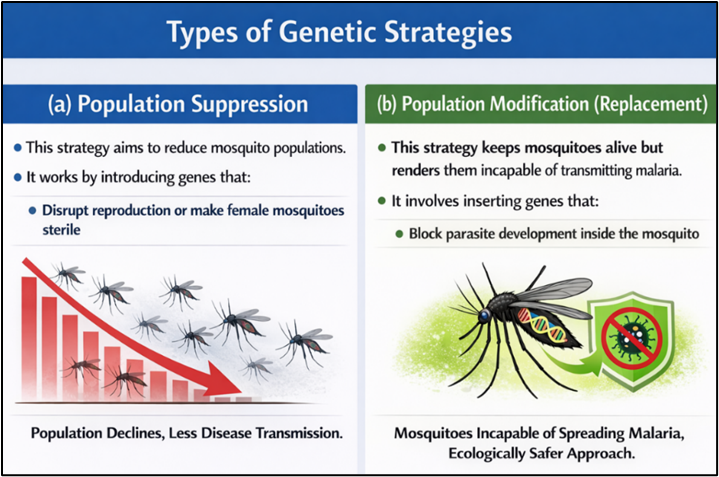
Malaria control has traditionally relied on reducing mosquito populations and treating infections, but growing resistance to insecticides and drugs has reduced effectiveness. Recent studies and advances show that genetically modified mosquitoes can block malaria transmission, shifting the strategy from eliminating mosquitoes to altering their biological capacity to carry disease.
Key Takeaways:
Core Scientific Idea:
Malaria is transmitted by female Anopheles mosquitoes carrying Plasmodium parasites.
Instead of killing mosquitoes, the new approach focuses on genetically modifying mosquitoes so parasites cannot survive inside them
This breaks the transmission cycle between mosquito and human.
Key Technologies and Concepts:
1. Gene Editing (CRISPR-Cas9):
Gene editing allows scientists to precisely modify DNA sequences.
The CRISPR-Cas9 system functions like molecular scissors that:
Cut specific DNA segments
Insert new genes with desired traits
In malaria control, genes are inserted to:
Destroy malaria parasites or prevent their development inside mosquitoes
2. Mendelian Genetics vs Gene Drive:
Mendelian genetics describes how traits pass from parents to offspring. Under Mendelian inheritance, any gene has only a 50% probability of being passed to offspring, which slows the spread of traits.
Gene drive technology alters this rule by ensuring that a gene is inherited by:
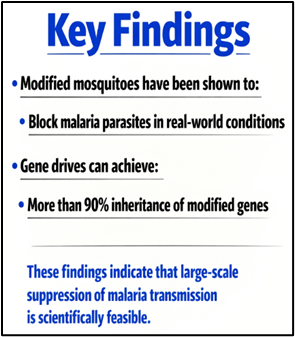
More than 90% of offspring, instead of 50%
This enables the rapid spread of engineered traits across mosquito populations.
3. Gene Drive Technology:
Gene drives are designed to bias inheritance patterns, ensuring that modified genes spread quickly.
Over successive generations, this leads to:
Population-wide genetic transformation
It allows small initial releases to have large-scale impact.
4. Transmission Blocking Mechanism:
Genetically modified mosquitoes are engineered to produce:
Anti-parasitic molecules such as antimicrobial peptides
These molecules:
Destroy malaria parasites inside the mosquito’s gut
Prevent parasites from reaching salivary glands
As a result, mosquitoes cannot transmit malaria to humans.
5. Field-Based Genetic Engineering:
Earlier research was limited to laboratory settings, but recent studies show:
Genetic modification can be conducted in malaria-endemic regions
This allows:
Testing under real-world conditions
Development of local scientific and regulatory capacity
6. Self-Propagating vs Controlled Gene Drives:
Self-propagating gene drives spread automatically through populations once released.
Self-limiting or reversible gene drives are being developed to:
Control or stop gene spread if risks emerge
This enhances safety and regulatory acceptability.
Challenges:
Biological challenges: Different parasite strains may require different genetic strategies, and parasites may evolve resistance.
Ecological concerns: Altering mosquito populations may affect food chains and biodiversity.
Ethical issues: Releasing genetically modified organisms requires public acceptance and strict regulation.
Uncertainty: Long-term ecological and genetic impacts are not fully known.
Complementary Role:
Genetically modified mosquitoes are not a standalone solution.
Effective malaria control will still require:
Bed nets, insecticides, medicines, vaccines, and surveillance systems
Conclusion:
The use of genetically altered mosquitoes represents a paradigm shift from killing vectors to engineering them to prevent disease transmission.
While highly promising, the approach requires careful regulation, ecological safeguards, and integration with existing public health strategies to ensure safe and effective implementation.
Source: (The Hindu)
La Excellence IAS Academy, the best IAS coaching in Hyderabad, known for delivering quality content and conceptual clarity for UPSC 2026 preparation.
FOLLOW US ON:
◉ YouTube : https://www.youtube.com/@CivilsPrepTeam
◉ Facebook: https://www.facebook.com/LaExcellenceIAS
◉ Instagram: https://www.instagram.com/laexcellenceiasacademy/
GET IN TOUCH:
Contact us at info@laex.in, https://laex.in/contact-us/
or Call us @ +91 9052 29 2929, +91 9052 99 2929, +91 9154 24 2140
OUR BRANCHES:
Head Office: H No: 1-10-225A, Beside AEVA Fertility Center, Ashok Nagar Extension, VV Giri Nagar, Ashok Nagar, Hyderabad, 500020
Madhapur: Flat no: 301, survey no 58-60, Guttala begumpet Madhapur metro pillar: 1524, Rangareddy Hyderabad, Telangana 500081
Bangalore: Plot No: 99, 2nd floor, 80 Feet Road, Beside Poorvika Mobiles, Chandra Layout, Attiguppe, Near Vijaya Nagara, Bengaluru, 560040