
Paper: GS – III, Subject: Science and Technology, Topic: Medical science and Health, Issue: Hantavirus as a Warning for Future Pandemics.
Context:
A recent Hantavirus outbreak linked to the Dutch-flagged polar expedition cruise ship MV Hondius, which travelled across the South Atlantic after departing from Argentina, has renewed global concern regarding zoonotic diseases that spread from animals to humans.
Key Takeaways:
Background:
- The outbreak involves the Andes virus (ANDV) strain, which is unique because it is the only known hantavirus capable of limited human-to-human transmission.
- Experts warn that increasing human intrusion into forests, climate change, biodiversity loss, and intensive farming practices are creating favourable conditions for the emergence of new infectious diseases worldwide.
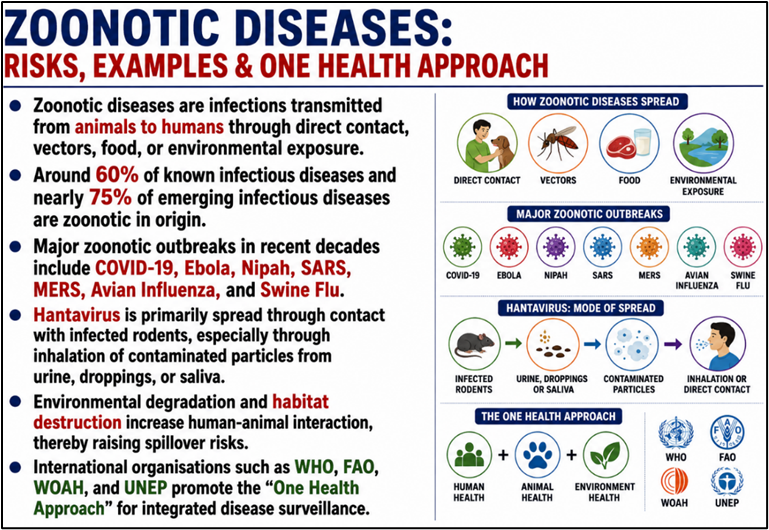
Explanation:
What is Hantavirus?
- Hantavirus is a rodent-borne viral disease caused by viruses belonging to the Hantaviridae family.
While hantaviruses usually spread through inhalation of aerosolised particles from infected rodent droppings or urine, the Andes virus (ANDV) strain involved in the recent outbreak is capable of limited human-to-human transmission.
- Humans usually get infected by inhaling aerosolised particles contaminated with rodent excreta.
- The disease can cause severe respiratory illness known as Hantavirus Pulmonary Syndrome (HPS) or kidney-related disease called Hemorrhagic Fever with Renal Syndrome (HFRS).
- There is currently no widely available specific antiviral cure or vaccine for most hantavirus infections.
Why Are Zoonotic Outbreaks Increasing?
Deforestation and Habitat Encroachment:
- Forest destruction forces wild animals and rodents to move closer to human settlements.
- Human expansion into wildlife habitats increases opportunities for pathogen spillover.
Climate Change:
- Rising temperatures and changing rainfall patterns alter the distribution of vectors and reservoir species.
- Rodents, mosquitoes, and bats are expanding into newer geographical regions.
Industrial Agriculture and Livestock Intensification:
- High-density animal farming creates conditions for rapid mutation and transmission of pathogens.
- Poor biosecurity in farms and live animal markets increases infection risks.
Globalisation and Urbanisation:
- Increased travel and trade allow local outbreaks to spread rapidly across borders.
- Urban crowding accelerates disease transmission.
One Health Approach:
- One Health recognises the interconnectedness of human, animal, and environmental health.
- It promotes coordination between medical professionals, veterinarians, ecologists, and policymakers.
- India has strengthened surveillance systems through Integrated Disease Surveillance Programme (IDSP) and zoonotic monitoring mechanisms.
Challenges in Disease Preparedness:
- Weak wildlife disease surveillance in many countries.
- Limited coordination between environmental and health agencies.
- Inadequate early-warning systems and laboratory capacity.
- Insufficient investment in public health infrastructure.
Conclusion:
The rise of hantavirus and similar zoonotic outbreaks reflects growing ecological imbalance caused by human activities. Preventing future pandemics requires strengthening disease surveillance, protecting ecosystems, improving public health systems, and adopting a comprehensive One Health strategy at national and global levels.
Source: (The Indian Express)
La Excellence IAS Academy, the best IAS coaching in Hyderabad, known for delivering quality content and conceptual clarity for UPSC 2026 preparation.
FOLLOW US ON:
◉ YouTube : https://www.youtube.com/@CivilsPrepTeam
◉ Facebook: https://www.facebook.com/LaExcellenceIAS
◉ Instagram: https://www.instagram.com/laexcellenceiasacademy/
GET IN TOUCH:
Contact us at info@laex.in, https://laex.in/contact-us/
or Call us @ +91 9052 29 2929, +91 9052 99 2929, +91 9154 24 2140
OUR BRANCHES:
Head Office: H No: 1-10-225A, Beside AEVA Fertility Center, Ashok Nagar Extension, VV Giri Nagar, Ashok Nagar, Hyderabad, 500020
Madhapur: Flat no: 301, survey no 58-60, Guttala begumpet Madhapur metro pillar: 1524, Rangareddy Hyderabad, Telangana 500081
Bangalore: Plot No: 99, 2nd floor, 80 Feet Road, Beside Poorvika Mobiles, Chandra Layout, Attiguppe, Near Vijaya Nagara, Bengaluru, 560040