
Paper: GS – I, Subject: Geography, Topic: Physical geography of India & Drainage, Issue: Infrastructure Safety and Ecological Fragility in the Himalayas (Teesta Stage-VI Project).
Context:
The Himalayas are India’s ecological and hydrological lifeline, but their young and unstable geology makes infrastructure construction exceptionally hazardous. A suspected methane-related tunnel accident at the Teesta Stage-VI Hydroelectric Project in Sikkim has renewed questions about worker safety, environmental appraisal and regulatory accountability.
Key Takeaways:
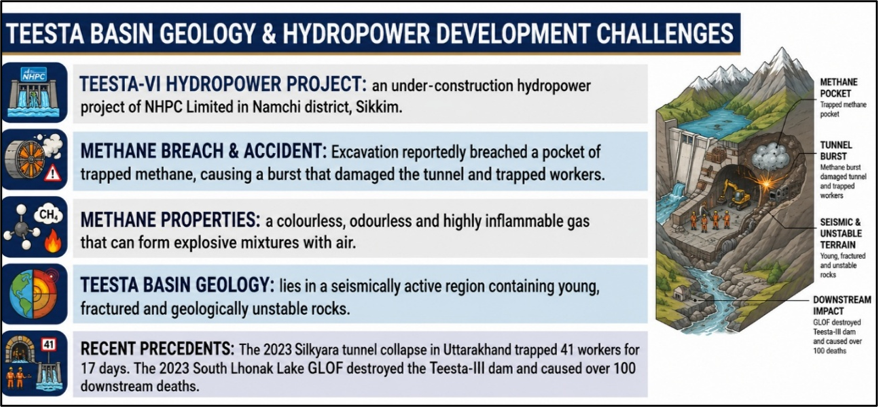
Explanation:
Why Himalayan Tunnelling Is Dangerous?
- Tunnels may encounter unstable rock, fault zones, groundwater and compressed gas pockets.
- Earthquakes, landslides and intense rainfall can destabilise excavated areas and obstruct rescue operations.
- Geological uncertainty cannot be eliminated, but detailed surveys and predictive risk modelling can reduce exposure.
Essential Safety Measures:
- Projects require continuous gas detection, forced ventilation, explosion-proof machinery and automatic warning systems.
- Workers must receive protective equipment, evacuation training and regular emergency drills.
- Multiple escape routes, rescue chambers and real-time communication systems should remain functional throughout construction.
Environmental and Climate Concerns:
- Hydropower construction can destabilise slopes and alter river flow, sediment transport and aquatic ecology.
- Climate change is increasing glacier retreat, extreme precipitation and the danger of Glacial Lake Outburst Floods.
- Numerous projects within one basin may create cumulative impacts that individual project-level assessments fail to capture.
Governance and Accountability:
- Rescue and medical assistance must remain the immediate priority.
- An independent inquiry should examine whether geological and methane risks were assessed before excavation.
- Compliance with environmental-clearance and occupational-safety conditions must be independently audited.
- Basin-level carrying-capacity studies, transparent monitoring and enforceable accountability are necessary.
Conclusion:
Hydropower is valuable for energy security, but renewable energy cannot be sustainable if it endangers workers or Himalayan ecosystems. Infrastructure planning must follow the precautionary principle, scientific assessment and strict regulatory oversight.
Source: (The Hindu)
La Excellence IAS Academy, the best IAS coaching in Hyderabad, known for delivering quality content and conceptual clarity for UPSC 2026 preparation.
FOLLOW US ON:
◉ YouTube : https://www.youtube.com/@CivilsPrepTeam
◉ Facebook: https://www.facebook.com/LaExcellenceIAS
◉ Instagram: https://www.instagram.com/laexcellenceiasacademy/
GET IN TOUCH:
Contact us at info@laex.in, https://laex.in/contact-us/
or Call us @ +91 9052 29 2929, +91 9052 99 2929, +91 9154 24 2140
OUR BRANCHES:
Head Office: H No: 1-10-225A, Beside AEVA Fertility Center, Ashok Nagar Extension, VV Giri Nagar, Ashok Nagar, Hyderabad, 500020
Madhapur: Flat no: 301, survey no 58-60, Guttala begumpet Madhapur metro pillar: 1524, Rangareddy Hyderabad, Telangana 500081
Bangalore: Plot No: 99, 2nd floor, 80 Feet Road, Beside Poorvika Mobiles, Chandra Layout, Attiguppe, Near Vijaya Nagara, Bengaluru, 560040