
Paper: GS – II, Subject: International Relations, Topic: India’s foreign policy, Issue: Lessons from 1991 for India’s Contemporary Foreign Policy.
Context:
India faces renewed geopolitical uncertainty arising from conflicts in West Asia, protectionist trade measures, energy insecurity and questions surrounding Russia’s global position. The simultaneous economic and strategic disruptions experienced in 1991 offer valuable lessons for navigating this changing international order.
Key Takeaways:
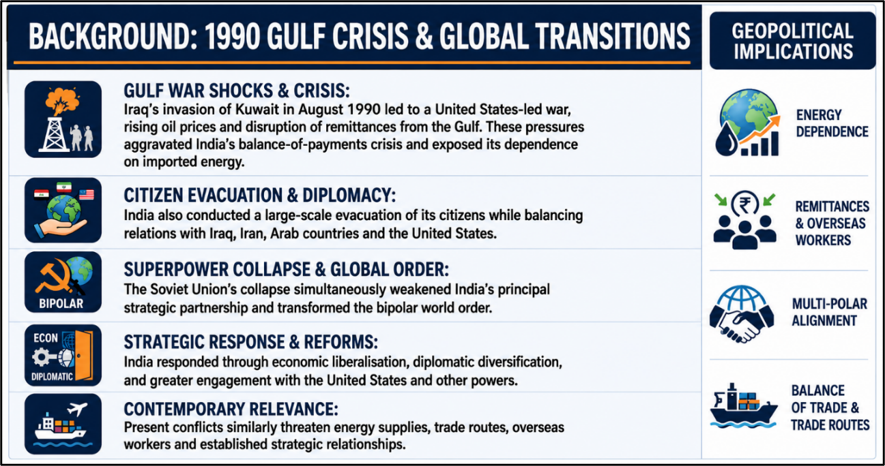
Explanation:
No Balance of Power Is Permanent:
- The stable Soviet partnership and bipolar order disappeared rapidly in 1991, demonstrating that geopolitical certainties can collapse unexpectedly.
- Present-day strategy must prepare for discontinuities arising from wars, sanctions, leadership changes, technological disruption and shifting alliances.
- India should avoid excessive dependence on any single country, energy supplier, trade route or defence partner.
- Strategic autonomy therefore requires diversified partnerships rather than isolation or rigid non-alignment.
Debate and Expertise Are Strategic Assets:
- Rigid foreign-policy consensus can overlook inconvenient possibilities and encourage decisions based on sentiment or historical loyalty.
- In 1991, domestic sympathy for Iraq complicated India’s response even though Iraq had violated Kuwait’s sovereignty.
- India needs deeper expertise in regional languages, history and domestic politics, particularly concerning Russia, Iran, Central Asia, Eastern Europe and West Asia.
- Policymaking institutions should examine competing scenarios, encourage contrarian assessments and separate national interests from ideological preferences.
Diplomacy Cannot Substitute for Domestic Strength:
- The 1991 crisis exposed how fiscal weakness, low foreign-exchange reserves and import dependence restricted India’s diplomatic choices.
- Economic liberalisation subsequently strengthened India’s capacity to conduct a more flexible and diversified foreign policy.
- Today, diplomatic resilience must be supported by energy diversification, defence indigenisation, competitive manufacturing, secure supply chains and adequate foreign-exchange reserves.
- Internal reform expands external options; economic and technological weakness reduces strategic autonomy.
Contemporary Relevance:
- Conflicts involving major energy-producing regions can affect oil prices, shipping routes and overseas Indian workers.
- Sanctions and secondary tariffs can force India to balance affordable imports against relations with Western partners.
- Policy must combine immediate crisis management with long-term preparation for multiple geopolitical futures.
Conclusion:
The central lesson of 1991 is that uncertainty is a permanent feature of international relations. India can manage future disruptions only through diversified diplomacy, institutional expertise and continuous domestic reform that strengthens its economic and strategic resilience.
Source: (The Indian Express)
La Excellence IAS Academy, the best IAS coaching in Hyderabad, known for delivering quality content and conceptual clarity for UPSC 2026 preparation.
FOLLOW US ON:
◉ YouTube : https://www.youtube.com/@CivilsPrepTeam
◉ Facebook: https://www.facebook.com/LaExcellenceIAS
◉ Instagram: https://www.instagram.com/laexcellenceiasacademy/
GET IN TOUCH:
Contact us at info@laex.in, https://laex.in/contact-us/
or Call us @ +91 9052 29 2929, +91 9052 99 2929, +91 9154 24 2140
OUR BRANCHES:
Head Office: H No: 1-10-225A, Beside AEVA Fertility Center, Ashok Nagar Extension, VV Giri Nagar, Ashok Nagar, Hyderabad, 500020
Madhapur: Flat no: 301, survey no 58-60, Guttala begumpet Madhapur metro pillar: 1524, Rangareddy Hyderabad, Telangana 500081
Bangalore: Plot No: 99, 2nd floor, 80 Feet Road, Beside Poorvika Mobiles, Chandra Layout, Attiguppe, Near Vijaya Nagara, Bengaluru, 560040