
Paper: GS – III, Subject: Economy, Topic: Infrastructure – Energy, Issue: Long-Duration Energy Storage and India’s Green Transition.
Context:
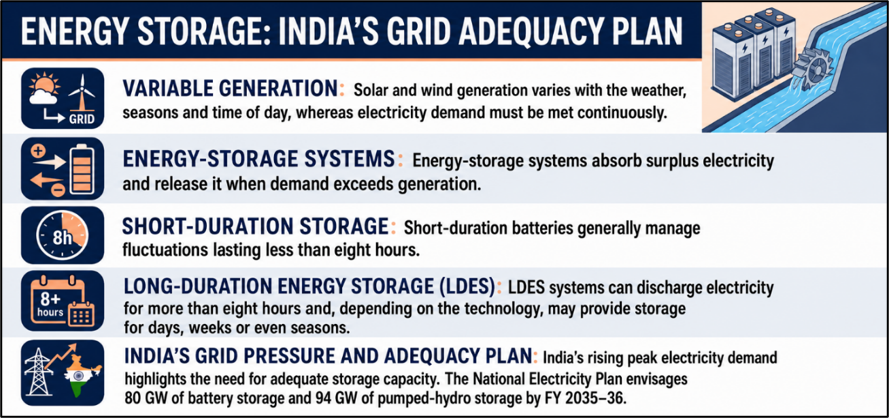
India’s rising electricity demand and rapid expansion of variable solar and wind power have made grid reliability a major concern. Long-Duration Energy Storage (LDES) is increasingly necessary to supply electricity during prolonged periods of weak renewable generation.
Key Takeaways:]
Explanation:
Why India Needs LDES:
- Planned batteries and pumped-hydro projects have average discharge durations of approximately four and six hours, respectively, which may be insufficient during extended heatwaves, weak monsoons or low-wind periods.
- LDES can reduce renewable-energy curtailment, provide peak power, relieve transmission congestion and decrease reliance on coal- or gas-based backup generation.
- It also improves grid flexibility by balancing seasonal and multi-day differences between electricity supply and demand.
Available Technologies:
- Pumped-Hydro Energy Storage (PHES) pumps water into an upper reservoir during surplus generation and releases it through turbines when electricity is needed. It is mature and efficient but requires suitable terrain and water availability.
- Compressed-Air Energy Storage (CAES) stores pressurised air in underground caverns but depends upon appropriate geological formations.
- Thermal storage retains energy as heat or cold, while hydrogen can provide seasonal storage.
- Flow batteries use liquid electrolytes and allow storage duration to be expanded independently of power-generating capacity.
- India is testing emerging solutions, including a 160-MWh carbon-dioxide battery at NTPC Kudgi and a 3-MWh vanadium redox-flow battery at Greater Noida.
Major Challenges:
- LDES involves high initial capital costs, technological uncertainty and limited domestic manufacturing.
- India lacks technology-specific capacity targets, clear deployment timelines and stable long-term revenue mechanisms.
- Land acquisition, environmental clearances, transmission connectivity and geographical constraints can delay projects.
- Viability-gap funding, capacity payments, long-term storage contracts and region-specific resource mapping are required.
- Grid operators also need training and operating protocols for multi-day scheduling and state-of-charge management.
Conclusion:
LDES can convert India’s expanding renewable capacity into dependable round-the-clock electricity. A technology-neutral but duration-focused policy, supported by investment incentives, domestic innovation and regional planning, is essential for a secure and affordable green transition.
Source: (The Hindu)
La Excellence IAS Academy, the best IAS coaching in Hyderabad, known for delivering quality content and conceptual clarity for UPSC 2026 preparation.
FOLLOW US ON:
◉ YouTube : https://www.youtube.com/@CivilsPrepTeam
◉ Facebook: https://www.facebook.com/LaExcellenceIAS
◉ Instagram: https://www.instagram.com/laexcellenceiasacademy/
GET IN TOUCH:
Contact us at info@laex.in, https://laex.in/contact-us/
or Call us @ +91 9052 29 2929, +91 9052 99 2929, +91 9154 24 2140
OUR BRANCHES:
Head Office: H No: 1-10-225A, Beside AEVA Fertility Center, Ashok Nagar Extension, VV Giri Nagar, Ashok Nagar, Hyderabad, 500020
Madhapur: Flat no: 301, survey no 58-60, Guttala begumpet Madhapur metro pillar: 1524, Rangareddy Hyderabad, Telangana 500081
Bangalore: Plot No: 99, 2nd floor, 80 Feet Road, Beside Poorvika Mobiles, Chandra Layout, Attiguppe, Near Vijaya Nagara, Bengaluru, 560040