
Paper: GS – II, Subject: International Relations, Topic: Agreements involving India and/or affecting India’s interests, Issue: NATO’s Ankara Summit: Warning Signals for India.
Context:
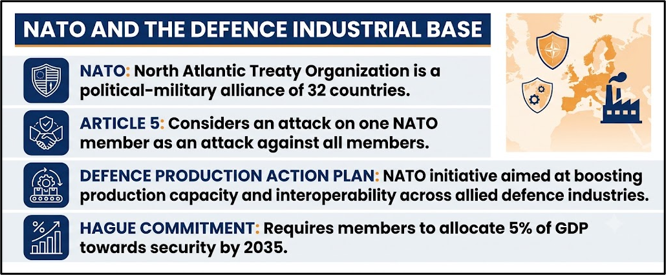
Recently, leaders of 32 North Atlantic Treaty Organization members met at the Ankara Summit on July 7–8, 2026. Their plans to increase defence spending and military production may strain global weapon supplies, creating serious concerns for India’s defence preparedness.
Key Takeaways:
Explanation:
NATO’s Changing Strategic Role:
| Finland and Sweden joined NATO as its 31st and 32nd members respectively, while Ukraine remains outside NATO. |
Evolving purpose: NATO shifted from containing the Soviet Union to Balkan operations and counterterrorism.
- Renewed rivalry: It now prioritises collective defence amid Russia’s aggression and growing Russia–China cooperation.
- Expansion debate: Russia sees eastward expansion as threatening, while NATO considers enlargement necessary for European security.
Ankara Commitments:
- Members reaffirmed Article 5, supported Ukraine and promised higher spending, technological innovation and industrial expansion.
- The summit aimed to convert political promises into military capability through investment and production.
Competition for Limited Supplies:
- Limited production: Europe cannot quickly produce enough missiles and ammunition. Its dependence on American suppliers makes European and Asian buyers compete for limited supplies.
- Operation Epic Fury: The United States reportedly fired over 850 Tomahawk missiles against Iran, while annual production was only 85.
- Modern conflicts consume weapons faster than factories replace them, transforming arms trade into a sellers’ market.
Implications and Way Forward for India:
- India may face higher prices, delayed deliveries and weaker bargaining power for imported weapons and critical components.
- Delayed American General Electric F404 engines for Tejas show how one imported component can disrupt an indigenous programme.
- India should strengthen domestic capacity in propulsion, ammunition, drones, electronics, artificial intelligence, cyber systems and electronic warfare.
- Self-reliance should ensure control over critical technologies, upgrades and wartime supplies, supported by selective foreign partnerships.
Conclusion:
NATO’s defence revival may strengthen Western security but strain global weapon supplies. India must combine domestic capability with partnerships to preserve military preparedness and strategic autonomy.
Source: (The Hindu)
La Excellence IAS Academy, the best IAS coaching in Hyderabad, known for delivering quality content and conceptual clarity for UPSC 2026 preparation.
FOLLOW US ON:
◉ YouTube : https://www.youtube.com/@CivilsPrepTeam
◉ Facebook: https://www.facebook.com/LaExcellenceIAS
◉ Instagram: https://www.instagram.com/laexcellenceiasacademy/
GET IN TOUCH:
Contact us at info@laex.in, https://laex.in/contact-us/
or Call us @ +91 9052 29 2929, +91 9052 99 2929, +91 9154 24 2140
OUR BRANCHES:
Head Office: H No: 1-10-225A, Beside AEVA Fertility Center, Ashok Nagar Extension, VV Giri Nagar, Ashok Nagar, Hyderabad, 500020
Madhapur: Flat no: 301, survey no 58-60, Guttala begumpet Madhapur metro pillar: 1524, Rangareddy Hyderabad, Telangana 500081
Bangalore: Plot No: 99, 2nd floor, 80 Feet Road, Beside Poorvika Mobiles, Chandra Layout, Attiguppe, Near Vijaya Nagara, Bengaluru, 560040