
Paper: GS – II, Subject: Polity, Topic: Rights issues, Issue: Right to Work and the Weakening of Rural Employment Guarantee.
Context:
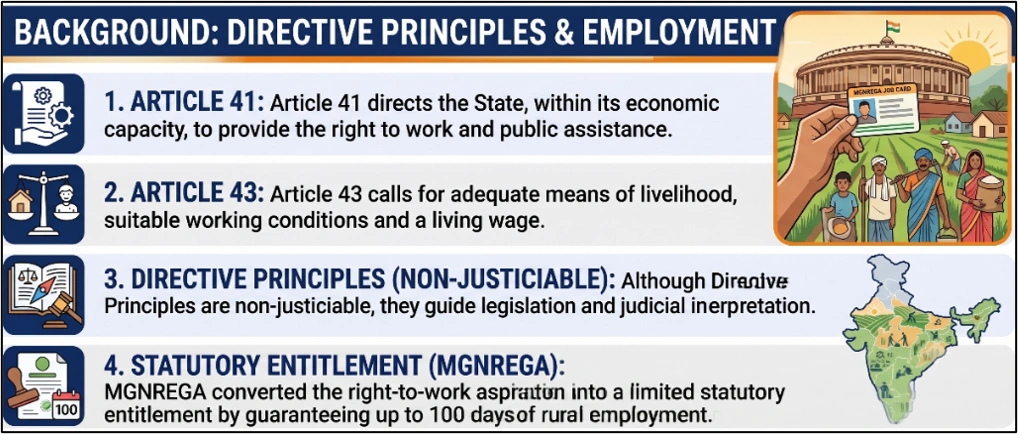
Recently, the Supreme Court revived debate over whether the right to work should remain a Directive Principle or be recognised as part of the enforceable right to life under Article 21. The replacement of MGNREGA with the VB-GRAM G Act has raised concerns about reduced employment, constrained funding and weakening of the rural safety net.
Key Takeaways:
Explanation:
- In Olga Tellis v. Bombay Municipal Corporation (1985), the Supreme Court recognised the right to livelihood as part of Article 21.
- In Sanjit Roy v. State of Rajasthan (1983), the Court held that paying less than the statutory minimum wage in relief work could amount to forced labour under Article 23.
MGNREGA as a Right-Based Programme:
- MGNREGA provided up to 100 days of wage employment to rural households demanding unskilled manual work.
- Its demand-driven character placed a legal obligation on the State to provide work or pay unemployment allowance.
- It supported rural incomes during agricultural distress, seasonal unemployment and economic shocks.
Shrinking Employment Guarantee:
- The Viksit Bharat – Guarantee for Rozgar and Ajeevika Mission (Gramin) Act replaced MGNREGA and became operational in July 2026.
- Rural households received about 44 crore person-days of work on average during July–August over the preceding five years.
- Under the new arrangement, person-days declined sharply, producing an estimated 68% fall in employment during the corresponding period.
- Estimated July–August household earnings fell from ₹13,780 crore in 2021–22 to approximately ₹4,210 crore in 2026–27.
Dilution of the Employment Guarantee:
- MGNREGA’s demand-driven structure required the government to provide work when eligible households demanded it.
- Arbitrary expenditure ceilings can limit employment irrespective of genuine rural demand.
- A higher State funding burden may disadvantage fiscally weaker States and deepen regional inequality.
- Exclusion of specified areas and employment restrictions can weaken the universality of the earlier framework.
- Reversing an established social entitlement may raise concerns under the constitutional principle of non-retrogression.
Constitutional and Economic Implications:
- Treating the right to livelihood as part of Article 21 strengthens the case for an enforceable employment guarantee.
- Rural employment schemes support consumption, local markets and the creation of productive community assets.
- Higher wages generate a multiplier effect by increasing demand for goods and services.
- Stagnant real wages, delayed payments and inadequate funding weaken livelihood security, particularly for women and marginal workers.
Required Reforms:
- Employment funding should respond to demand rather than fixed expenditure ceilings.
- Wages should be linked to living costs and paid without delay.
- Social audits and local institutions should be strengthened to improve accountability and reduce corruption.
Conclusion:
A meaningful right to work requires more than formal legislation; it needs enforceable entitlements, sufficient funding and wages consistent with dignity. Strengthening employment guarantees would advance constitutional welfare commitments while supporting rural demand, asset creation and inclusive economic growth.
Source: (The Hindu)
La Excellence IAS Academy, the best IAS coaching in Hyderabad, known for delivering quality content and conceptual clarity for UPSC 2026 preparation.
FOLLOW US ON:
◉ YouTube : https://www.youtube.com/@CivilsPrepTeam
◉ Facebook: https://www.facebook.com/LaExcellenceIAS
◉ Instagram: https://www.instagram.com/laexcellenceiasacademy/
GET IN TOUCH:
Contact us at info@laex.in, https://laex.in/contact-us/
or Call us @ +91 9052 29 2929, +91 9052 99 2929, +91 9154 24 2140
OUR BRANCHES:
Head Office: H No: 1-10-225A, Beside AEVA Fertility Center, Ashok Nagar Extension, VV Giri Nagar, Ashok Nagar, Hyderabad, 500020
Madhapur: Flat no: 301, survey no 58-60, Guttala begumpet Madhapur metro pillar: 1524, Rangareddy Hyderabad, Telangana 500081
Bangalore: Plot No: 99, 2nd floor, 80 Feet Road, Beside Poorvika Mobiles, Chandra Layout, Attiguppe, Near Vijaya Nagara, Bengaluru, 560040