
Paper: GS-III, Subject: Science & Technology, Topic: Defence Technologies, Issue: US Weapons in Space
Context
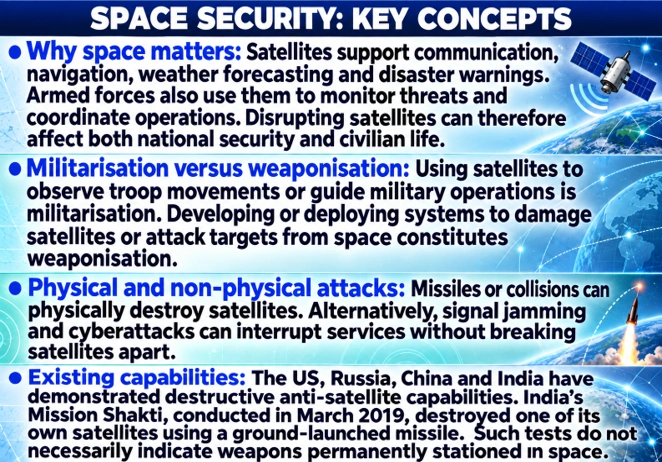
The United States has acknowledged deploying weapons in Earth orbit, without revealing their type or number. China and Russia have warned against turning space into a battlefield. This raises concerns about an arms race and whether existing international agreements can adequately regulate weapons in space.
Explanation
Space Security: How Could Weapons Be Used?
- Earth-to-Space (E–S): A missile launched from Earth can destroy a satellite, while ground-based equipment can interfere with its signals. Such attacks could weaken an opponent’s communication, navigation or surveillance.
- Space-to-Space (S–S): A spacecraft could approach another satellite and damage it through collision or interfere with its operations. Close approaches become particularly concerning when the spacecraft’s intentions are unclear.
- Space-to-Earth (S–E): Weapons stationed in orbit could potentially strike Earth-based targets or interfere with ground systems. However, the US announcement does not establish that it has deployed this particular capability.
International Law: What Do Existing Rules Prohibit?
- Outer Space Treaty, 1967: It prohibits placing nuclear weapons or other weapons of mass destruction in Earth orbit or stationing them elsewhere in space. It also reserves the Moon and other celestial bodies for peaceful purposes, prohibiting military bases, weapons testing and military manoeuvres there.
- Regulatory gaps: The treaty does not impose a blanket ban on conventional weapons in Earth orbit or comprehensively prohibit ground-launched anti-satellite weapons. Nevertheless, these gaps do not make every attack lawful: the UN Charter and other applicable international law continue to govern state conduct.
Global Governance: Why Stronger Agreements Remain Difficult
- Competing interests: Countries describe their own weapons as defensive but interpret rival capabilities as threats. Each side’s response can therefore encourage further weapons development.
- Verification difficulties: Equipment designed to repair satellites could also damage them. Distinguishing peaceful activities from preparations for attack is consequently difficult.
- Incomplete agreements: Broader arms-control proposals remain stalled. The Artemis Accords guide peaceful civil exploration but do not constitute a binding space-disarmament treaty.
Way Forward
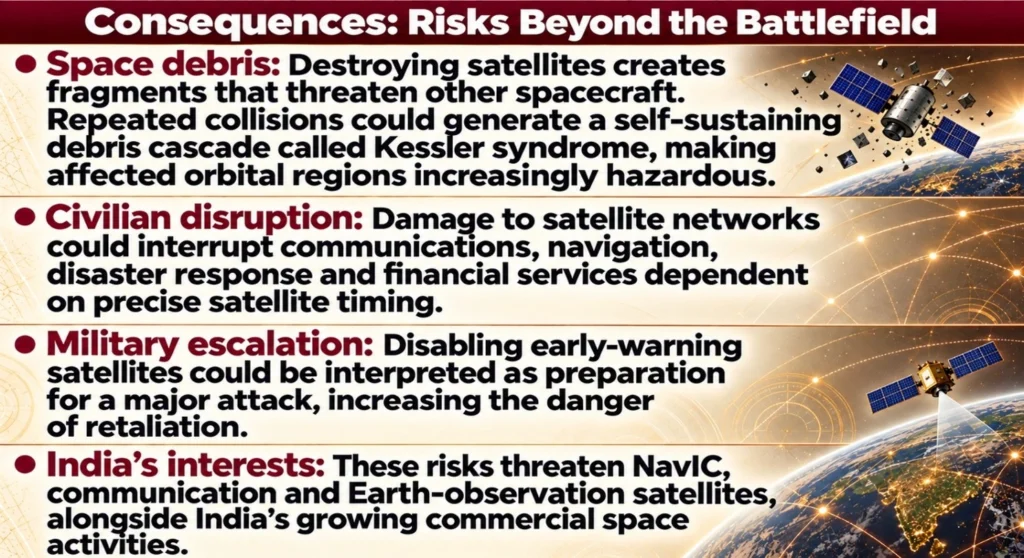
- Negotiate verifiable restrictions on destructive attacks and harmful interference.
- Establish communication channels and advance notifications to reduce misunderstandings.
- Strengthen satellite cybersecurity, backup services and orbital monitoring while cooperating on debris prevention.
Conclusion
Space security requires restraint alongside protective capabilities. Preserving usable orbits safeguards both national interests and the shared infrastructure supporting everyday life.
Source: (The Indian Express, The Hindu)
La Excellence IAS Academy, the best IAS coaching in Hyderabad, known for delivering quality content and conceptual clarity for UPSC 2026 preparation.
FOLLOW US ON:
◉ YouTube : https://www.youtube.com/@CivilsPrepTeam
◉ Facebook: https://www.facebook.com/LaExcellenceIAS
◉ Instagram: https://www.instagram.com/laexcellenceiasacademy/
GET IN TOUCH:
Contact us at info@laex.in, https://laex.in/contact-us/
or Call us @ +91 9052 29 2929, +91 9052 99 2929, +91 9154 24 2140
OUR BRANCHES:
Head Office: H No: 1-10-225A, Beside AEVA Fertility Center, Ashok Nagar Extension, VV Giri Nagar, Ashok Nagar, Hyderabad, 500020
Madhapur: Flat no: 301, survey no 58-60, Guttala begumpet Madhapur metro pillar: 1524, Rangareddy Hyderabad, Telangana 500081
Bangalore: Plot No: 99, 2nd floor, 80 Feet Road, Beside Poorvika Mobiles, Chandra Layout, Attiguppe, Near Vijaya Nagara, Bengaluru, 560040