Paper: GS-II, Subject: Governance, Topic: Government Policies and Intervention, Issue: PM SHRI: Improving Quality and Equity in School Education
Context:
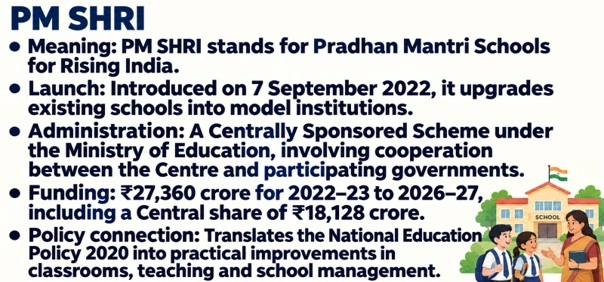
PM SHRI completed four years in September 2026. By July 2026, 13,092 schools had been selected towards a target of over 14,500 model schools, strengthening efforts to improve educational quality and inclusion.
Education and Human Resource Development
- Quality of education: Teaching through experiments, discussions and projects strengthens conceptual understanding, critical thinking and problem-solving.
- Practical application: Students could measure their classroom and calculate the tiles needed to cover its floor, connecting mathematical concepts with everyday life.
- Learning outcomes: Assessments emphasise what children understand and can apply, helping teachers identify learning gaps.
- Human capital formation: Academic learning, sports, arts and vocational exposure support the development of knowledgeable, skilled and confident citizens.
Social Justice and Inclusive Development
- Equality of opportunity: Support for children from disadvantaged backgrounds seeks to reduce disparities in access to quality education.
- Disability inclusion: Accessible infrastructure and appropriate learning support enable children with disabilities to participate meaningfully.
- Linguistic inclusion: Teaching in the mother tongue or local language, particularly in early grades, supports comprehension and participation.
- Gender equity: Safe facilities and inclusive school practices help create an enabling environment for girls’ education.
Technology and Environmental Sustainability
- Digital education: Smart classrooms, internet connectivity and digital resources can expand learning opportunities and strengthen digital literacy.
- Sustainable development: Water conservation, waste management, nutrition gardens and energy efficiency connect environmental education with daily behaviour.
- Preservation of culture: Exposure to local arts, crafts and traditions links education with India’s cultural heritage.
Governance and Institutional Capacity
- Capacity building: Teacher training and leadership development strengthen classroom instruction and school management.
- Cooperative federalism: Selection involves agreements with participating governments, identification of eligible schools and competition against prescribed standards.
- Accountability: Physical verification and the School Quality Assessment Framework support monitoring; selection alone does not establish completed transformation.
- Community participation: Engagement with parents and local institutions can improve responsiveness to children’s needs.
- Institutional collaboration: Selected schools mentor neighbouring institutions, spreading effective practices beyond individual campuses.
Conclusion
PM SHRI can advance social justice and human resource development through better schooling. Its success depends on measurable learning gains, effective teacher support and sustained inclusion of disadvantaged children.
Source: (PIB)
La Excellence IAS Academy, the best IAS coaching in Hyderabad, known for delivering quality content and conceptual clarity for UPSC 2026 preparation.
FOLLOW US ON:
◉ YouTube : https://www.youtube.com/@CivilsPrepTeam
◉ Facebook: https://www.facebook.com/LaExcellenceIAS
◉ Instagram: https://www.instagram.com/laexcellenceiasacademy/
GET IN TOUCH:
Contact us at info@laex.in, https://laex.in/contact-us/
or Call us @ +91 9052 29 2929, +91 9052 99 2929, +91 9154 24 2140
OUR BRANCHES:
Head Office: H No: 1-10-225A, Beside AEVA Fertility Center, Ashok Nagar Extension, VV Giri Nagar, Ashok Nagar, Hyderabad, 500020
Madhapur: Flat no: 301, survey no 58-60, Guttala begumpet Madhapur metro pillar: 1524, Rangareddy Hyderabad, Telangana 500081
Bangalore: Plot No: 99, 2nd floor, 80 Feet Road, Beside Poorvika Mobiles, Chandra Layout, Attiguppe, Near Vijaya Nagara, Bengaluru, 560040