
Paper: GS-II, Subject: International Relations, Topic: Global issues, Issue: 25 Years After 9/11: How the War on Terror Reshaped Global Politics
Context:
September 11, 2026 marks 25 years since the 9/11 attacks. The response that followed transformed global counter-terrorism, American foreign policy, West Asian geopolitics and debates on civil liberties, while also producing several unintended consequences that continue to shape the international order.
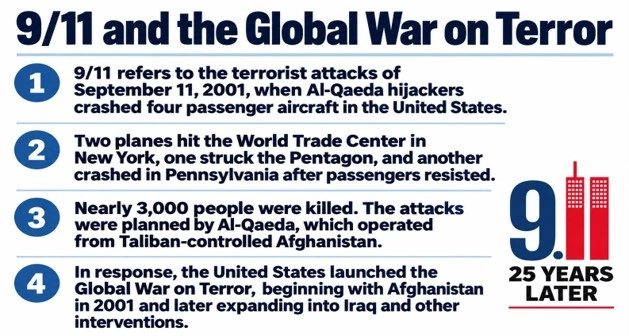
From Counter-terrorism to Wider Military Intervention
- The initial objective was to destroy Al-Qaeda, eliminate terrorist safe havens and prevent another major attack.
- Over time, counter-terrorism expanded into regime change, democracy promotion, state-building and long-term military occupation.
- Afghanistan, Iraq and later Libya showed that removing a regime is much easier than constructing a legitimate and stable political order.
- Prolonged intervention generated enormous human, financial and strategic costs, while often producing outcomes very different from the original objectives.
Afghanistan: Limits of External Nation-building
- The Taliban regime was removed in 2001, but the movement gradually regrouped and sustained a long insurgency.
- Despite two decades of military presence and reconstruction efforts, Afghan institutions remained politically fragile and heavily dependent on external support.
- The US withdrawal in 2021 and Taliban’s return to power demonstrated the limits of externally driven nation-building.
- The experience underlined the importance of local legitimacy, political reconciliation, social realities and regional dynamics in achieving durable stability.
Iraq, State Collapse and the Rise of ISIS
- The 2003 invasion removed Saddam Hussein but severely disrupted Iraqi political and security institutions.
- The resulting vacuum intensified Sunni-Shia sectarian competition, insurgency and militia politics.
- Al-Qaeda in Iraq grew in this environment and later contributed to the emergence of ISIS.
- ISIS demonstrated how weak states, political exclusion, sectarian conflict and ungoverned spaces can transform terrorism into a territorial and quasi-state challenge.
Terrorism Changed Rather Than Disappeared
- Al-Qaeda’s central leadership was considerably weakened, but extremist violence became more decentralised, networked and geographically dispersed.
- Terrorist affiliates expanded across parts of West Asia, South Asia and Africa, particularly the Sahel.
- This showed that terrorism cannot be defeated through military action alone.
- Effective counter-terrorism requires intelligence sharing, terror-finance tracking, border management, cyber monitoring, counter-radicalisation and stronger local governance.
The Unexpected Strategic Rise of Iran
- Before 2001, Iran faced two hostile regimes: the Taliban in Afghanistan and Saddam Hussein in Iraq.
- US interventions removed both, unintentionally improving Iran’s strategic environment.
- Shia political forces gained greater influence in post-Saddam Iraq, expanding Tehran’s regional leverage.
- Iran subsequently strengthened networks across Iraq, Syria, Lebanon, Yemen and Palestine.
- Through the IRGC, Quds Force, proxy groups and asymmetric warfare, Iran developed influence without matching US conventional military power.
- This became a major example of how foreign intervention can produce unintended geopolitical consequences.
Security versus Civil Liberties
- After 9/11, many governments expanded surveillance, detention, intelligence and counter-terrorism powers.
- These measures raised difficult questions concerning privacy, due process, torture, indefinite detention and executive authority.
- The central dilemma remains: how far should a democratic state restrict individual liberty in the name of national security?
- Durable security therefore requires both effective state capacity and constitutional restraint.
From US Unipolarity to a More Multipolar Order
- 9/11 occurred when the United States enjoyed extraordinary dominance after the Cold War.
- Two decades of prolonged wars consumed enormous American attention and resources.
- Meanwhile, China rose as a major economic and strategic competitor, while Russia re-emerged as an assertive military power.
- Washington later tried to shift its strategic focus towards the Indo-Pacific, but repeated crises in West Asia continued to draw it back.
- The wider lesson is that military superiority does not automatically translate into lasting political influence or strategic success.
Conclusion
The post-9/11 era shows that terrorism is not merely a military problem. Sustainable security depends on stable institutions, political inclusion, intelligence cooperation, regional diplomacy, economic opportunity and protection of civil liberties. The deeper legacy of the last 25 years is that interventions can reshape regions for decades, often in ways their architects never intended.
Source: (The Indian Express, The Hindu)
La Excellence IAS Academy, the best IAS coaching in Hyderabad, known for delivering quality content and conceptual clarity for UPSC 2026 preparation.
FOLLOW US ON:
◉ YouTube : https://www.youtube.com/@CivilsPrepTeam
◉ Facebook: https://www.facebook.com/LaExcellenceIAS
◉ Instagram: https://www.instagram.com/laexcellenceiasacademy/
GET IN TOUCH:
Contact us at info@laex.in, https://laex.in/contact-us/
or Call us @ +91 9052 29 2929, +91 9052 99 2929, +91 9154 24 2140
OUR BRANCHES:
Head Office: H No: 1-10-225A, Beside AEVA Fertility Center, Ashok Nagar Extension, VV Giri Nagar, Ashok Nagar, Hyderabad, 500020
Madhapur: Flat no: 301, survey no 58-60, Guttala begumpet Madhapur metro pillar: 1524, Rangareddy Hyderabad, Telangana 500081
Bangalore: Plot No: 99, 2nd floor, 80 Feet Road, Beside Poorvika Mobiles, Chandra Layout, Attiguppe, Near Vijaya Nagara, Bengaluru, 560040