
Paper: GS-II, Subject: Governance, Topic: Good governance and applications, Issue: Road Safety in India: Beyond Judicial Intervention
Context:
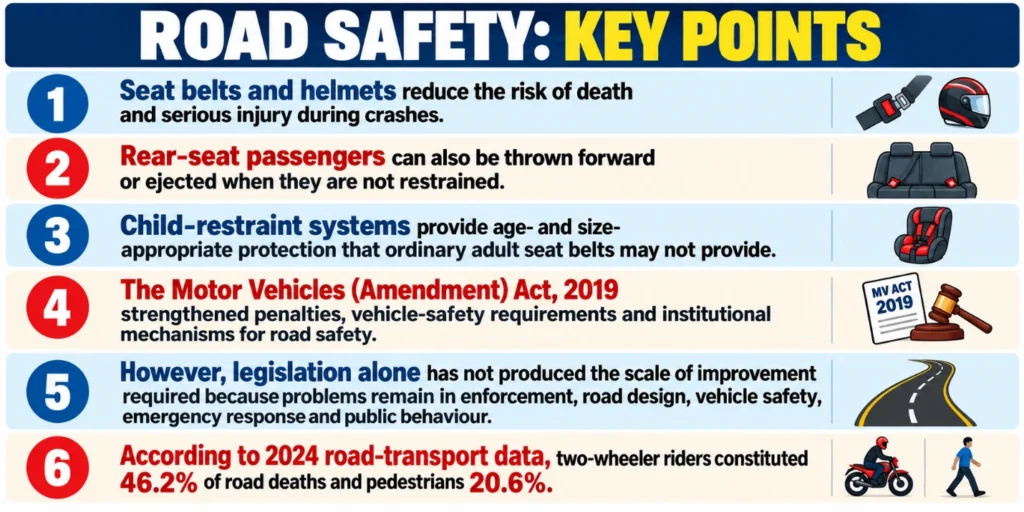
The Supreme Court recently asked the Union Road Transport Ministry to consider measures for improving compliance with seat belts, rear-seat belts and child-restraint systems. The issue highlights a larger concern: India has only about 1% of the world’s vehicles but accounts for around 11% of global road-traffic deaths.
Explanation
Seat belts address only part of the problem
- Seat belts and child restraints are essential, but they mainly protect occupants of enclosed vehicles.
- Two-wheeler riders and pedestrians together constitute nearly two-thirds of road fatalities.
- Therefore, even perfect seat-belt compliance cannot by itself substantially solve India’s road-safety crisis.
Speeding is a major cause
- Speeding remains the dominant recorded traffic violation associated with fatalities.
- Policy should therefore move beyond merely punishing speeding.
- Roads must be designed to discourage dangerous speeds, particularly near schools, residential areas and pedestrian zones.
- Traffic calming, safer junctions, pedestrian crossings and appropriate speed management can reduce both the occurrence and severity of crashes.
Road design is itself a safety issue
- Governments should not assume that every driver or pedestrian will behave perfectly.
- The Safe System approach accepts that human beings will inevitably make mistakes.
- Roads should therefore be designed so that ordinary human errors do not result in death.
- This requires: identification and redesign of accident-prone black spots, safer footpaths and crossings, protected spaces for pedestrians and cyclists, safer junctions, separation of vulnerable road users from high-speed traffic.
Enforcement capacity remains weak
- Traffic policing suffers from manpower and implementation gaps.
- Helmet rules, seat-belt rules, speed limits and lane discipline are frequently violated.
- Better enforcement must therefore accompany engineering improvements.
Vehicle manufacturers also have responsibility
- Vehicle safety should not depend completely on user behaviour.
- Technologies such as tamper-resistant seat-belt reminders and stronger safety systems can reduce the scope for bypassing protections.
- Road safety therefore also requires safety-by-design in vehicles.
Emergency response can determine survival
- Some crash deaths can be prevented through faster rescue and treatment.
- Governments need: efficient ambulance networks, rapid trauma response, accessible trauma-care facilities, better coordination between police, hospitals and emergency services.
India also faces a road-safety culture problem
- Unsafe practices are often socially normalised: riding without helmets, ignoring rear-seat belts, wrong-side driving, speeding, unsafe carriage of children, casual violation of pedestrian rules.
- Sustainable improvement therefore requires a public culture in which unsafe behaviour becomes socially unacceptable.
Role of the judiciary and executive
- The Supreme Court has appropriately highlighted the issue and nudged the government towards action.
- However, detailed road-safety policy must primarily be designed and implemented by the executive.
- Courts can ensure accountability, but they cannot themselves redesign roads, recruit traffic police, regulate every vehicle or establish trauma-care systems.
Conclusion
India’s road-safety challenge cannot be reduced to a question of seat belts or individual responsibility. It is simultaneously a problem of governance, infrastructure, enforcement, vehicle design, emergency care and public culture. The ultimate goal should be to build a transport system in which human mistakes do not automatically become fatal mistakes.
Source: (The Hindu)
La Excellence IAS Academy, the best IAS coaching in Hyderabad, known for delivering quality content and conceptual clarity for UPSC 2026 preparation.
FOLLOW US ON:
◉ YouTube : https://www.youtube.com/@CivilsPrepTeam
◉ Facebook: https://www.facebook.com/LaExcellenceIAS
◉ Instagram: https://www.instagram.com/laexcellenceiasacademy/
GET IN TOUCH:
Contact us at info@laex.in, https://laex.in/contact-us/
or Call us @ +91 9052 29 2929, +91 9052 99 2929, +91 9154 24 2140
OUR BRANCHES:
Head Office: H No: 1-10-225A, Beside AEVA Fertility Center, Ashok Nagar Extension, VV Giri Nagar, Ashok Nagar, Hyderabad, 500020
Madhapur: Flat no: 301, survey no 58-60, Guttala begumpet Madhapur metro pillar: 1524, Rangareddy Hyderabad, Telangana 500081
Bangalore: Plot No: 99, 2nd floor, 80 Feet Road, Beside Poorvika Mobiles, Chandra Layout, Attiguppe, Near Vijaya Nagara, Bengaluru, 560040