
Paper: GS-III, Subject: Environment, Ecology and Disaster Management, Topic: Biodiversity and its conservation, Issue: Deep-Sea Mining & its consequences.
Introduction
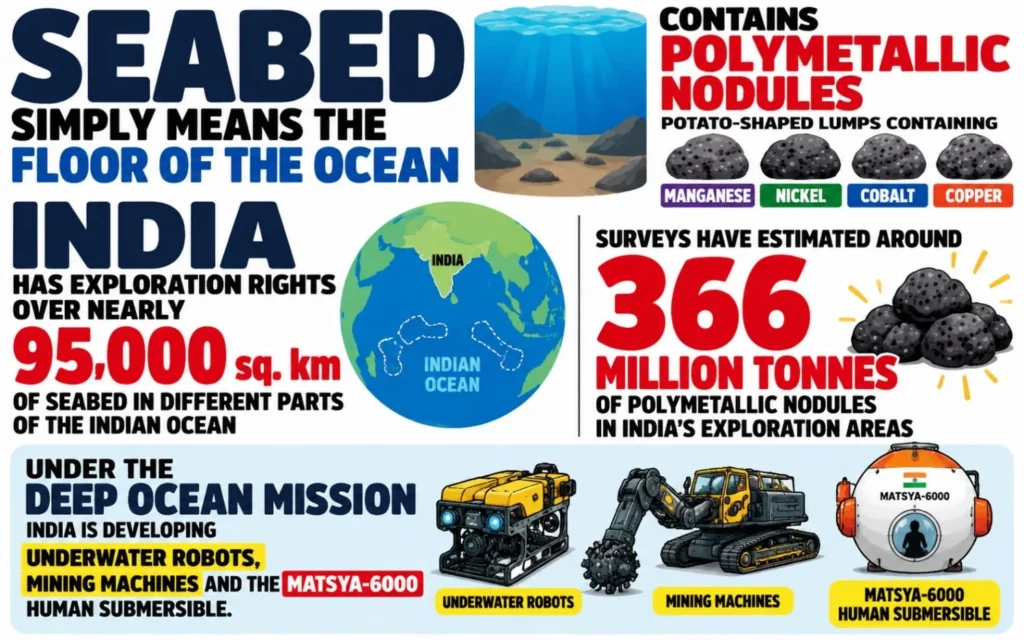
The deep ocean floor contains valuable minerals that can be used in batteries, electric vehicles, renewable energy systems and modern industries. India is developing technology to explore and possibly mine these resources. However, the deep sea is still one of the least understood ecosystems on Earth. Therefore, the key question is not only “Can India mine the deep sea?” but also “Should it mine everywhere just because it can?”
Background
Why Does India Want to Explore the Deep Sea?
1. Important Minerals
- Nickel, cobalt, copper and manganese are important for batteries, EVs, renewable-energy equipment and electronics.
- Many such minerals currently come from a limited number of countries.
- Access to seabed minerals can therefore strengthen India’s resource security and supply-chain resilience.
2. Scientific and Technological Benefits
- Deep-sea exploration helps scientists understand the ocean floor and marine ecosystems.
- It enables discovery of new marine species that may otherwise remain unknown.
- It helps India map mineral deposits and assess their possible economic value.
- It supports development of underwater robots, submersibles and deep-sea technologies.
- Thus, exploration itself is useful even if commercial mining does not immediately begin.
What Is the Problem with Deep-Sea Mining?
1. The Deep Ocean Is Poorly Understood
- The deep ocean is dark, cold and extremely difficult to study.
- Scientists are still discovering organisms that were previously unknown.
- Some organisms may depend on seabed nodules and surrounding habitats for survival.
- Mining could therefore destroy species before humans even understand their ecological role.
2. Mining Can Physically Damage the Seabed
- Large machines would move across the seabed and collect mineral nodules.
- They can crush organisms living on the ocean floor.
- Removing nodules may destroy habitats that developed over very long periods.
- Mining can stir up mud and sediments, creating underwater sediment clouds.
- These sediments may affect organisms beyond the actual mining site.
- Some ecological damage may take decades or centuries to recover, while some may be irreversible.
Exploration and Mining Are Not the Same
- Exploration means studying the seabed, mapping minerals, collecting samples and examining marine life.
- Mining means removing minerals on a large commercial scale.
- Therefore, technological ability to explore does not automatically justify commercial extraction.
- India can continue scientific research while keeping the option of mining under careful review.
Exploration capability → does not automatically mean → mining permission
Do We Really Need to Mine?
- Before disturbing the ocean floor, India should first examine whether the same minerals can be obtained through safer alternatives.
- Recycling: Recover nickel, cobalt and copper from old batteries and electronic waste.
- Resource efficiency: Use smaller quantities of minerals more efficiently in manufacturing.
- Substitution: Develop alternative materials where possible.
- Reuse: Extend the life of products instead of replacing them frequently.
- Circular economy: Keep materials in economic use for as long as possible.
Thus, deep-sea mining should be considered only when the need cannot reasonably be met through less damaging alternatives.
What Should India’s Approach Be?
- Adopt a precautionary approach because scientific knowledge remains incomplete.
- Conduct detailed environmental studies before allowing large-scale mining.
- Establish strict ecological thresholds and monitoring systems.
- Protect especially sensitive areas as deep-sea ecological reserves.
- Balance mineral security with the principles of Mission LiFE and the circular economy.
- Follow the sequence:
Study first → Understand impacts → Establish real need → Protect sensitive areas → Mine only if necessary
Conclusion
Deep-sea minerals can support India’s clean-energy, industrial and strategic ambitions, but the ocean floor is not merely a storehouse of metals—it is also a living ecosystem. Real scientific progress means knowing not only how to extract resources, but also when extraction should be avoided. Sustainable development must therefore combine technology, resource security and environmental responsibility.
Source: (The Hindu)
La Excellence IAS Academy, the best IAS coaching in Hyderabad, known for delivering quality content and conceptual clarity for UPSC 2026 preparation.
FOLLOW US ON:
◉ YouTube : https://www.youtube.com/@CivilsPrepTeam
◉ Facebook: https://www.facebook.com/LaExcellenceIAS
◉ Instagram: https://www.instagram.com/laexcellenceiasacademy/
GET IN TOUCH:
Contact us at info@laex.in, https://laex.in/contact-us/
or Call us @ +91 9052 29 2929, +91 9052 99 2929, +91 9154 24 2140
OUR BRANCHES:
Head Office: H No: 1-10-225A, Beside AEVA Fertility Center, Ashok Nagar Extension, VV Giri Nagar, Ashok Nagar, Hyderabad, 500020
Madhapur: Flat no: 301, survey no 58-60, Guttala begumpet Madhapur metro pillar: 1524, Rangareddy Hyderabad, Telangana 500081
Bangalore: Plot No: 99, 2nd floor, 80 Feet Road, Beside Poorvika Mobiles, Chandra Layout, Attiguppe, Near Vijaya Nagara, Bengaluru, 560040