
Paper: GS-III, Subject: Environment, Ecology and Disaster Management, Topic: Global Warming and Climate Change, Issue: Earth-System Stability
Context
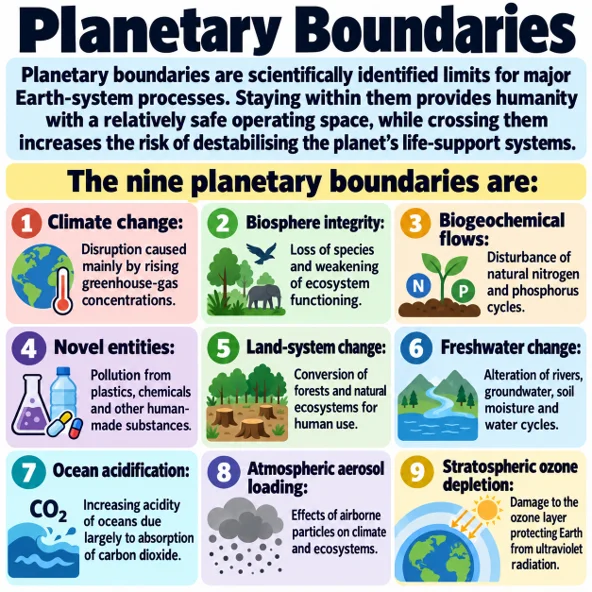
The Planetary Health Check 2026 warns that human activity is pushing the Earth beyond its environmentally safe limits. Seven of the nine planetary boundaries have now been transgressed, and all seven are showing worsening trends, increasing the risk of large-scale and potentially irreversible environmental change.
Explanation
1. Seven Boundaries Have Been Crossed
- Climate change, biosphere integrity, biogeochemical flows and novel entities have entered the high-risk zone.
- Land-system change, freshwater change and ocean acidification have entered the increasing-risk zone.
- Only stratospheric ozone depletion and atmospheric aerosol loading remain within the global safe operating space, although aerosol limits are already exceeded regionally, including in South Asia.
2. Human Pressure Has Accelerated
- Human civilisation developed during the relatively stable environmental conditions of the Holocene, lasting roughly 11,700 years.
- Since the mid-20th century, rapid growth in population, energy consumption, industrial production, fertiliser use, transport, water use and land conversion has sharply increased pressure on Earth systems.
3. Boundaries Are Interconnected
- These environmental problems cannot be treated independently because changes in one system can intensify pressures on others.
- For example, deforestation reduces biodiversity and carbon absorption, worsening climate change, while climate change further damages forests and freshwater systems.
- Such interactions can create cascading effects, where disruption spreads across several Earth systems.
4. Rising Risk of Tipping Points
- Crossing a planetary boundary does not mean immediate ecological collapse; it signifies that the risk of serious and persistent change has increased.
- Continued warming, biodiversity loss and ecosystem degradation can push natural systems towards tipping points, after which changes may become self-reinforcing or extremely difficult to reverse.
- The weakening of land carbon sinks, damage to the seafloor and uncontrolled spread of synthetic chemicals illustrate these emerging systemic risks.
Conclusion
The planetary-boundaries framework shows that climate change, biodiversity loss, pollution, water stress and ecosystem degradation are different dimensions of a single Earth-system crisis. Protecting long-term human well-being therefore requires coordinated action that brings multiple environmental pressures back within a safe operating space.
Source: (Down to Earth)
La Excellence IAS Academy, the best IAS coaching in Hyderabad, known for delivering quality content and conceptual clarity for UPSC 2026 preparation.
FOLLOW US ON:
◉ YouTube : https://www.youtube.com/@CivilsPrepTeam
◉ Facebook: https://www.facebook.com/LaExcellenceIAS
◉ Instagram: https://www.instagram.com/laexcellenceiasacademy/
GET IN TOUCH:
Contact us at info@laex.in, https://laex.in/contact-us/
or Call us @ +91 9052 29 2929, +91 9052 99 2929, +91 9154 24 2140
OUR BRANCHES:
Head Office: H No: 1-10-225A, Beside AEVA Fertility Center, Ashok Nagar Extension, VV Giri Nagar, Ashok Nagar, Hyderabad, 500020
Madhapur: Flat no: 301, survey no 58-60, Guttala begumpet Madhapur metro pillar: 1524, Rangareddy Hyderabad, Telangana 500081
Bangalore: Plot No: 99, 2nd floor, 80 Feet Road, Beside Poorvika Mobiles, Chandra Layout, Attiguppe, Near Vijaya Nagara, Bengaluru, 560040