
Paper: GS-II, Subject: International Relations, Topic: Agreements involving India and/or affecting India’s interests, Issue: Malacca Model for Hormuz.
Context
The Strait of Hormuz is a vital passage connecting the Persian Gulf with the Arabian Sea and global markets. With recent conflict severely disrupting shipping, Iran and Oman have discussed arrangements for reopening and managing the Strait. One idea is to learn from the Malacca-Singapore Straits, where neighbouring countries combined national sovereignty with uninterrupted international navigation.
How the Malacca-Singapore Model Developed
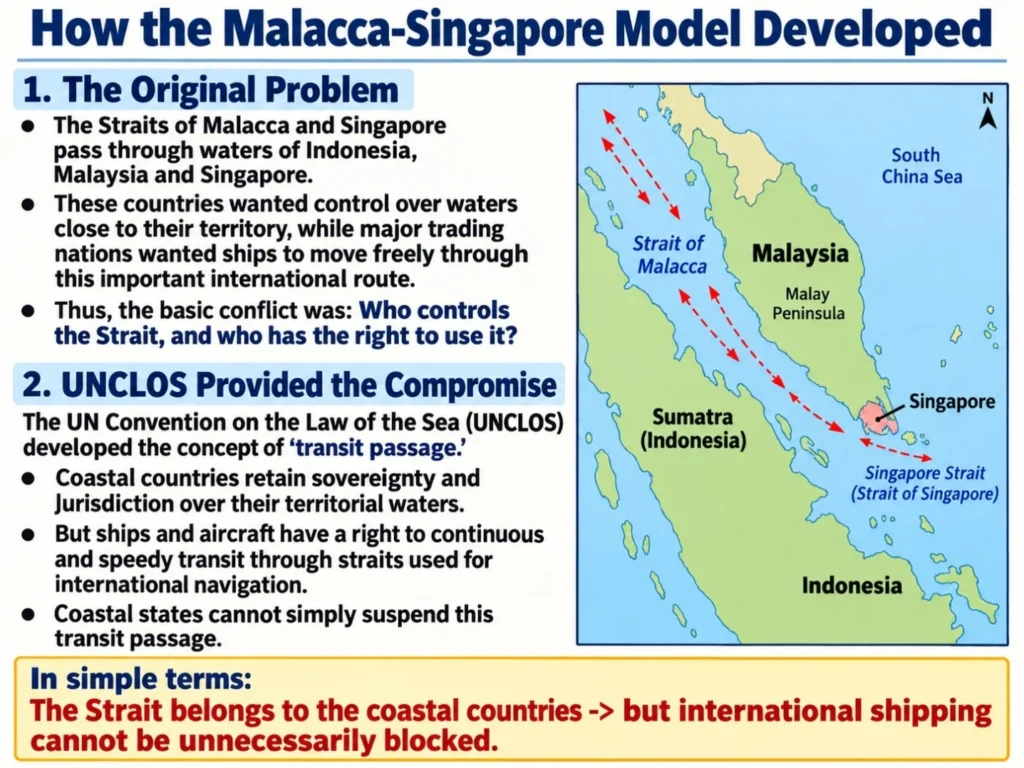
Cooperation Instead of Internationalisation
The 2007 Cooperative Mechanism
- Indonesia, Malaysia and Singapore later created a cooperative arrangement involving the three coastal states, countries whose ships use the Strait, shipping companies and international organisations.
- It supports navigation aids, removal of hazards, environmental protection, safety surveys and other projects. Users may contribute financially, but these contributions are voluntary rather than compulsory tolls.
- Thus, foreign powers help maintain the waterway without taking control of it.
Can This Work in Hormuz?
Geographic Similarity
Hormuz also passes through the territorial waters of neighbouring coastal states, principally Iran and Oman, while being crucial for international shipping.
A Malacca-style arrangement could therefore involve:
- Iran-Oman coordination over navigation;
- common shipping lanes and safety rules;
- cooperation with other Gulf states and major shipping nations;
- voluntary funding for navigation and safety infrastructure; and
- protection of coastal-state sovereignty alongside continued passage.
Oman has already proposed elements resembling the Malacca arrangement.
But Hormuz Is More Difficult
- The biggest difference is that Malacca’s cooperation mainly centres on navigation safety and environmental protection, whereas Hormuz is deeply connected with military security and geopolitical rivalry.
- There is also a legal complication: Oman has ratified UNCLOS, while Iran has signed but not ratified it.
Conclusion
The Malacca-Singapore experience shows that a strategic Strait need not be a choice between complete coastal control and complete international control. A cooperative mechanism can protect sovereignty while keeping international navigation functioning. However, applying this model to Hormuz ultimately depends on resolving the much deeper security and political disagreements surrounding the Strait.
Source: (The Hindu)
La Excellence IAS Academy, the best IAS coaching in Hyderabad, known for delivering quality content and conceptual clarity for UPSC 2026 preparation.
FOLLOW US ON:
◉ YouTube : https://www.youtube.com/@CivilsPrepTeam
◉ Facebook: https://www.facebook.com/LaExcellenceIAS
◉ Instagram: https://www.instagram.com/laexcellenceiasacademy/
GET IN TOUCH:
Contact us at info@laex.in, https://laex.in/contact-us/
or Call us @ +91 9052 29 2929, +91 9052 99 2929, +91 9154 24 2140
OUR BRANCHES:
Head Office: H No: 1-10-225A, Beside AEVA Fertility Center, Ashok Nagar Extension, VV Giri Nagar, Ashok Nagar, Hyderabad, 500020
Madhapur: Flat no: 301, survey no 58-60, Guttala begumpet Madhapur metro pillar: 1524, Rangareddy Hyderabad, Telangana 500081
Bangalore: Plot No: 99, 2nd floor, 80 Feet Road, Beside Poorvika Mobiles, Chandra Layout, Attiguppe, Near Vijaya Nagara, Bengaluru, 560040