
Paper: GS-II, Subject: International Relations, Topic: Global issues, Issue: Global Crisis Diplomacy.
Diplomacy in an Age of Global Crisis
Context
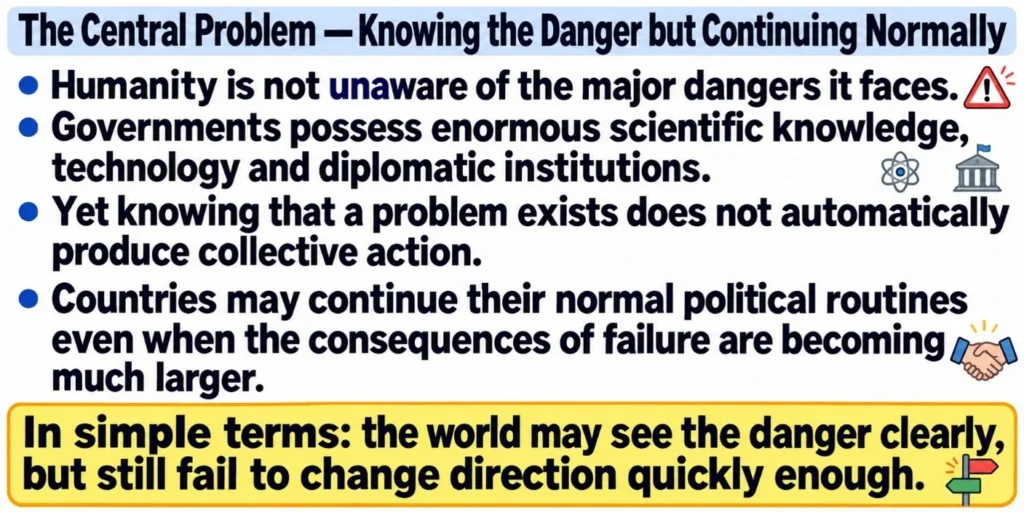
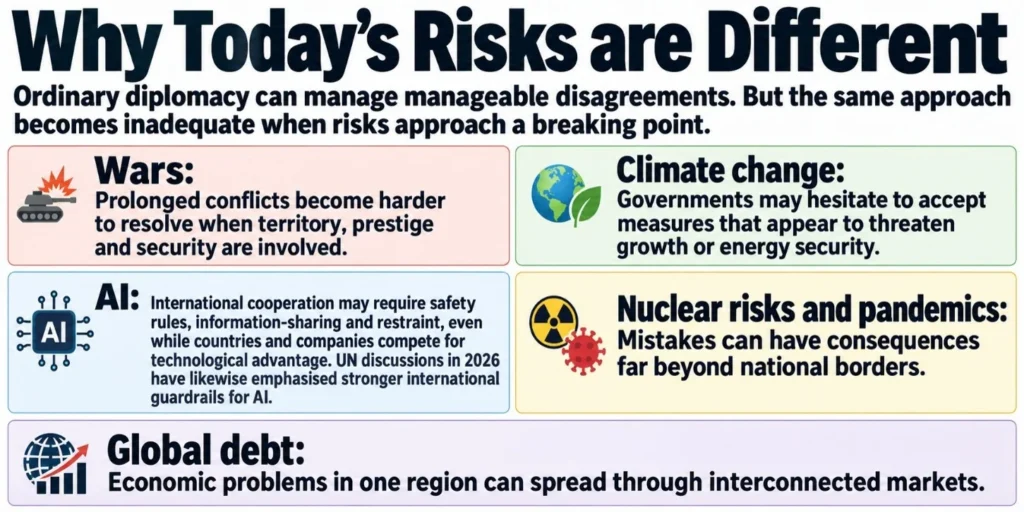
The world is simultaneously dealing with wars, geopolitical rivalry, climate change, nuclear dangers, debt pressures and rapidly advancing AI. Yet international politics often continues through the familiar routine of summits, declarations and negotiations. The concern is whether diplomacy built for normal times is sufficient for exceptional risks. The UN’s 2026 Global Risk Report similarly describes today’s major risks as increasingly interconnected.
Why Global Leadership is Difficult
1. No Country Can Simply Control the World
Even major powers such as the United States and China cannot independently rewrite global rules.
- Countries constrain one another.
- Leaders must consider domestic voters, jobs, inflation and national security.
- Therefore, even powerful governments have limited freedom to compromise internationally.
This makes global leadership less about one dominant leader and more about building cooperation among competing interests.
2. National Interest vs Global Interest
What appears sensible for one country can create problems collectively.
For example:
Energy security → greater fossil-fuel dependence → harder climate cooperation
Technology competition → faster AI development → less willingness to slow down for regulation
Military security → arms buildup → greater international insecurity
Thus, individually rational decisions can sometimes produce collectively dangerous outcomes.
The Danger of “Politics as Usual”
Summits and diplomatic meetings remain necessary. They maintain communication and can prevent crises from worsening.
However, their regular occurrence can also create a false feeling that the international system is functioning normally, even when underlying dangers are growing.
The real test of diplomacy is therefore not how many summits are held, but whether countries can change behaviour before crises become irreversible.
Conclusion
Modern diplomacy must move from merely managing day-to-day disputes to anticipating shared global risks. A highly interconnected world requires stronger cooperation, preventive diplomacy, institutional reform and a willingness to balance immediate national interests with humanity’s long-term security.
Source: (The Indian Express)
La Excellence IAS Academy, the best IAS coaching in Hyderabad, known for delivering quality content and conceptual clarity for UPSC 2026 preparation.
FOLLOW US ON:
◉ YouTube : https://www.youtube.com/@CivilsPrepTeam
◉ Facebook: https://www.facebook.com/LaExcellenceIAS
◉ Instagram: https://www.instagram.com/laexcellenceiasacademy/
GET IN TOUCH:
Contact us at info@laex.in, https://laex.in/contact-us/
or Call us @ +91 9052 29 2929, +91 9052 99 2929, +91 9154 24 2140
OUR BRANCHES:
Head Office: H No: 1-10-225A, Beside AEVA Fertility Center, Ashok Nagar Extension, VV Giri Nagar, Ashok Nagar, Hyderabad, 500020
Madhapur: Flat no: 301, survey no 58-60, Guttala begumpet Madhapur metro pillar: 1524, Rangareddy Hyderabad, Telangana 500081
Bangalore: Plot No: 99, 2nd floor, 80 Feet Road, Beside Poorvika Mobiles, Chandra Layout, Attiguppe, Near Vijaya Nagara, Bengaluru, 560040