
Paper: GS-III, Subject: Environment, Ecology and Disaster Management, Topic: Global Agreements and Efforts, Issue: Fossil-Fuel Transition and Climate Finance
Context
UNFCCC COP31 will be held in Antalya, Türkiye, from 9–20 November 2026. Türkiye will hold the COP31 Presidency, while Australia will lead the negotiations under a special partnership arrangement. The meeting comes amid growing pressure for clearer action on fossil fuels and renewed concern over adaptation and climate finance following severe disasters, including the Nepal floods in August 2026.
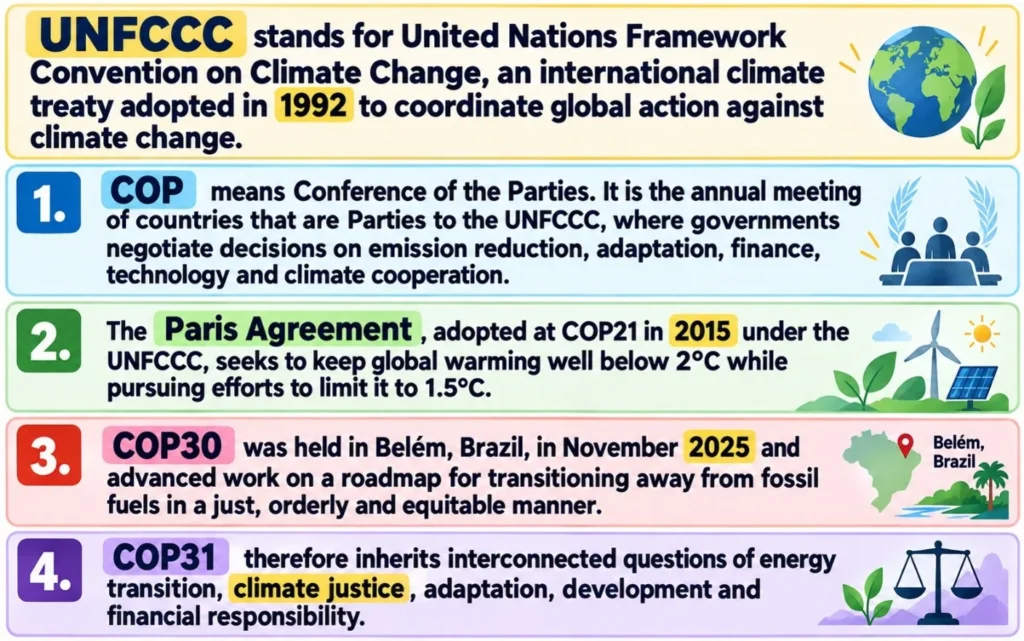
Explanation
1. Why Fossil Fuels Are the Central Issue
- Coal, oil and natural gas remain central to electricity, transport, industry, employment and government revenues in many countries.
- At the same time, reducing their use is essential for lowering greenhouse-gas emissions and meeting the Paris temperature goals.
- Therefore, the real debate is increasingly about how fast the transition should occur, which countries should move first and how developing countries will be supported.
2. The Türkiye–Australia Challenge
- Türkiye is hosting and presiding over COP31, while an Australian representative will lead the formal negotiations.
- Both economies retain significant links with fossil-fuel production or consumption.
- Their leadership will consequently test whether domestic energy interests can be reconciled with stronger international climate commitments.
3. Climate Justice and Developing Countries
- Developing countries argue that every country cannot follow an identical transition timetable.
- Countries differ greatly in historical emissions, income, technology, energy access and development needs.
- This reflects the principle of Common but Differentiated Responsibilities and Respective Capabilities, which links environmental responsibility with fairness.
4. Nepal Floods and the Adaptation Question
- The recent floods in Nepal caused major loss of life, displacement and damage to houses, roads, bridges and hydropower infrastructure.
- Such disasters highlight the vulnerability of Himalayan and developing regions to extreme events.
- Consequently, poorer countries demand not only emission reduction but also greater adaptation finance, disaster resilience and support for loss and damage.
5. Finance Is Crucial
- Moving towards renewable energy requires massive investment in electricity grids, storage, public transport, clean industry and new technologies.
- Without adequate finance and technology transfer, rapid transition can impose disproportionate costs on developing economies.
Conclusion
COP31 represents a larger global dilemma: climate action must become faster without making development unfairer. A durable transition requires fossil-fuel reduction to proceed alongside climate finance, technological cooperation, adaptation and recognition of differing national capabilities.
Source: (The Hindu)
La Excellence IAS Academy, the best IAS coaching in Hyderabad, known for delivering quality content and conceptual clarity for UPSC 2026 preparation.
FOLLOW US ON:
◉ YouTube : https://www.youtube.com/@CivilsPrepTeam
◉ Facebook: https://www.facebook.com/LaExcellenceIAS
◉ Instagram: https://www.instagram.com/laexcellenceiasacademy/
GET IN TOUCH:
Contact us at info@laex.in, https://laex.in/contact-us/
or Call us @ +91 9052 29 2929, +91 9052 99 2929, +91 9154 24 2140
OUR BRANCHES:
Head Office: H No: 1-10-225A, Beside AEVA Fertility Center, Ashok Nagar Extension, VV Giri Nagar, Ashok Nagar, Hyderabad, 500020
Madhapur: Flat no: 301, survey no 58-60, Guttala begumpet Madhapur metro pillar: 1524, Rangareddy Hyderabad, Telangana 500081
Bangalore: Plot No: 99, 2nd floor, 80 Feet Road, Beside Poorvika Mobiles, Chandra Layout, Attiguppe, Near Vijaya Nagara, Bengaluru, 560040