
Paper: GS-III, Subject: Environment, Ecology and Disaster Management, Topic: Global Agreements and Efforts, Issue: Sea-Level Rise, Small Island States and International Law
Context
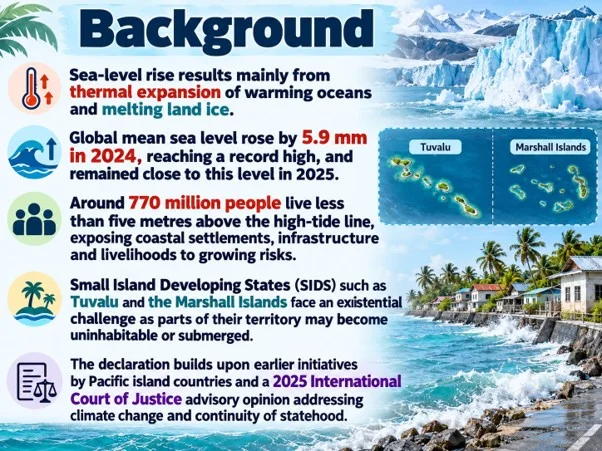
On 24 September 2026, the UN General Assembly adopted its first-ever declaration specifically addressing sea-level rise. It affirms that island countries threatened by rising seas do not automatically lose their statehood or established maritime rights even if their physical territory becomes submerged, while calling for stronger adaptation, finance and climate action.
Explanation
1. Statehood Can Continue Despite Submergence
- Traditionally, a State is associated with territory, population and effective government.
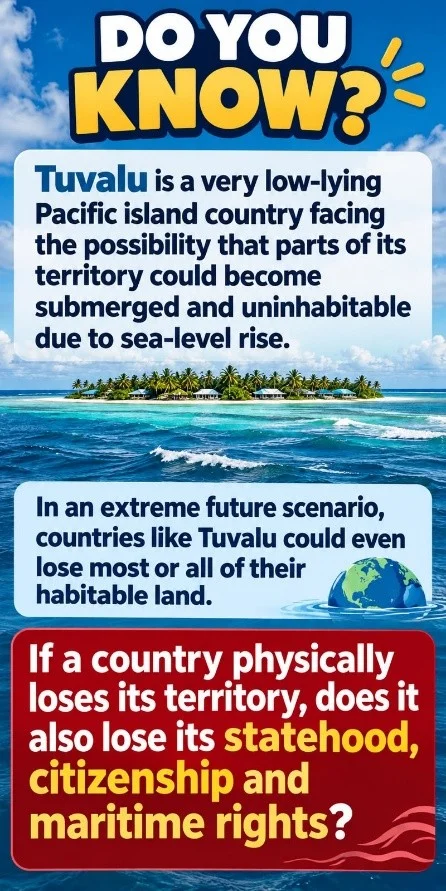
- Climate change creates an unprecedented situation where a recognised country’s physical territory could significantly disappear.
- The declaration affirms that loss of territory because of sea-level rise does not automatically terminate statehood.
- Thus, citizens of vulnerable island countries need not automatically become stateless merely because their islands become uninhabitable.
2. Protection of Maritime Zones
- Rising seas can shift coastlines, which normally serve as the baseline for calculating maritime zones.
- The declaration supports the stability of already established maritime zones, even when coastlines physically change.
- This is crucial because these zones determine rights over fisheries, seabed resources and other ocean activities.
- Without such protection, island States could suffer a double loss: land territory as well as economically valuable ocean space.
3. Adaptation Becomes a Development Priority
The declaration calls for:
- Multi-hazard early-warning systems
- Climate-risk assessments in development planning
- Climate-resilient ports, roads, energy systems, water supply and healthcare infrastructure
- Coastal protection, land elevation and reclamation where feasible
These measures are particularly important for densely populated coastal regions and vulnerable developing countries.
4. Nature-Based Solutions
- Mangroves, seagrass meadows and kelp forests can reduce wave energy and coastal erosion.
- Their restoration can simultaneously support biodiversity, carbon storage and livelihoods.
- Such solutions can complement engineered coastal defences.
5. Climate Finance and Equity
- Vulnerable countries often contribute little to historical greenhouse-gas emissions but face disproportionate climate impacts.
- The declaration therefore calls for stronger financial, technological and policy support, particularly for SIDS and least-developed countries.
- However, adaptation alone cannot solve the problem; continued warming will lock in further sea-level rise.
Conclusion
The declaration marks an important evolution in global climate governance by recognising that climate change can threaten not only territory and livelihoods, but also sovereignty and legal rights. Its effectiveness will ultimately depend on stronger emission reductions, adequate adaptation finance and implementation by States.
Source: (Down to Earth)
La Excellence IAS Academy, the best IAS coaching in Hyderabad, known for delivering quality content and conceptual clarity for UPSC 2026 preparation.
FOLLOW US ON:
◉ YouTube : https://www.youtube.com/@CivilsPrepTeam
◉ Facebook: https://www.facebook.com/LaExcellenceIAS
◉ Instagram: https://www.instagram.com/laexcellenceiasacademy/
GET IN TOUCH:
Contact us at info@laex.in, https://laex.in/contact-us/
or Call us @ +91 9052 29 2929, +91 9052 99 2929, +91 9154 24 2140
OUR BRANCHES:
Head Office: H No: 1-10-225A, Beside AEVA Fertility Center, Ashok Nagar Extension, VV Giri Nagar, Ashok Nagar, Hyderabad, 500020
Madhapur: Flat no: 301, survey no 58-60, Guttala begumpet Madhapur metro pillar: 1524, Rangareddy Hyderabad, Telangana 500081
Bangalore: Plot No: 99, 2nd floor, 80 Feet Road, Beside Poorvika Mobiles, Chandra Layout, Attiguppe, Near Vijaya Nagara, Bengaluru, 560040