
Paper: GS – III, Subject: Economy, Topic: Economy related – Acts, Schemes, Policies, Indices, Issue: Delhi EV Policy and India’s Clean Mobility Transition.
Context:
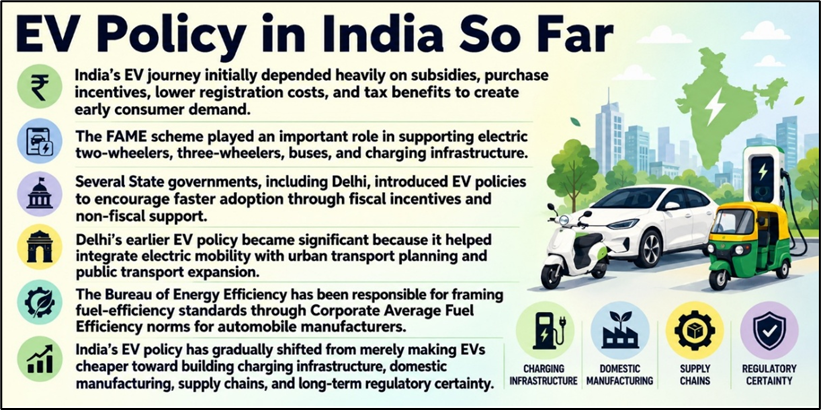
India’s transition towards electric mobility has entered a crucial phase with the Delhi Government proposing a new Electric Vehicle (EV) Policy and the Bureau of Energy Efficiency (BEE) releasing revised fuel-efficiency norms under the Corporate Average Fuel Efficiency (CAFÉ III) framework. The debate has now shifted from temporary subsidies towards creating a long-term regulatory and market-driven ecosystem for electric mobility.
Key Takeaways:
Core Theme:
- The main policy shift is from short-term subsidies to long-term regulatory mechanisms that can permanently change automobile production and consumer behaviour.
- The Bureau of Energy Efficiency’s CAFE-3 framework is important because fuel-efficiency rules can push manufacturers toward cleaner technologies, including EVs.
- India’s future EV transition will depend not only on incentives but also on clear phase-out timelines, strict compliance norms, and sector-specific policies for cars, two-wheelers, buses, and freight vehicles.
Explanation:
- Delhi’s proposed new EV policy indicates a stronger approach by planning a gradual phase-out of internal combustion engine vehicles, especially three-wheelers and two-wheelers, within defined timelines.
- Such phase-out signals are important because they inform manufacturers, investors, charging companies, and consumers that the shift toward EVs is not temporary.
- The Bureau of Energy Efficiency’s revised CAFE-III norms are significant because they can make automobile manufacturers accountable for improving the average fuel efficiency of their vehicle fleets.
- Stronger CAFE norms can indirectly encourage manufacturers to produce more electric vehicles because EVs help reduce the overall emission and fuel-consumption profile of a company’s fleet.
- The earlier policy concern was that excessive support for hybrid vehicles could delay full electrification by allowing manufacturers to continue depending on transitional technologies.
- Plug-in hybrids and strong hybrids may help in the short term, but they should not become a substitute for zero-emission mobility in the long run.
- Heavy-duty and freight vehicles remain a weak area in India’s EV transition because current rules focus more on model-specific fuel efficiency rather than fleet-wide emission reduction.
- India needs a dedicated framework for electric freight, including charging corridors, differentiated targets for vehicle categories, incentives for clean logistics, and regulatory pressure on manufacturers.
Conclusion:
India’s electric mobility transition requires a balanced combination of incentives, regulations, technology development, and infrastructure expansion. Subsidies helped create the early EV market, but long-term transformation will depend on institutions such as the Bureau of Energy Efficiency, stronger CAFE norms, and clear phase-out timelines. A stable regulatory pathway can help India reduce emissions, improve urban air quality, cut oil dependence, and build a globally competitive EV ecosystem.
Source: (The Indian Express)
La Excellence IAS Academy, the best IAS coaching in Hyderabad, known for delivering quality content and conceptual clarity for UPSC 2026 preparation.
FOLLOW US ON:
◉ YouTube : https://www.youtube.com/@CivilsPrepTeam
◉ Facebook: https://www.facebook.com/LaExcellenceIAS
◉ Instagram: https://www.instagram.com/laexcellenceiasacademy/
GET IN TOUCH:
Contact us at info@laex.in, https://laex.in/contact-us/
or Call us @ +91 9052 29 2929, +91 9052 99 2929, +91 9154 24 2140
OUR BRANCHES:
Head Office: H No: 1-10-225A, Beside AEVA Fertility Center, Ashok Nagar Extension, VV Giri Nagar, Ashok Nagar, Hyderabad, 500020
Madhapur: Flat no: 301, survey no 58-60, Guttala begumpet Madhapur metro pillar: 1524, Rangareddy Hyderabad, Telangana 500081
Bangalore: Plot No: 99, 2nd floor, 80 Feet Road, Beside Poorvika Mobiles, Chandra Layout, Attiguppe, Near Vijaya Nagara, Bengaluru, 560040