
Paper: GS – II, Subject: Governance, Topic: Good governance and applications, Issue: India’s Public Data Governance Challenge and the Need for Standardised Public Data.
Context:
India is rapidly expanding welfare delivery, digital governance, and data-driven policymaking. However, the recent debate on India’s “data room” highlights that despite generating massive amounts of data, government databases often remain fragmented, inconsistent, and poorly standardised. This weakens governance efficiency and leads to fiscal leakages, duplication, and poor policy outcomes.
Key Takeaways:
Background:
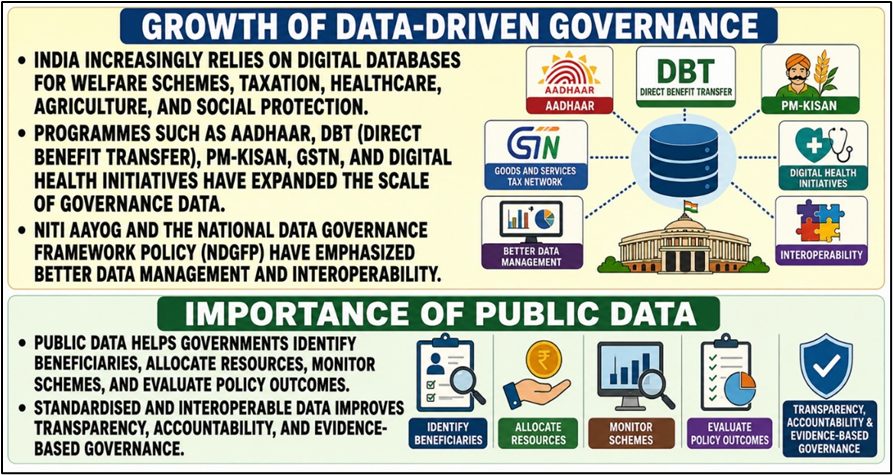
Explanation:
Anatomy of the Problem: Fragmented Data Ecosystem:
Lack of Standardisation:
- Different Ministries and departments often use different formats, definitions, and methodologies for collecting data.
- Basic indicators such as age, income, occupation, beneficiary status, or district names may be recorded differently across databases.
- This creates inconsistencies and reduces comparability.
Poor Interoperability:
- Government databases frequently operate in silos and cannot seamlessly communicate with one another.
- Data from health, agriculture, education, taxation, and welfare departments often remains disconnected.
- As a result, consolidated policymaking becomes difficult.
Duplication and Data Quality Issues:
- The same individual may appear multiple times in different databases.
- Duplicate entries distort statistics and create confusion in governance.
- Example: In healthcare databases, one patient may be counted multiple times across disease surveillance systems and immunisation records.
Impact on Governance:
- Fragmented data reduces administrative efficiency and delays decision-making.
- Policymakers may rely on outdated or inaccurate information.
- Lack of reliable district-level and real-time data weakens targeted governance.
Fiscal Leakages and Economic Costs:
A NITI Aayog report from June 2025 indicates that welfare program databases often list the same beneficiary multiple times, inflating spending by 4%-7% annually.
Meaning of Fiscal Leakages:
- Fiscal leakage refers to wastage of public money due to duplication, fake beneficiaries, inefficiencies, or weak monitoring systems.
Examples Highlighted in the Debate:
- PM-KISAN beneficiary databases reportedly contained duplicate or ineligible names.
- Duplicate LPG connections and fake ration cards have also contributed to subsidy leakages.
- Such inefficiencies can inflate government expenditure significantly.
- Recent clean-ups of government data have revealed significant potential savings, such as:
- ₹190 billion from removing ineligible names from the PM-KISAN scheme.
- ₹210 billion from eliminating bogus LPG connections.
- ₹100 billion from removing fake ration cards.
Measures Suggested:
National Data Governance Framework:
- The proposed India Data Management Office (IDMO) aims to create common standards and protocols for data management.
- It seeks to improve interoperability, metadata standards, and dispute resolution mechanisms.
Unified Statistical Standards:
- Harmonising definitions and methodologies across Ministries can improve reliability.
- Alignment with international statistical frameworks can strengthen credibility.
Strengthening Data Platforms:
- Expanding platforms such as data.gov.in can improve accessibility and transparency.
- Ministries should regularly upload machine-readable and standardised datasets.
Data Accountability:
- Linking data quality benchmarks with administrative performance can encourage reforms.
- Regular audits and database clean-ups are necessary.
Conclusion:
India’s governance capacity increasingly depends on the quality, interoperability, and reliability of its public data systems. Without standardisation and coordination, fragmented databases can weaken policymaking and cause large fiscal leakages. Strengthening data governance is therefore not merely a technical reform, but a foundational requirement for efficient welfare delivery, economic planning, and accountable governance.
Source: (The Hindu)
La Excellence IAS Academy, the best IAS coaching in Hyderabad, known for delivering quality content and conceptual clarity for UPSC 2026 preparation.
FOLLOW US ON:
◉ YouTube : https://www.youtube.com/@CivilsPrepTeam
◉ Facebook: https://www.facebook.com/LaExcellenceIAS
◉ Instagram: https://www.instagram.com/laexcellenceiasacademy/
GET IN TOUCH:
Contact us at info@laex.in, https://laex.in/contact-us/
or Call us @ +91 9052 29 2929, +91 9052 99 2929, +91 9154 24 2140
OUR BRANCHES:
Head Office: H No: 1-10-225A, Beside AEVA Fertility Center, Ashok Nagar Extension, VV Giri Nagar, Ashok Nagar, Hyderabad, 500020
Madhapur: Flat no: 301, survey no 58-60, Guttala begumpet Madhapur metro pillar: 1524, Rangareddy Hyderabad, Telangana 500081
Bangalore: Plot No: 99, 2nd floor, 80 Feet Road, Beside Poorvika Mobiles, Chandra Layout, Attiguppe, Near Vijaya Nagara, Bengaluru, 560040