
Paper: GS – I, Subject: Geography, Topic: Oceanography, Issue: Atlantic Meridional Overturning Circulation (AMOC).
Context:
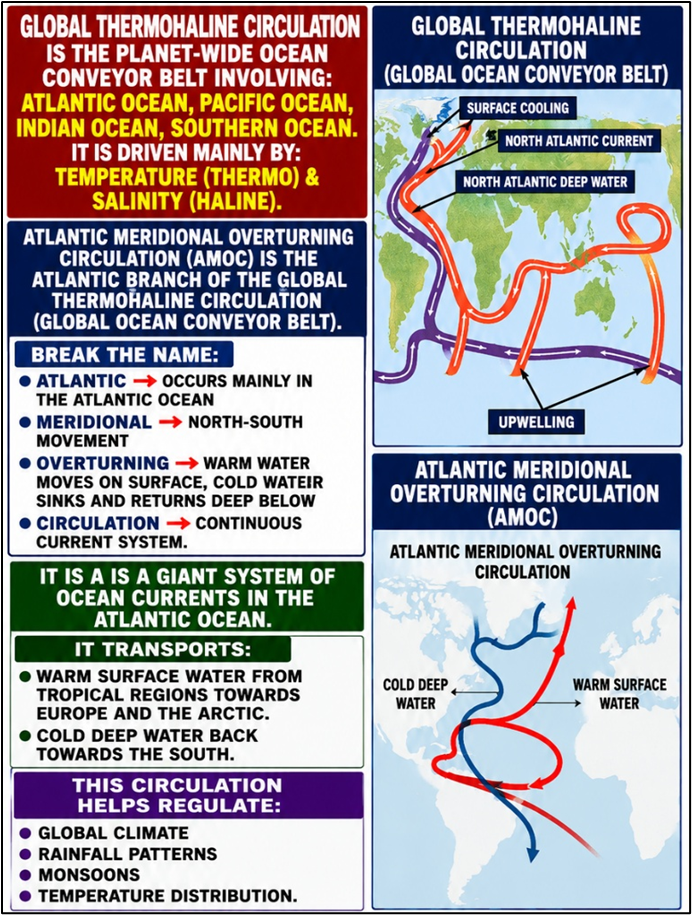
Recent scientific studies have warned that the Atlantic Meridional Overturning Circulation (AMOC), a major system of ocean currents in the Atlantic Ocean, may weaken significantly due to climate change. Scientists fear that a severe slowdown or collapse of this system could disrupt global climate patterns, including rainfall systems, monsoons, sea levels, and extreme weather events.
Key Takeaways:
Background:
Explanation:
How Climate Change Affects AMOC:
- Rising global temperatures are accelerating the melting of Arctic ice sheets and Greenland glaciers.
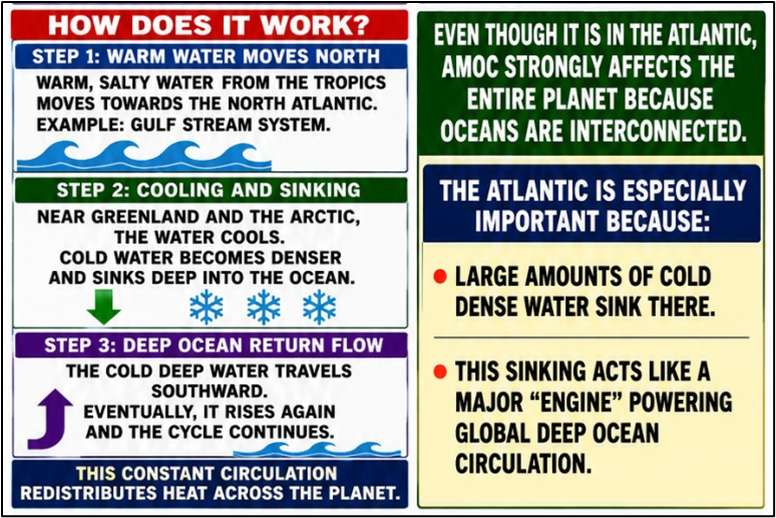
- Large quantities of freshwater are entering the North Atlantic Ocean.
- Freshwater is less salty and less dense, reducing the sinking process that drives AMOC circulation.
- This weakens the “engine” of the ocean conveyor belt.
Importance of AMOC in Global Climate:
- AMOC transfers heat from tropical regions to northern latitudes.
- It influences atmospheric circulation, rainfall patterns, and storm systems across multiple continents.
- A strong AMOC helps maintain stable climatic conditions in Europe, Africa, Asia, and the Americas.
Possible Consequences of AMOC Collapse:
- Europe may experience severe cooling despite overall global warming.
- Sea levels along the eastern coast of North America could rise sharply.
- Extreme weather events such as droughts, floods, storms, and heatwaves may intensify globally.
- Agricultural productivity and freshwater availability may decline in several regions.
Connection with El Niño and Global Climate Systems:
- Ocean and atmospheric systems are interconnected.
- A weakened AMOC may disturb Pacific Ocean circulation and influence El Niño patterns.
- This could make climate events more frequent, irregular, and extreme.
Impact on India:
- India depends heavily on the southwest monsoon for agriculture, water supply, and food security.
- Weakening of AMOC may disrupt monsoon circulation and reduce moisture transport.
- This can lead to irregular rainfall, droughts, floods, and increased climate uncertainty.
- Sectors such as agriculture, fisheries, water management, and rural livelihoods may face serious risks.
Conclusion:
The possible weakening of AMOC highlights the deep interconnection between climate change and Earth’s ocean systems. Although uncertainty remains regarding the exact timeline of collapse, the issue underlines the urgent need for global climate mitigation, stronger adaptation policies, and scientific monitoring of ocean circulation systems.
Source: (The Indian Express)
La Excellence IAS Academy, the best IAS coaching in Hyderabad, known for delivering quality content and conceptual clarity for UPSC 2026 preparation.
FOLLOW US ON:
◉ YouTube : https://www.youtube.com/@CivilsPrepTeam
◉ Facebook: https://www.facebook.com/LaExcellenceIAS
◉ Instagram: https://www.instagram.com/laexcellenceiasacademy/
GET IN TOUCH:
Contact us at info@laex.in, https://laex.in/contact-us/
or Call us @ +91 9052 29 2929, +91 9052 99 2929, +91 9154 24 2140
OUR BRANCHES:
Head Office: H No: 1-10-225A, Beside AEVA Fertility Center, Ashok Nagar Extension, VV Giri Nagar, Ashok Nagar, Hyderabad, 500020
Madhapur: Flat no: 301, survey no 58-60, Guttala begumpet Madhapur metro pillar: 1524, Rangareddy Hyderabad, Telangana 500081
Bangalore: Plot No: 99, 2nd floor, 80 Feet Road, Beside Poorvika Mobiles, Chandra Layout, Attiguppe, Near Vijaya Nagara, Bengaluru, 560040