
Paper: GS – III, Subject: Economy, Topic: Growth and Development, Issue: Consumption Inequality in India: Insights from HCES 2023–24.
Context:
Recent policy changes such as the implementation of new Labour Codes and the Viksit Bharat-Guarantee for Rozgar and Ajeevika Mission (Gramin) Act (replaced the MGNREGA) and the debates around them have raised concerns about the welfare of informal workers and rural communities and overall inequality in India.
Key Takeaways:
Background:
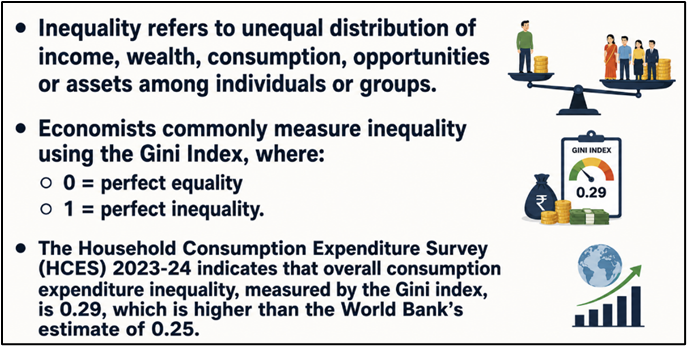
- Inequality refers to unequal distribution of income, wealth, consumption, opportunities or assets among individuals or groups.
- India traditionally relied on NSSO consumption expenditure surveys to estimate inequality because reliable income data is difficult to obtain.
- Consumption expenditure is divided into Food expenditure (spending on essential food items) & non-food expenditure (spending on education, healthcare, transport, housing, digital services, lifestyle goods etc).
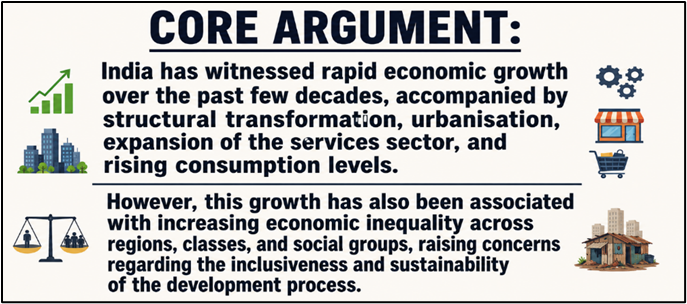
- Urbanisation, economic reforms after 1991, expansion of the service sector and technological growth significantly changed India’s economic structure.
- There is an official or administrative belief today that inequality is not as serious a concern in India as it was earlier, particularly compared to the early 2010s.
- However, benefits of growth have not been distributed uniformly across regions, occupations and social groups.
Explanation:
Consumption Expenditure Inequality:
- Urban India shows much higher inequality than rural India, especially in non-food expenditure such as education, healthcare, housing, transport, and digital services.
- The average urban non-food Monthly Per Capita Expenditure (MPCE) is significantly higher than rural expenditure, reflecting unequal access to modern services and opportunities.
- Non-food inequality has become more important because economic growth increasingly depends on access to quality services and human capital.
Unequal Distribution of Growth Benefits
- Economic reforms, urbanisation, and expansion of the service sector mainly benefited professionals, business owners, and skilled workers.
- Informal workers, agricultural labourers, and small farmers have not benefited proportionately from economic growth.
- This has widened class-based and regional disparities in India’s development process.
Decile and Class Disparities:
- The top 10% of urban households account for a disproportionately large share of total non-food expenditure.
- The spending gap between the richest and poorest households remains extremely high, particularly in urban India.
- Such disparities indicate unequal access to education, healthcare, technology, and better living standards.
Limitations in Measuring Inequality:
- Consumption surveys may underestimate actual inequality because the superrich are often underrepresented in official datasets.
- Wealth inequality is much higher than consumption inequality because asset ownership and capital gains are not fully captured in surveys.
- Debt-led consumption among lower-income groups can also create a misleading picture of economic well-being.
Conclusion:
India’s growth experience shows that high GDP growth alone does not automatically ensure equitable development. Sustainable and inclusive growth requires wider access to quality education, healthcare, formal employment, social protection, and economic opportunities. Reducing inequality is essential for strengthening social stability, economic resilience, and long-term democratic development.
Source: (The Indian Express, The Hindu, Live Mint)
La Excellence IAS Academy, the best IAS coaching in Hyderabad, known for delivering quality content and conceptual clarity for UPSC 2026 preparation.
FOLLOW US ON:
◉ YouTube : https://www.youtube.com/@CivilsPrepTeam
◉ Facebook: https://www.facebook.com/LaExcellenceIAS
◉ Instagram: https://www.instagram.com/laexcellenceiasacademy/
GET IN TOUCH:
Contact us at info@laex.in, https://laex.in/contact-us/
or Call us @ +91 9052 29 2929, +91 9052 99 2929, +91 9154 24 2140
OUR BRANCHES:
Head Office: H No: 1-10-225A, Beside AEVA Fertility Center, Ashok Nagar Extension, VV Giri Nagar, Ashok Nagar, Hyderabad, 500020
Madhapur: Flat no: 301, survey no 58-60, Guttala begumpet Madhapur metro pillar: 1524, Rangareddy Hyderabad, Telangana 500081
Bangalore: Plot No: 99, 2nd floor, 80 Feet Road, Beside Poorvika Mobiles, Chandra Layout, Attiguppe, Near Vijaya Nagara, Bengaluru, 560040