
Paper: GS-III and GS-I | Subject: Environment and Biodiversity | Geography | Topic: Climate Change and Biodiversity Conservation | Issue: Climate-Driven Species Range Shifts
Context
Rising temperatures are pushing wildlife towards cooler regions, changing species distributions across land and oceans. In India, a Himalayan bird has shifted approximately 400 metres uphill, raising concerns about conservation areas with fixed boundaries.

Explanation: Great Migration: How Climate Change Is Redrawing Wildlife Maps
Evidence of a changing wildlife map
- In the Himalayas, the yellow-bellied fairy-fantail has shifted approximately 400 metres uphill, from 1,950 to 2,350 metres.
- Researchers using eBird observations found its occurrence probability declining by 46% at lower elevations and increasing by 43% higher up.
- Similar changes affect approximately 12,000 species globally, including marine fish expanding towards cooler waters as ocean temperatures rise.
- India’s oil sardine has extended northwards, while projections suggest 66–73% of Indian bird species may undergo future range shifts.
Ecological consequences of species movement
- Species depend on interconnected food webs, where plants, pollinators, predators and prey maintain important ecological relationships.
- When these organisms shift at different speeds, plants may lose pollinators while predators struggle to find suitable prey.
- Newly arriving species may compete with native wildlife, while mosquitoes and agricultural pests can expand into previously cooler regions.
- Consequently, these ecological changes can affect crop productivity, disease patterns and fishing livelihoods, extending biodiversity impacts into human society.
Why movement may not ensure survival
- Species can reach suitable climates only when movement routes exist, but roads, farms and fragmented forests frequently block them.
- Plants and amphibians may spread too slowly, while animals dependent on continuous forests struggle to cross disturbed landscapes.
- Mountain species face an “escalator to extinction”, as continued uphill movement eventually leaves no suitable habitat above them.
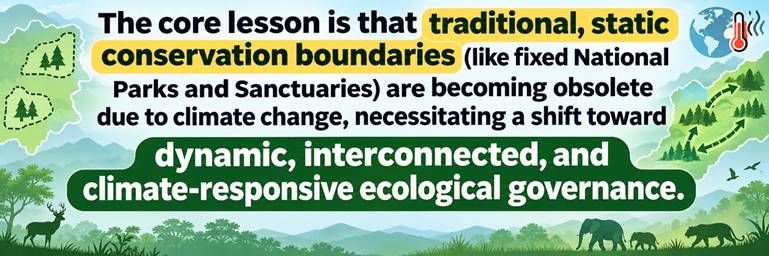
- This threatens isolated sky islands in the Western Ghats, while shifting wildlife may also move beyond protected-area boundaries.
Making conservation climate-responsive
- Wildlife corridors connect separated habitats, enabling species to move across elevations and geographical regions as climatic conditions change.
- Climate refugia, including cooler valleys and old-growth forests, provide relatively favourable conditions where vulnerable species can survive.
- Long-term monitoring through citizen science and wildlife surveys can guide changing protected-area management plans and fisheries regulations.
- India’s biodiversity policies and the Kunming-Montreal Global Biodiversity Framework support connected habitats, improved protection and climate-responsive conservation planning.
Conclusion
Climate change is transforming wildlife distribution, creating ecological disruptions that fixed conservation boundaries cannot adequately address. India needs connected habitats, protected climate refugia and flexible conservation policies to safeguard species as their ranges shift.
Source: (Down to Earth)
La Excellence IAS Academy, the best IAS coaching in Hyderabad, known for delivering quality content and conceptual clarity for UPSC 2026 preparation.
FOLLOW US ON:
◉ YouTube: https://www.youtube.com/@CivilsPrepTeam
◉ Facebook: https://www.facebook.com/LaExcellenceIAS
◉ Instagram: https://www.instagram.com/laexcellenceiasacademy/
GET IN TOUCH:
Contact us at info@laex.in, https://laex.in/contact-us/
or Call us @ +91 9052 29 2929, +91 9052 99 2929, +91 9154 24 2140
OUR BRANCHES:
Head Office: H No: 1-10-225A, Beside AEVA Fertility Center, Ashok Nagar Extension, VV Giri Nagar, Ashok Nagar, Hyderabad, 500020
Madhapur: Flat no: 301, survey no 58-60, Guttala begumpet Madhapur metro pillar: 1524, Rangareddy Hyderabad, Telangana 500081
Bangalore: Plot No: 99, 2nd floor, 80 Feet Road, Beside Poorvika Mobiles, Chandra Layout, Attiguppe, Near Vijaya Nagara, Bengaluru, 560040