
Paper: GS – III, Subject: Environment and Ecology, Topic: Biodiversity and Conservation, Issue: Human–Wildlife Conflict (HWC).
Context:
Human–Wildlife Conflict (HWC) refers to situations where interactions between humans and wild animals lead to loss of life, crops, livestock, property, or ecological stability. The issue has become more frequent due to habitat fragmentation, climate change, infrastructure expansion, and rising human pressure on forests and biodiversity-rich landscapes.
Key Takeaways:
Background:
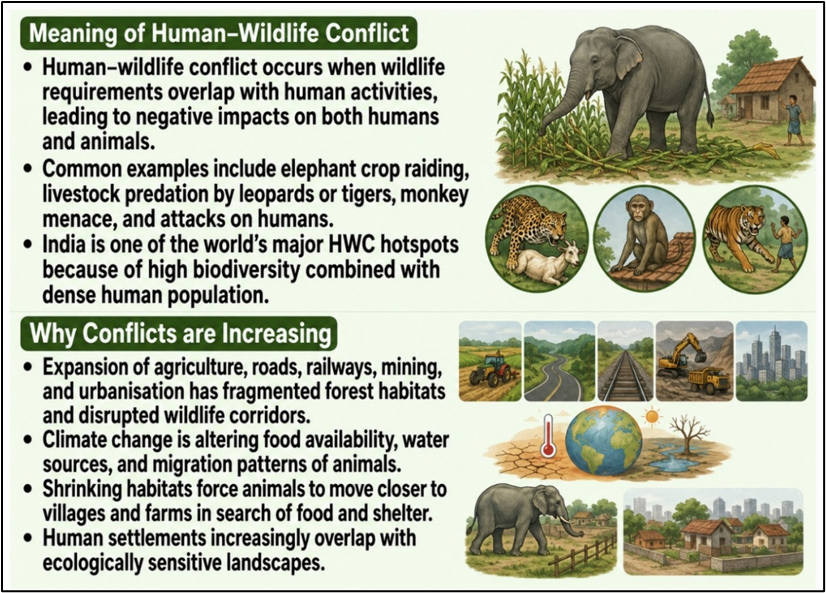
Explanation:
Human–Wildlife Conflict as an Ecological Problem:
- HWC is not merely a law-and-order issue but reflects ecological imbalance and unsustainable land-use patterns.
- Wildlife movement is natural, but habitat fragmentation interrupts migration and breeding pathways.
- Many species require large territories and connected ecosystems for survival.
Socio-Economic Dimensions:
- Farmers and forest-dependent communities suffer major crop and livestock losses.
- Poor compensation mechanisms often increase resentment against conservation policies.
- Economic insecurity may lead to retaliatory killing or illegal hunting of wildlife.
India’s Present Challenges:
- Wildlife corridors across India are fragmented by highways, railways, dams, and settlements.
- Rapid infrastructure development in forest areas increases accidental animal deaths.
- Compensation systems are often delayed, inaccessible, or inadequate.
- Conflict-prone States include Karnataka, Assam, Odisha, West Bengal, Maharashtra, and Uttarakhand.
Measures Adopted in India:
- Project Elephant and Project Tiger support habitat protection and conflict mitigation.
- Eco-sensitive zones and wildlife corridors are being identified for ecological connectivity.
- Solar fencing, early-warning systems, drone surveillance, and GPS tracking are increasingly used.
- Community participation through Joint Forest Management and eco-development committees is being encouraged.
Some Global Best Practices:
- Botswana and Namibia use community-based conservation linked to tourism revenue sharing.
- Costa Rica integrates ecological corridors into national planning.
- Finland combines rapid compensation with real-time monitoring systems.
- Nepal and Bhutan show that community-managed forests can reduce conflict significantly.
Way Forward:
- Conservation policies must balance ecological protection with livelihood security.
- Scientific land-use planning and restoration of wildlife corridors are essential.
- Faster compensation and insurance mechanisms can reduce local hostility.
- Education and awareness programmes should promote coexistence rather than fear.
- Long-term solutions require sustainable development that respects ecological limits.
Conclusion:
Human – wildlife conflict is a predictable outcome of ecological disruption and unsustainable development patterns. The solution lies not in eliminating wildlife, but in creating scientifically informed, socially just, and ecologically sustainable systems of coexistence between humans and nature.
Source: (The Hindu)
La Excellence IAS Academy, the best IAS coaching in Hyderabad, known for delivering quality content and conceptual clarity for UPSC 2026 preparation.
FOLLOW US ON:
◉ YouTube : https://www.youtube.com/@CivilsPrepTeam
◉ Facebook: https://www.facebook.com/LaExcellenceIAS
◉ Instagram: https://www.instagram.com/laexcellenceiasacademy/
GET IN TOUCH:
Contact us at info@laex.in, https://laex.in/contact-us/
or Call us @ +91 9052 29 2929, +91 9052 99 2929, +91 9154 24 2140
OUR BRANCHES:
Head Office: H No: 1-10-225A, Beside AEVA Fertility Center, Ashok Nagar Extension, VV Giri Nagar, Ashok Nagar, Hyderabad, 500020
Madhapur: Flat no: 301, survey no 58-60, Guttala begumpet Madhapur metro pillar: 1524, Rangareddy Hyderabad, Telangana 500081
Bangalore: Plot No: 99, 2nd floor, 80 Feet Road, Beside Poorvika Mobiles, Chandra Layout, Attiguppe, Near Vijaya Nagara, Bengaluru, 560040