
Paper: GS-III Subject: Environment and Ecology,Topic: Pollution, Issue: National Air Quality Monitoring (NCAP)
Context:
India observed Swachh Vayu Diwas on September 7, coinciding with the International Day of Clean Air for Blue Skies. The occasion highlighted progress in India’s efforts to monitor and reduce urban air pollution.
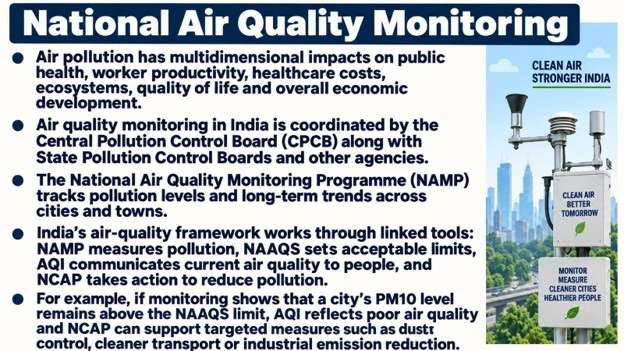
National Ambient Air Quality Standards
- National Ambient Air Quality Standards (NAAQS) prescribe permissible concentrations of major air pollutants.
- They act as benchmarks for judging whether air quality in an area is acceptable.
- For PM10, the annual national standard is 60 μg/m³.
- Areas repeatedly exceeding prescribed limits require stronger pollution-control measures.
Air Quality Index
- The Air Quality Index (AQI) converts pollution data into an easy-to-understand numerical indicator.
- It considers eight pollutants – PM10, PM2.5, NO₂, SO₂, CO, O₃, NH₃ and Lead.
- Air quality is classified from Good (0-50) to Severe (401-500).
National Clean Air Programme
- Launched in 2019, the NCAP currently covers 130 cities.
- It uses city-specific action plans, as major sources of pollution differ across cities.
- Measures include road-dust control, cleaner transport, industrial emission reduction, waste management and increasing green cover.
- Its revised objective was to achieve up to 40% reduction in PM10 levels or attain the national PM10 standard, compared with the 2017–18 baseline.
Performance of NCAP
- By 2025–26, 108 of 130 cities recorded a decline in annual PM10 levels.
- 72 cities achieved reductions of more than 20%.
- 26 cities achieved reductions above 40%.
- However, only 14 cities actually met the national PM10 standard.
- Around ₹16,423 crore was provided to participating cities, of which about 70.5% was utilised.
Critical Analysis
- NCAP shows that targeted measures can reduce pollution, but lower pollution does not necessarily mean clean air.
- The fact that only 14 cities met the prescribed standard shows that significant gaps remain.
- Pollution also crosses municipal and State boundaries, limiting the effectiveness of city-level action alone.
Way Forward
- Improve local implementation and fund utilisation.
- Give greater attention to PM2.5 and major local pollution sources.
- Promote airshed-based planning across administrative boundaries.
- Regularly review city action plans using measurable outcomes.
Conclusion
India has made measurable progress in reducing urban air pollution. The next priority should be to move from relative improvement to actual compliance with national air-quality standards.
Source: (PIB)
La Excellence IAS Academy, the best IAS coaching in Hyderabad, known for delivering quality content and conceptual clarity for UPSC 2026 preparation.
FOLLOW US ON:
◉ YouTube : https://www.youtube.com/@CivilsPrepTeam
◉ Facebook: https://www.facebook.com/LaExcellenceIAS
◉ Instagram: https://www.instagram.com/laexcellenceiasacademy/
GET IN TOUCH:
Contact us at info@laex.in, https://laex.in/contact-us/
or Call us @ +91 9052 29 2929, +91 9052 99 2929, +91 9154 24 2140
OUR BRANCHES:
Head Office: H No: 1-10-225A, Beside AEVA Fertility Center, Ashok Nagar Extension, VV Giri Nagar, Ashok Nagar, Hyderabad, 500020
Madhapur: Flat no: 301, survey no 58-60, Guttala begumpet Madhapur metro pillar: 1524, Rangareddy Hyderabad, Telangana 500081
Bangalore: Plot No: 99, 2nd floor, 80 Feet Road, Beside Poorvika Mobiles, Chandra Layout, Attiguppe, Near Vijaya Nagara, Bengaluru, 560040