
Paper: GS II | Subject: Society and Social Justice | Topic: Issues of Women | Issue: Gender Inequality and Women’s Participation in Development
Context
India aspires to become a major global economy through infrastructure development, technological advancement and demographic advantages. However, persistent gender inequality within families, violence against women and inadequate female representation continue to restrict women’s opportunities and India’s inclusive development.
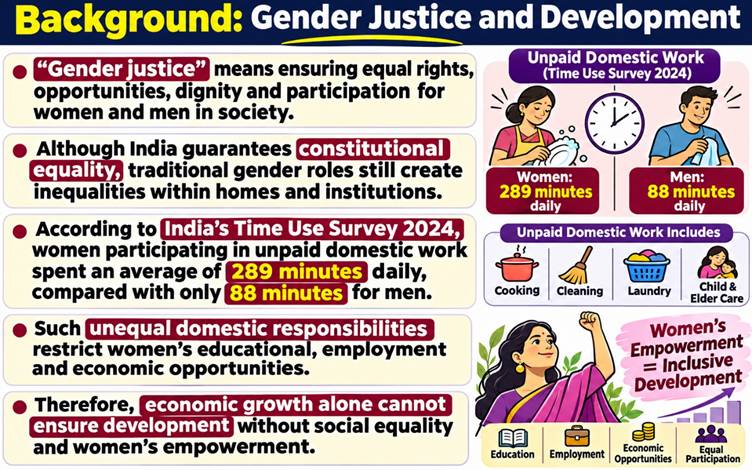
Three Major Barriers to Gender Justice
Gender inequality in India persists through three interconnected challenges: unequal responsibilities within families, inadequate protection against violence and limited participation in employment and decision-making institutions.
1. Inequality Begins at Home
- Unequal domestic responsibilities: Women disproportionately perform childcare, cooking and household work without financial recognition.
- Educational inequality: Girls may be expected to assist with household chores, limiting their educational opportunities.
- Economic dependence: Unpaid care responsibilities restrict women’s participation in paid employment.
2. Violence Against Women
- Crime statistics: NCRB recorded approximately 4.48 lakh crimes against women in 2023, with a crime rate of 66.2 per lakh female population.
- Domestic violence: Cruelty by husbands or relatives accounted for 29.8% of registered cases.
- Institutional weaknesses: Inadequate policing, delayed investigations and insufficient victim protection weaken access to justice.
- Low female representation in policing can discourage victims from reporting sensitive offences.
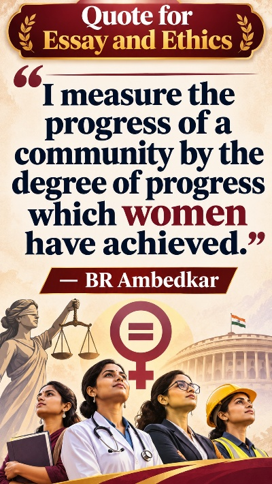
3. Inadequate Economic and Institutional Representation
- Economic participation: Women’s educational achievements have not translated into proportionate employment opportunities.
- Global Gender Gap Report 2025: India ranked 131st among 148 countries.
- Underrepresentation: Women remain inadequately represented in policing, judiciary, bureaucracy, corporate leadership and politics.
- Limited influence: Token representation rarely transforms institutional decision-making.
Way Forward: A Three-Part Gender Compact
- Equality at home: Promote shared domestic responsibilities, equal education and recognition of unpaid care work.
- Safety and justice: Strengthen policing, victim protection, speedy trials and enforcement of protective laws.
- Meaningful representation: Improve women’s recruitment, retention, promotion and leadership across institutions.
Conclusion
Gender justice is not merely an outcome of development but an essential condition for sustainable and inclusive development. Women must participate equally in shaping India’s economic and social progress.
Source: (The New Indian Express)
La Excellence IAS Academy, the best IAS coaching in Hyderabad, known for delivering quality content and conceptual clarity for UPSC 2026 preparation.
FOLLOW US ON:
◉ YouTube: https://www.youtube.com/@CivilsPrepTeam
◉ Facebook: https://www.facebook.com/LaExcellenceIAS
◉ Instagram: https://www.instagram.com/laexcellenceiasacademy/
GET IN TOUCH:
Contact us at info@laex.in, https://laex.in/contact-us/
or Call us @ +91 9052 29 2929, +91 9052 99 2929, +91 9154 24 2140
OUR BRANCHES:
Head Office: H No: 1-10-225A, Beside AEVA Fertility Center, Ashok Nagar Extension, VV Giri Nagar, Ashok Nagar, Hyderabad, 500020
Madhapur: Flat no: 301, survey no 58-60, Guttala begumpet Madhapur metro pillar: 1524, Rangareddy Hyderabad, Telangana 500081
Bangalore: Plot No: 99, 2nd floor, 80 Feet Road, Beside Poorvika Mobiles, Chandra Layout, Attiguppe, Near Vijaya Nagara, Bengaluru, 560040