
Paper: GS – II, Subject: International Relations, Topic: India and Its Neighborhood, Issue: Evolving China’s Economy Model.
Context:
In 2025, Chinese economy demonstrated resilience, exceeding 140 trillion yuan (approximately $20 trillion) with a 5% year-on-year increase. This growth is driven by a combination of factors, with a notable shift in the internal structure:
Key Highlights:
- Domestic Demand as the Primary Engine: Final consumption expenditure contributed 52% to economic growth, highlighting the increasing importance of domestic consumption. While some may perceive “insufficient consumption” due to lower prices compared to the global average, China’s physical consumption ranks among the world’s top countries.
- Resilient Exports: Exports of goods and services contributed 32.7% to economic growth, acting as a key booster.
- High-tech product exports grew by as much as 13.2% throughout the year.
- Exports to major markets such as ASEAN and the European Union maintained stable growth.
- Transformation of Growth Engines: Gross capital formation contributed 15.3% to growth, indicating a shift from relying on investment and exports to a model led by domestic consumption, with export and innovation adding impetus.
- Breakthroughs in cutting-edge fields such as AI, quantum technology, and brain-computer interfaces.
- Rapid growth in high-end manufacturing, including servers and industrial robots.
- Flourishing green industries such as renewable electricity and clean energy.
Why Export Production Capacity?
China is not exporting “overcapacity,” but rather high-quality production capacity and advanced solutions that are widely welcomed by developing countries.
- No “Overcapacity” in China: In 2025, the capacity utilization rate of China’s above-designated-size industry stood at 74.4%, equivalent to that of the U.S. and the EU across all sectors.
- Global Competitiveness: The competitiveness of Chinese products stems from long-term, high-intensity R&D investment, robust domestic competition, and the most comprehensive industrial system, rather than subsidies or dumping.
- Real Demand from the Global Market: China’s expanding production capacity is driven by genuine global demand, with many developing countries using high-quality Chinese equipment and technology to build infrastructure, support energy transition, and advance industrialization.
Mitigating India’s Trade Deficit with China:
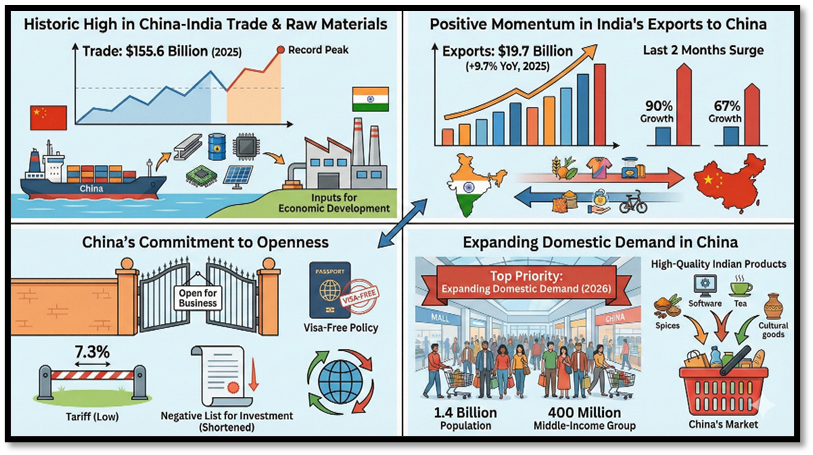
China’s evolving economic model reflects a transition towards quality-driven, sustainable growth aligned with global demand. For India, calibrated engagement focused on technology, market access, and strategic cooperation can convert trade asymmetries into shared development gains and strengthen Asia’s economic future.
Source: (The Hindu)
La Excellence IAS Academy, the best IAS coaching in Hyderabad, known for delivering quality content and conceptual clarity for UPSC 2026 preparation.
FOLLOW US ON:
◉ YouTube : https://www.youtube.com/@CivilsPrepTeam
◉ Facebook: https://www.facebook.com/LaExcellenceIAS
◉ Instagram: https://www.instagram.com/laexcellenceiasacademy/
GET IN TOUCH:
Contact us at info@laex.in, https://laex.in/contact-us/
or Call us @ +91 9052 29 2929, +91 9052 99 2929, +91 9154 24 2140
OUR BRANCHES:
Head Office: H No: 1-10-225A, Beside AEVA Fertility Center, Ashok Nagar Extension, VV Giri Nagar, Ashok Nagar, Hyderabad, 500020
Madhapur: Flat no: 301, survey no 58-60, Guttala begumpet Madhapur metro pillar: 1524, Rangareddy Hyderabad, Telangana 500081
Bangalore: Plot No: 99, 2nd floor, 80 Feet Road, Beside Poorvika Mobiles, Chandra Layout, Attiguppe, Near Vijaya Nagara, Bengaluru, 560040