
Paper: GS – III, Subject: Economy, Topic: Trade and External sector, Issue: Rupee Depreciation: Managing Stability.
Context:
The Indian rupee has come under sustained depreciation pressure against the US dollar due to global and domestic macroeconomic factors, posing a policy challenge for the Reserve Bank of India (RBI) to balance exchange rate stability, capital flows, and macroeconomic fundamentals.
Key Takeaways:
BACKGROUND:
- Exchange rate reflects value of domestic currency against foreign currencies, influenced by trade balance, capital flows, and monetary policy.
- India follows a managed float regime where RBI actively intervenes to curb excessive volatility. Under normal circumstances, RBI will not intervene (it will let the value float).
- Recent trend: Rupee depreciated beyond 95 per dollar; fell about 9.6% in 2025–26.
- Forex reserves of India and capital inflows from outside into India are the usual key buffers in such circumstances;
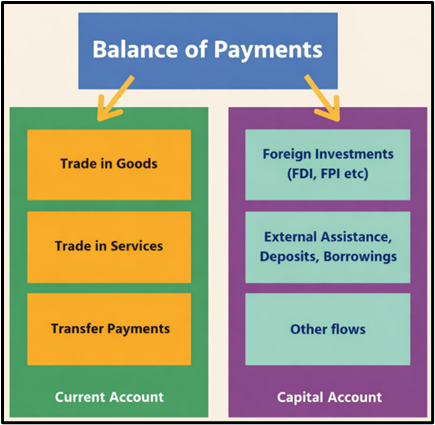
- India’s rising Current Account Deficit (CAD) also reflects external vulnerability.
CORE ANALYSIS:
Key drivers of current Rupee depreciation:
- Rising crude oil prices (around $113.5/barrel) increase import bill of India and widen CAD by 30–40 basis points.
- Weak capital inflows: High FPI outflows ($13.6 billion) and sharp fall in FDI (to $1.6 billion in April–January).
- Global dollar strengthening and synchronized currency declines across Asian economies.
External sector implications:
- Higher import costs fuel inflation in the Country and strain fiscal stability.
- Usually, Importers lose and Exporters gain if Rupee depreciates. However, currently Export gains are also limited despite weaker rupee due to global demand slowdown.
RBI interventions:
- Imposition of cap on banks’ forex positions to curb speculative pressure.
- Active forex market intervention reflected in fall of reserves from $575 billion to $557 billion.
- Rising net short dollar positions indicate forward market operations.
Policy dilemma:
- Excessive intervention depletes reserves and distorts market signals.
- Allowing free fall risks inflation, external imbalance, and investor confidence erosion.
Strategic responses: (Choices before India)
- Use of US Federal Reserve’s FIMA facility to access dollar liquidity if needed.
- Emphasis on exchange rate as a shock absorber rather than a fixed target.
- Need to revive capital inflows and reduce oil dependency.
WAY FORWARD:
- Maintain calibrated RBI intervention to manage volatility, not defend levels.
- Strengthen forex reserves through stable capital inflows and export diversification.
- Reduce oil import dependence via energy transition.
- Deepen domestic financial markets to reduce external vulnerability.
- Ensure macroeconomic stability to retain investor confidence.
UPSC SYLLABUS LINKAGE -GS PAPER III (Economy – external sector; exchange rate management)
Source: (The Indian Express)
La Excellence IAS Academy, the best IAS coaching in Hyderabad, known for delivering quality content and conceptual clarity for UPSC 2026 preparation.
FOLLOW US ON:
◉ YouTube : https://www.youtube.com/@CivilsPrepTeam
◉ Facebook: https://www.facebook.com/LaExcellenceIAS
◉ Instagram: https://www.instagram.com/laexcellenceiasacademy/
GET IN TOUCH:
Contact us at info@laex.in, https://laex.in/contact-us/
or Call us @ +91 9052 29 2929, +91 9052 99 2929, +91 9154 24 2140
OUR BRANCHES:
Head Office: H No: 1-10-225A, Beside AEVA Fertility Center, Ashok Nagar Extension, VV Giri Nagar, Ashok Nagar, Hyderabad, 500020
Madhapur: Flat no: 301, survey no 58-60, Guttala begumpet Madhapur metro pillar: 1524, Rangareddy Hyderabad, Telangana 500081
Bangalore: Plot No: 99, 2nd floor, 80 Feet Road, Beside Poorvika Mobiles, Chandra Layout, Attiguppe, Near Vijaya Nagara, Bengaluru, 560040