
Paper: GS – III, Subject: Science and Technology, Topic: Computer and ICT, Issue: V2V technology India.
Context:
India is planning to introduce Vehicle-to-Vehicle (V2V) communication to improve road safety amid rising accidents. However, concerns have emerged that without adequate road infrastructure, interoperability, and institutional readiness, such advanced technologies may deliver limited benefits.
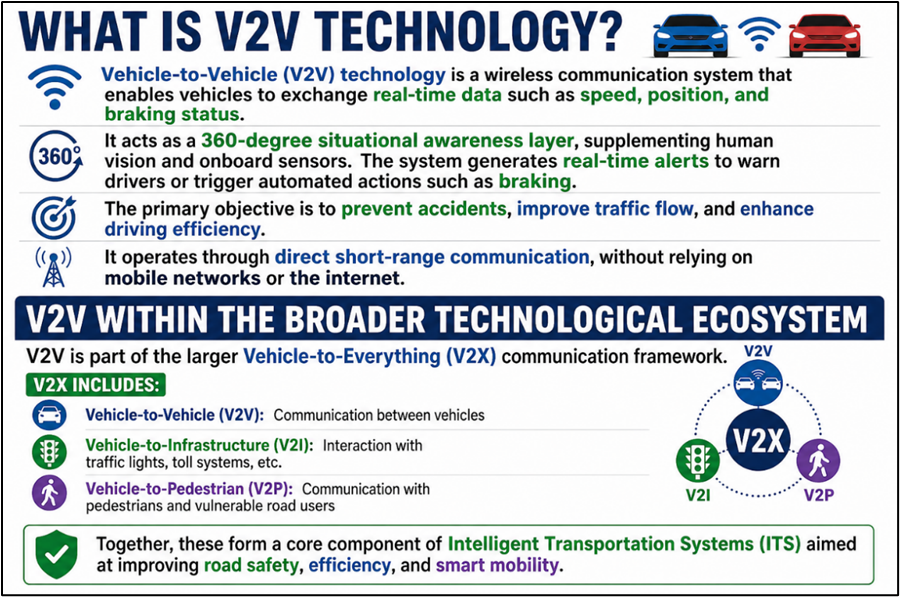
Key Takeaways:
Core Issue:
- India is attempting to deploy advanced technological solutions like V2V before addressing fundamental gaps in road infrastructure, planning, and enforcement.
- This reflects a classic “cart before the horse” problem, where technology adoption precedes systemic readiness.
- Rising road accidents and recent Supreme Court observations have increased urgency, but structural deficiencies persist.
How V2V Technology Works:
- Vehicles continuously broadcast Basic Safety Messages (BSMs) containing movement data.
- Communication occurs within a short range (around 300 metres) using the 5.9 GHz spectrum.
- It functions through an ad hoc mesh network, enabling direct and instantaneous interaction between vehicles.
- Two key technological standards are used:
- DSRC (Dedicated Short-Range Communication): Wi-Fi based standard
- C-V2X (Cellular Vehicle-to-Everything): 5G-based advanced system
Potential Benefits of V2V:
A. Road Safety Enhancement:
- Detects hazards beyond line of sight, such as around corners or behind obstacles.
- Provides early warnings for sudden braking or collision risks.
- Can significantly reduce accidents and fatalities.
B. Traffic Efficiency:
- Enables smoother traffic flow by maintaining optimal speed and spacing.
- Reduces congestion and the “accordion effect” in traffic jams.
- Facilitates platooning, improving fuel efficiency and road capacity.
C. Support for Autonomous Driving:
- Acts as a critical input in sensor fusion, complementing LiDAR, radar, and cameras.
- Enhances decision-making capabilities of self-driving vehicles.
Concerns and Challenges:
A. Infrastructure Deficit:
- Poor road design, lack of proper routing, and weak traffic management systems limit effectiveness.
- Mixed traffic conditions (two-wheelers, pedestrians, non-motorised transport) complicate implementation.
B. Lack of Interoperability and Backend Systems
- India currently lacks the digital ecosystem required to operationalise V2V at scale.
- Standards (DSRC vs C-V2X) are yet to be finalised, creating uncertainty.
C. High-Cost Burden:
- Additional costs for hardware, tracking devices, and compliance fall on vehicle owners.
- Absence of subsidies or competitive markets increases financial barriers.
D. User Adaptation Issues:
- Drivers, especially in commercial segments, may not be trained to interpret system alerts.
- Human-machine interface challenges could reduce effectiveness.
E. Cybersecurity Risks:
- Possibility of malicious actors sending false signals (e.g., fake braking alerts).
- Lack of robust encryption and security protocols increases vulnerability.
F. Network Limitations:
- Potential congestion in communication channels (5.9 GHz band).
- Risk of data packet loss affecting reliability.
Broader Governance and Policy Concerns:
- Technology-driven solutions are being prioritised without parallel investment in physical infrastructure.
- The Supreme Court has emphasised the State’s duty to ensure road safety as part of the Right to Life.
- The approach risks low returns on high-cost investments if foundational gaps remain unaddressed.
Conclusion/Way Forward:
- While V2V offers significant potential for safer and more efficient mobility, its success depends on supporting infrastructure, interoperability, and user readiness.
- A phased and integrated approach is essential, combining road infrastructure upgrades, standardisation across technologies, cybersecurity safeguards, and driver training.
- V2V must be implemented as part of a broader ITS and V2X ecosystem, ensuring that technological adoption complements, rather than substitutes, foundational transport system improvements.
La Excellence IAS Academy, the best IAS coaching in Hyderabad, known for delivering quality content and conceptual clarity for UPSC 2026 preparation.
FOLLOW US ON:
◉ YouTube : https://www.youtube.com/@CivilsPrepTeam
◉ Facebook: https://www.facebook.com/LaExcellenceIAS
◉ Instagram: https://www.instagram.com/laexcellenceiasacademy/
GET IN TOUCH:
Contact us at info@laex.in, https://laex.in/contact-us/
or Call us @ +91 9052 29 2929, +91 9052 99 2929, +91 9154 24 2140
OUR BRANCHES:
Head Office: H No: 1-10-225A, Beside AEVA Fertility Center, Ashok Nagar Extension, VV Giri Nagar, Ashok Nagar, Hyderabad, 500020
Madhapur: Flat no: 301, survey no 58-60, Guttala begumpet Madhapur metro pillar: 1524, Rangareddy Hyderabad, Telangana 500081
Bangalore: Plot No: 99, 2nd floor, 80 Feet Road, Beside Poorvika Mobiles, Chandra Layout, Attiguppe, Near Vijaya Nagara, Bengaluru, 560040