
Paper: GS – II, Subject: International Relations, Topic: India’s relations with major powers, Issue: UAE OPEC exit.
Context:
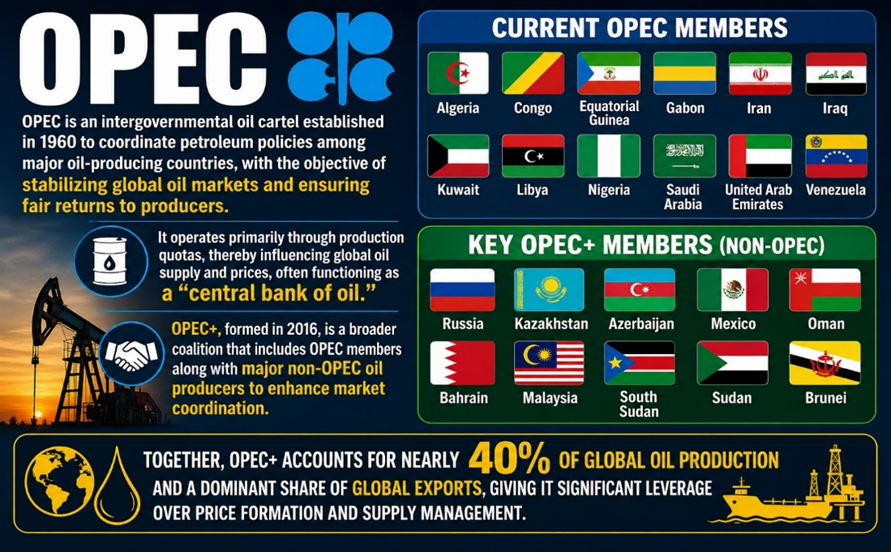
The decision of the United Arab Emirates (UAE) to exit the Organization of the Petroleum Exporting Countries marks a significant shift in global energy governance, reflecting tensions between collective cartel discipline and national economic strategies. The development has implications for oil price dynamics, geopolitical alignments, and energy security for major importers such as India.
Key Takeaways:
Reasons for UAE’s Exit from OPEC:
- Production Constraints and Capacity Utilization:
- OPEC-imposed quotas restrict the UAE’s ability to fully utilize its production capacity, estimated at nearly 5 million barrels per day.
- The UAE seeks to maximize output to capture greater market share.
- Strategic Economic Diversification:
- The UAE is transitioning towards a post-oil economy (technology, finance, services), requiring higher immediate oil revenues to fund structural transformation.
- Anticipation of Peak Oil Demand:
- With the global shift toward renewable energy, the UAE aims to monetize hydrocarbon reserves rapidly before demand structurally declines.
- Low-Cost Production Advantage:
- The UAE enjoys relatively low extraction costs, enabling it to remain competitive even under lower price regimes and incentivizing higher production.
- Geopolitical Considerations and Strategic Autonomy:
- OPEC decision-making is consensus-driven, including members like Iran, which constrains flexibility.
- Regional tensions, particularly around the Strait of Hormuz, encourage the UAE to pursue independent energy and security strategies.
- Desire for Independent Energy Diplomacy:
- Exit allows the UAE to form bilateral energy partnerships and deploy oil policy as an instrument of national strategy rather than collective cartel policy.
Impact on the Global Oil Market and International System:
- Weakening of Cartel Cohesion:
- The exit of a significant producer undermines OPEC’s collective bargaining strength and signals fragmentation within the cartel.
- Shift Towards Competitive Market Dynamics:
- Increased independent production may dilute coordinated supply cuts, leading to a more market-driven pricing mechanism.
- Downward Pressure on Oil Prices (Long Term):
- Higher supply from UAE and potential imitation by other producers could exert sustained downward pressure on global oil prices.
- Increased Price Volatility:
- Reduced coordination among major producers may lead to supply-demand mismatches, amplifying price fluctuations.
- Geopolitical Reconfiguration:
- The move reflects a broader transition from multilateral energy governance to state-centric energy strategies, intensifying competition among producers.
- Implications for Energy Transition:
- Lower oil prices may slow down global energy transition efforts by making fossil fuels relatively more attractive in the short term.
Impact on India:
- Reduction in Import Bill:
- As a major oil importer (≈85–90% dependence), India benefits directly from lower global oil prices through reduced import expenditure.
- Macroeconomic Stability:
- Lower oil prices contribute to reduced inflation, improved fiscal balance, and enhanced current account stability.
- Enhanced Energy Security:
- Increased supply diversity and weakening of cartel control improve India’s bargaining position and access to competitive oil sources.
- Strategic Opportunity for Diversification:
- India can leverage competitive pricing to diversify supply sources and strengthen strategic petroleum reserves.
- Potential Risk of Volatility:
- Increased global price fluctuations may complicate long-term energy planning and pricing strategies.
Conclusion:
The UAE’s exit from OPEC represents a structural shift from coordinated cartel-based oil governance to competitive, state-driven energy strategies. While it may weaken OPEC’s traditional influence, it simultaneously accelerates the transformation of global energy markets toward greater fragmentation and volatility, with mixed but largely beneficial implications for energy-importing economies like India.
La Excellence IAS Academy, the best IAS coaching in Hyderabad, known for delivering quality content and conceptual clarity for UPSC 2026 preparation.
FOLLOW US ON:
◉ YouTube : https://www.youtube.com/@CivilsPrepTeam
◉ Facebook: https://www.facebook.com/LaExcellenceIAS
◉ Instagram: https://www.instagram.com/laexcellenceiasacademy/
GET IN TOUCH:
Contact us at info@laex.in, https://laex.in/contact-us/
or Call us @ +91 9052 29 2929, +91 9052 99 2929, +91 9154 24 2140
OUR BRANCHES:
Head Office: H No: 1-10-225A, Beside AEVA Fertility Center, Ashok Nagar Extension, VV Giri Nagar, Ashok Nagar, Hyderabad, 500020
Madhapur: Flat no: 301, survey no 58-60, Guttala begumpet Madhapur metro pillar: 1524, Rangareddy Hyderabad, Telangana 500081
Bangalore: Plot No: 99, 2nd floor, 80 Feet Road, Beside Poorvika Mobiles, Chandra Layout, Attiguppe, Near Vijaya Nagara, Bengaluru, 560040