
Paper: GS – III, Subject: Environment and Ecology, Topic: Climate Change, Issue: Climate Conference.
Context:
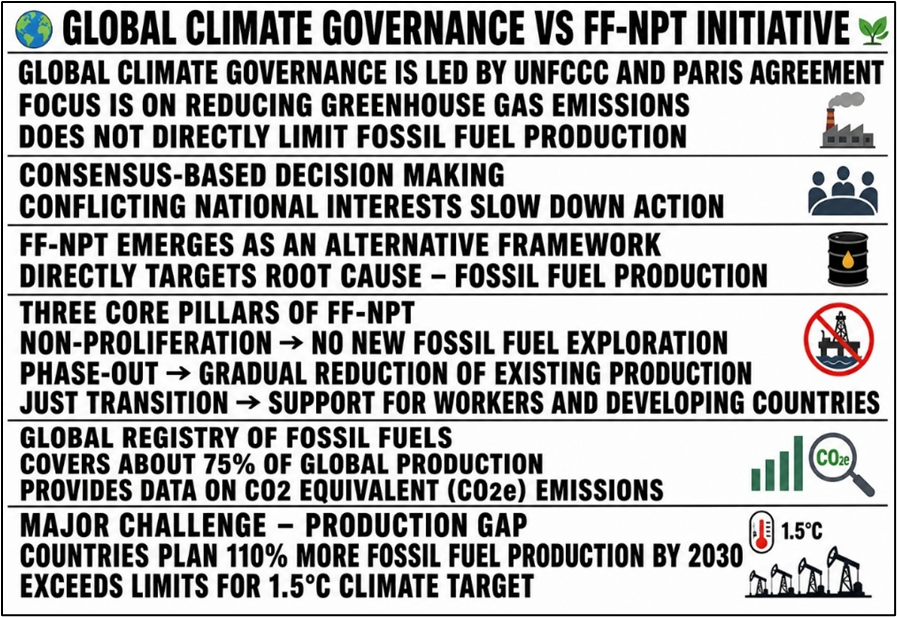
A climate conference held in Santa Marta, Colombia (2026) brought together 50+ countries to push for national roadmaps to phase out fossil fuels, reflecting frustration with slow UN climate negotiations. The initiative is closely linked to the broader Fossil Fuel Non-Proliferation Treaty (FF-NPT) movement.
Key Takeaways:
Background:
Explanation:
1. Emergence & Nature of Santa Marta Conference:
- The Santa Marta conference reflects a shift from slow, consensus-based UNFCCC negotiations to faster, action-oriented coalitions of willing countries.
- It is formally linked to the FF-NPT initiative, acting as the first in a series of efforts to build a global framework for phasing out fossil fuels.
- By operating outside the UN system, it avoids negotiation deadlocks and enables quicker policy direction.
2. Key Outcomes of the Conference:
- Participating countries agreed to prepare national roadmaps for reducing and eventually ending fossil fuel use.
- Some countries (e.g., France) indicated clear timelines (2030–2050) for phasing out oil and gas.
- A major focus is on aligning economic systems (trade and finance) with climate goals (decarbonisation), signalling a move toward policy integration.
3. Significance of the Initiative:
- Countries involved represent around 50% of global GDP, giving the initiative economic credibility.
- It brings together diverse actors (developed, developing, and small island nations), helping bridge traditional divides in climate negotiations.
- Marks a shift from symbolic climate pledges to implementation-oriented frameworks, addressing long-standing inaction.
4. Limitations Highlighted:
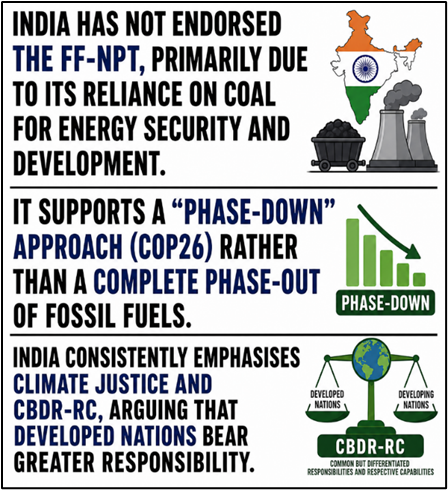
- The absence of major emitters like USA, China, and India significantly limits global impact.
- Since these countries contribute a large share of emissions, their non-participation weakens effectiveness.
- The coalition-based approach may also lead to fragmentation in global climate governance.
5. Structural Issues in Global Climate Action:
- UN climate processes often delay difficult decisions due to consensus requirements.
- They primarily focus on reducing emissions, while ignoring fossil fuel production itself.
- Many countries continue expanding fossil fuel production despite climate commitments, reflecting policy contradictions.
- There is also a lack of binding enforcement mechanisms and sufficient climate finance, especially for developing nations.
6. Need for Multi-Level Climate Governance:
- Climate change requires action beyond a single global institution like UNFCCC.
- Effective transition needs coordination among: Governments, Civil society & Private sector
- Hence, alliances of willing countries and actors are essential to accelerate progress.
Conclusion:
The Santa Marta conference signals a crucial shift from climate commitments to actionable frameworks, driven by initiatives like FF-NPT. However, meaningful global impact depends on including major emitters and ensuring equitable climate finance for a just transition.
Source: (The Indian Express, The Hindu, Live Mint)
La Excellence IAS Academy, the best IAS coaching in Hyderabad, known for delivering quality content and conceptual clarity for UPSC 2026 preparation.
FOLLOW US ON:
◉ YouTube : https://www.youtube.com/@CivilsPrepTeam
◉ Facebook: https://www.facebook.com/LaExcellenceIAS
◉ Instagram: https://www.instagram.com/laexcellenceiasacademy/
GET IN TOUCH:
Contact us at info@laex.in, https://laex.in/contact-us/
or Call us @ +91 9052 29 2929, +91 9052 99 2929, +91 9154 24 2140
OUR BRANCHES:
Head Office: H No: 1-10-225A, Beside AEVA Fertility Center, Ashok Nagar Extension, VV Giri Nagar, Ashok Nagar, Hyderabad, 500020
Madhapur: Flat no: 301, survey no 58-60, Guttala begumpet Madhapur metro pillar: 1524, Rangareddy Hyderabad, Telangana 500081
Bangalore: Plot No: 99, 2nd floor, 80 Feet Road, Beside Poorvika Mobiles, Chandra Layout, Attiguppe, Near Vijaya Nagara, Bengaluru, 560040