
Paper: GS – III, Subject: Economy, Topic: Trade and External sector, Issue: Rupee Depreciation: Fragile Five Revisited.
Context:
The Indian rupee has recently depreciated sharply (around 12% over the past year), raising concerns about a possible return to the 2013 “Fragile Five” scenario, when India faced currency instability due to external imbalances.
Key Takeaways:
Background:
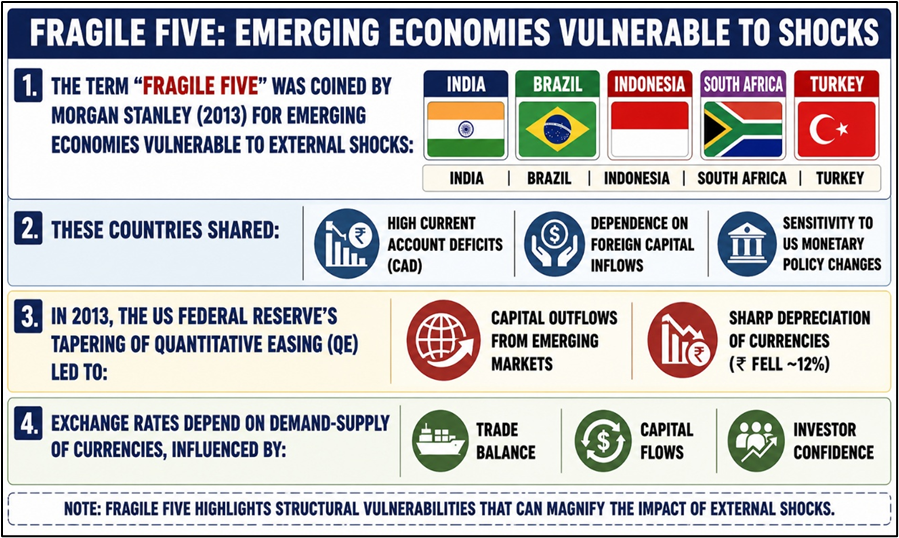
Explanation:
1. Current Rupee Weakness (2025–26):
Rupee has depreciated ~12% in the last 12 months, unusually high compared to normal 3–4% yearly decline
Recently touched historic lows (~₹95/$)
Indicates external sector stress
2. Comparison with 2013 Crisis:
Similarity:
Currency depreciation driven by external imbalances
Pressure due to capital outflows and global monetary tightening
Difference:
2013 fall was sudden and sharp (crisis-like)
2026 fall is more gradual and spread out
Thus, current situation = stress but not full-blown crisis
3. Balance of Payments (BoP) Concerns:
BoP has two components:
Current Account → trade in goods & services
Capital Account → foreign investments
Present issue: India faces deficits in both accounts simultaneously
This is risky because:
CAD → more imports than exports
Capital outflow → less foreign money coming in
Together → pressure on rupee + forex reserves
4. Causes of Current Weakness:
(a) Current Account Deficit
Weak export growth due to global slowdown
High import dependence (especially oil, electronics)
Reduced competitiveness in manufacturing
(b) Capital Account Issues
Decline in foreign portfolio investment (FPI)
Weak FDI inflows in manufacturing
Indians investing more abroad → capital outflow
5. Why Situation is Not Exactly 2013 Yet:
Stronger forex reserves buffer
Better macroeconomic management
More stable financial system
Controlled inflation compared to earlier
6. Risks Going Forward:
Continued depreciation can:
Increase import costs (inflation)
Widen trade deficit
Reduce investor confidence
If both deficits persist → possibility of external sector vulnerability
Conclusion:
While the rupee’s depreciation shows signs of external stress similar to 2013, India’s stronger macroeconomic fundamentals prevent an immediate crisis. However, persistent twin deficits and weak capital inflows could increase vulnerability if not addressed.
Source: (The Indian Express)
La Excellence IAS Academy, the best IAS coaching in Hyderabad, known for delivering quality content and conceptual clarity for UPSC 2026 preparation.
FOLLOW US ON:
◉ YouTube : https://www.youtube.com/@CivilsPrepTeam
◉ Facebook: https://www.facebook.com/LaExcellenceIAS
◉ Instagram: https://www.instagram.com/laexcellenceiasacademy/
GET IN TOUCH:
Contact us at info@laex.in, https://laex.in/contact-us/
or Call us @ +91 9052 29 2929, +91 9052 99 2929, +91 9154 24 2140
OUR BRANCHES:
Head Office: H No: 1-10-225A, Beside AEVA Fertility Center, Ashok Nagar Extension, VV Giri Nagar, Ashok Nagar, Hyderabad, 500020
Madhapur: Flat no: 301, survey no 58-60, Guttala begumpet Madhapur metro pillar: 1524, Rangareddy Hyderabad, Telangana 500081
Bangalore: Plot No: 99, 2nd floor, 80 Feet Road, Beside Poorvika Mobiles, Chandra Layout, Attiguppe, Near Vijaya Nagara, Bengaluru, 560040