
Paper: GS – IV, Subject: Ethics, Topic: Ethical Issues in International Relations and Funding, Issue: Treaty Ethics and Emotions in International Relations.
Context:
Recently, conflicts in West Asia and global reactions to civilian suffering have renewed debate on ethics in foreign policy. They show that military success alone cannot ensure legitimacy.
Key Takeaways:
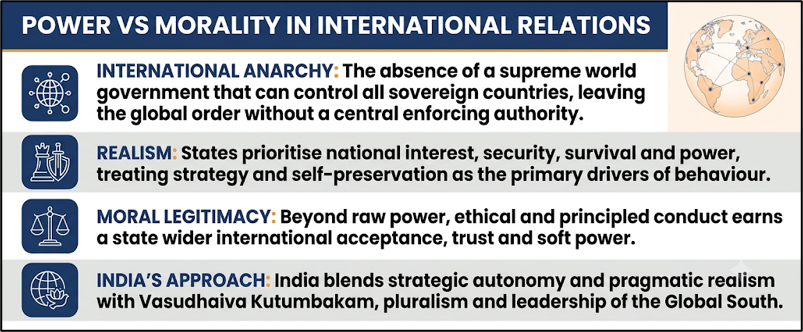
Explanation:
Why Ethics and Emotions Matter?
- Foreign policy is influenced not only by material interests but also by fear, grief, pride, anger and empathy.
- Leaders operate within societies shaped by public opinion, national identity, religion and memories of injustice.
- Military action may unexpectedly unite a divided society by creating nationalism, solidarity and a shared sense of victimhood.
Impact on International Legitimacy:
- Strategic success and moral legitimacy differ because an effective military operation may still appear unjust or disproportionate.
- Israel initially received sympathy after the October 2023 Hamas attacks, but civilian suffering in Gaza changed global opinion.
- Social media, artificial intelligence and instant communication circulate conflict images, increasing humanitarian pressure on governments.
- Therefore, battlefield superiority cannot protect a country’s reputation, soft power or diplomatic influence by itself.
Role of the Global South and India:
- The Non-Aligned Movement promoted sovereign equality, peaceful coexistence, anti-colonialism and a fairer international order.
| Moral capital is the trust, respect and credibility earned by a country or leader through consistent ethical and principled conduct. |
India combines strategic autonomy with Vasudhaiva Kutumbakam, meaning that the world should be viewed as one family.
- India’s democratic institutions, pluralism and anti-colonial legacy create moral capital alongside military capabilities.
- However, inconsistency between declared values and actual foreign-policy choices can weaken credibility among developing countries.
Way Forward:
- States should assess security gains alongside civilian harm, proportionality, international law and long-term public reactions.
- India should balance strategic interests with principled positions, humanitarian responsibility and support for peaceful dispute resolution.
- Domestic democracy and constitutional values must remain strong because international credibility often begins with conduct at home.
Conclusion:
Power and national interest remain essential in international relations, but they provide only a partial explanation. Ethical conduct, public emotions and moral legitimacy shape the durability of foreign-policy outcomes. India should combine strategic autonomy with consistent, humane and constitutionally grounded diplomacy.
Source: (The Hindu)
La Excellence IAS Academy, the best IAS coaching in Hyderabad, known for delivering quality content and conceptual clarity for UPSC 2026 preparation.
FOLLOW US ON:
◉ YouTube : https://www.youtube.com/@CivilsPrepTeam
◉ Facebook: https://www.facebook.com/LaExcellenceIAS
◉ Instagram: https://www.instagram.com/laexcellenceiasacademy/
GET IN TOUCH:
Contact us at info@laex.in, https://laex.in/contact-us/
or Call us @ +91 9052 29 2929, +91 9052 99 2929, +91 9154 24 2140
OUR BRANCHES:
Head Office: H No: 1-10-225A, Beside AEVA Fertility Center, Ashok Nagar Extension, VV Giri Nagar, Ashok Nagar, Hyderabad, 500020
Madhapur: Flat no: 301, survey no 58-60, Guttala begumpet Madhapur metro pillar: 1524, Rangareddy Hyderabad, Telangana 500081
Bangalore: Plot No: 99, 2nd floor, 80 Feet Road, Beside Poorvika Mobiles, Chandra Layout, Attiguppe, Near Vijaya Nagara, Bengaluru, 560040
Ethical Diplomacy: Power, Legitimacy and Global Order