
Paper: GS-II, Subject: Social Justice, Topic: Welfare of Vulnerable Sections, Issue: Persistence of Untouchability Despite Legal Safeguards.
Context
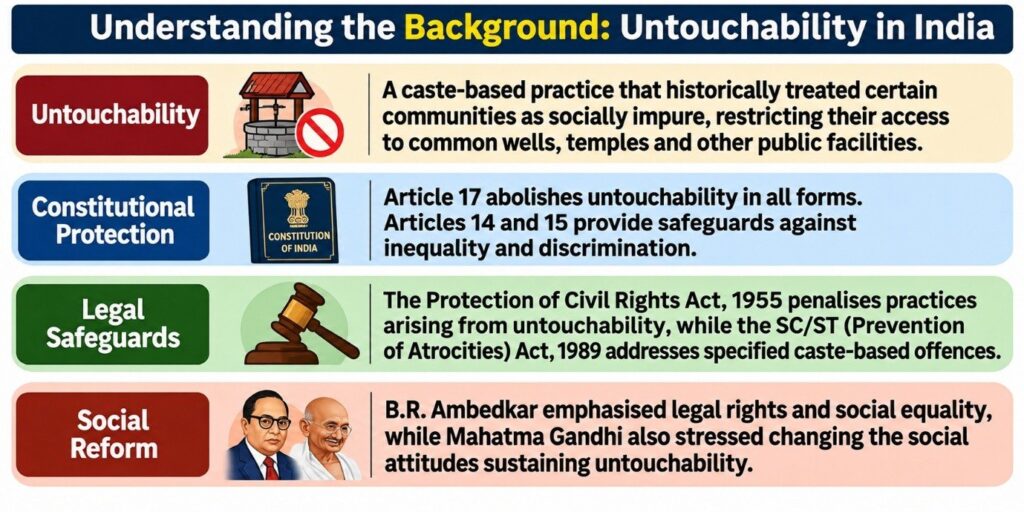
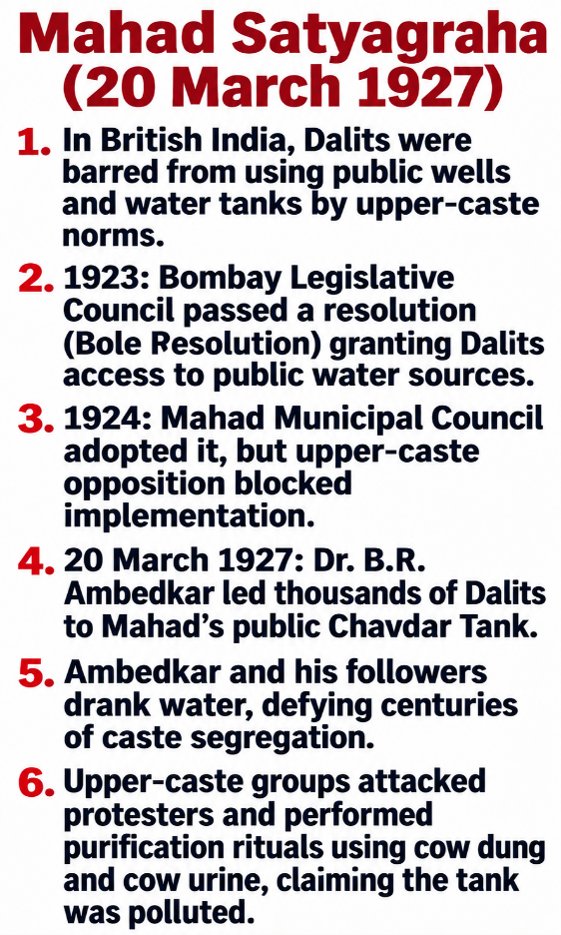
Recently, a “purification” ritual conducted after Congress president addressed a meeting in Uttarakhand triggered allegations of caste discrimination. The incident renewed debate over why untouchability persists despite constitutional and legal safeguards.
Explanation
Why Does Untouchability Persist Despite Legal Protection?
- Gap between law and society: Laws have reduced traditional practices of untouchability and improved Dalit participation in public life. However, deeply rooted caste prejudices continue to influence everyday behaviour.
- Changing forms of discrimination: Earlier practices included denying access to wells and temples. Today, discrimination may also involve social boycotts, humiliation and hostility towards Dalits achieving educational or economic advancement.
- Persistence of social attitudes: Political scientist Valerian Rodrigues argues that caste hierarchy remains embedded in social beliefs. Therefore, legal equality must translate into social equality, where everyone receives equal dignity in everyday life.
What Is Needed Beyond Legal Safeguards?
- Effective law enforcement: Criminal laws are essential for punishing atrocities. However, convictions require proof beyond reasonable doubt, making subtle forms of discrimination difficult to establish in court.
- Civil and institutional remedies: Lawyer Disha Wadekar emphasises that punishment alone is insufficient. Accessible complaint mechanisms, compensation and corrective measures can complement criminal laws in addressing discrimination.
- Inclusive social institutions: Schools, workplaces and public facilities must encourage interaction across castes. Inclusive education, teacher training and shared public spaces can help challenge discriminatory attitudes from childhood.
- Community participation: Local institutions and communities must actively promote equality and challenge caste-based exclusion, ensuring that social reform extends beyond legal enforcement.
Conclusion
Legal safeguards have significantly weakened untouchability, but eliminating it requires more than criminal punishment. Lasting social equality demands effective laws, inclusive institutions and changes in social attitudes, ensuring that constitutional rights become a reality in everyday life.
Source: (The Hindu)
La Excellence IAS Academy, the best IAS coaching in Hyderabad, known for delivering quality content and conceptual clarity for UPSC 2026 preparation.
FOLLOW US ON:
◉ YouTube : https://www.youtube.com/@CivilsPrepTeam
◉ Facebook: https://www.facebook.com/LaExcellenceIAS
◉ Instagram: https://www.instagram.com/laexcellenceiasacademy/
GET IN TOUCH:
Contact us at info@laex.in, https://laex.in/contact-us/
or Call us @ +91 9052 29 2929, +91 9052 99 2929, +91 9154 24 2140
OUR BRANCHES:
Head Office: H No: 1-10-225A, Beside AEVA Fertility Center, Ashok Nagar Extension, VV Giri Nagar, Ashok Nagar, Hyderabad, 500020
Madhapur: Flat no: 301, survey no 58-60, Guttala begumpet Madhapur metro pillar: 1524, Rangareddy Hyderabad, Telangana 500081
Bangalore: Plot No: 99, 2nd floor, 80 Feet Road, Beside Poorvika Mobiles, Chandra Layout, Attiguppe, Near Vijaya Nagara, Bengaluru, 560040