
Paper: GS-III | Subject: Science and Technology | Topic: Indigenous Technology | Issue: National Supercomputing Mission
Context
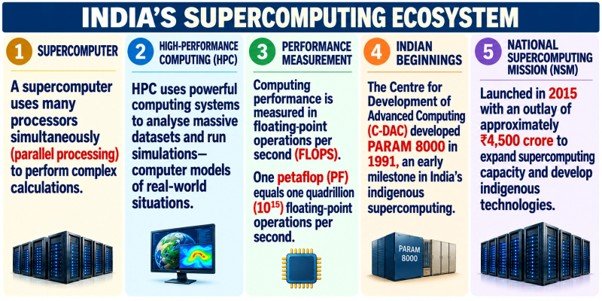
Recently, the government highlighted India’s progress under the National Supercomputing Mission (NSM), particularly the expansion of advanced computing infrastructure and indigenous technological capabilities. The initiative aims to strengthen scientific research and technological self-reliance.
Explanation
India’s Initiatives and Key Developments
- Need for supercomputing: Complex scientific problems involve enormous datasets and calculations, requiring processing capabilities beyond those of ordinary computers.
- Indigenous development: NSM follows a three-phase approach involving assembly, manufacturing, and design and manufacturing support to strengthen India’s domestic technological capabilities.
- Expanding capacity: By September 2026, India had installed 40 supercomputers with a combined capacity of 68 PF. The Mission targets 50 systems exceeding 123 PF.
- Domestic technologies: PARAM Rudra supercomputers use indigenous Rudra servers for calculations, high-speed interconnects for data exchange, cooling systems to prevent overheating and software to manage operations.
- Research accessibility: The National Knowledge Network (NKN) connects research institutions, enabling access to shared computing facilities. NSM has supported over 16,000 researchers across 400 institutions.
Importance and Applications
- Scientific research: Supercomputers analyse genetic information (genomics) and potential drug molecules, while supporting artificial intelligence, space science (astrophysics) and materials research.
- Disaster preparedness: They support flood forecasts up to two days ahead in the Mahanadi basin and forest-fire spread prediction in the Sikkim Himalayas.
- National significance: Indigenous supercomputing strengthens industrial competitiveness, strategic research and national security, while supporting scientific innovation and advanced technological development.
Challenges and Way Forward
- Challenges: High infrastructure costs, electricity consumption, dependence on advanced imported components and shortages of skilled professionals constrain further expansion.
- Way forward: India must develop energy-efficient systems, strengthen domestic manufacturing, expand technical training and improve computing access for smaller research institutions.
Conclusion
The National Supercomputing Mission goes beyond installing faster computers. By integrating indigenous technologies, skilled researchers and practical applications, India can address developmental challenges and strengthen its technological sovereignty.
Source: (PIB)
La Excellence IAS Academy, the best IAS coaching in Hyderabad, known for delivering quality content and conceptual clarity for UPSC 2026 preparation.
FOLLOW US ON:
◉ YouTube : https://www.youtube.com/@CivilsPrepTeam
◉ Facebook: https://www.facebook.com/LaExcellenceIAS
◉ Instagram: https://www.instagram.com/laexcellenceiasacademy/
GET IN TOUCH:
Contact us at info@laex.in, https://laex.in/contact-us/
or Call us @ +91 9052 29 2929, +91 9052 99 2929, +91 9154 24 2140
OUR BRANCHES:
Head Office: H No: 1-10-225A, Beside AEVA Fertility Center, Ashok Nagar Extension, VV Giri Nagar, Ashok Nagar, Hyderabad, 500020
Madhapur: Flat no: 301, survey no 58-60, Guttala begumpet Madhapur metro pillar: 1524, Rangareddy Hyderabad, Telangana 500081
Bangalore: Plot No: 99, 2nd floor, 80 Feet Road, Beside Poorvika Mobiles, Chandra Layout, Attiguppe, Near Vijaya Nagara, Bengaluru, 560040