
Paper: GS – I, Subject: Society and Social Justice, Topic: Population and associated issues, Issue: India’s Population Debate: From Malthusian Fear to Demographic Anxiety.
Context:
Recently, falling fertility, population ageing and possible depopulation have gained attention in India. These trends are often presented as a demographic crisis. However, they require careful analysis based on data, not fear.
Key Takeaways:
Explanation:
Is India Facing Depopulation?
- India’s population is likely to grow for some more decades.
- It may decline gradually later in the century. This is not an immediate population collapse.
- Some projections assume that educated women will continue having fewer children.
- Recent fertility data does not fully support this assumption.
Ageing, Labour Supply and Demographic Dividend:
- India’s elderly population will rise, but the child population will decline too.
- Hence, the working-age population may decline only slightly.
- India can still reap its demographic dividend if the large working-age population gets proper education, skills and jobs.
- AI, automation and higher female labour-force participation can further ease worker shortages.
Regional and Political Concerns:
- Southern states reduced fertility earlier than many northern states.
- This may reduce their political representation after delimitation.
- The concern is genuine because parliamentary seats depend on population.
- However, southern states also make a large economic contribution. Any solution must protect federal fairness.
Religious Population Fears:
- Muslim fertility is slightly higher than Hindu fertility.
- Yet fertility has declined in both communities. The gap is gradually narrowing.
- Claims of an imminent demographic takeover are not supported by evidence.
- Such claims can create unnecessary social tension.
Way Forward:
- The National Population Policy, 2000 should guide voluntary family planning, reproductive healthcare and informed choice.
- India must invest in health, education, skills and jobs to fully use its demographic dividend.
- The United Nations Population Fund (UNFPA) recommends protecting reproductive rights and avoiding coercive population measures.
- Future delimitation should be based on federal consultation. States that controlled population growth should not be unfairly penalised.
Conclusion:
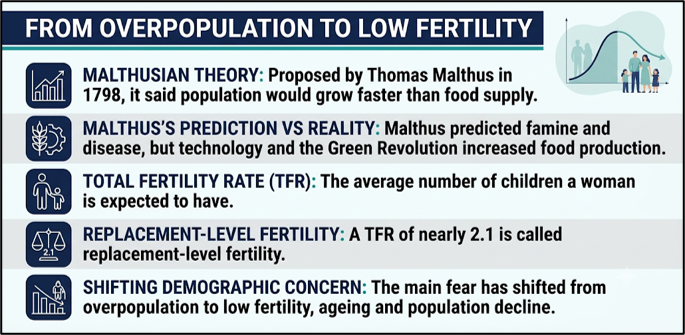
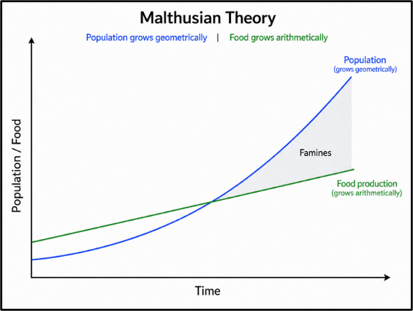
Malthusian predictions failed because they underestimated technology and human adaptation. Similar errors may occur when population decline is treated as an unavoidable disaster. India should use its demographic dividend while addressing ageing and regional imbalance through evidence-based and cooperative policies.
Source: (The Indian Express)
La Excellence IAS Academy, the best IAS coaching in Hyderabad, known for delivering quality content and conceptual clarity for UPSC 2026 preparation.
FOLLOW US ON:
◉ YouTube : https://www.youtube.com/@CivilsPrepTeam
◉ Facebook: https://www.facebook.com/LaExcellenceIAS
◉ Instagram: https://www.instagram.com/laexcellenceiasacademy/
GET IN TOUCH:
Contact us at info@laex.in, https://laex.in/contact-us/
or Call us @ +91 9052 29 2929, +91 9052 99 2929, +91 9154 24 2140
OUR BRANCHES:
Head Office: H No: 1-10-225A, Beside AEVA Fertility Center, Ashok Nagar Extension, VV Giri Nagar, Ashok Nagar, Hyderabad, 500020
Madhapur: Flat no: 301, survey no 58-60, Guttala begumpet Madhapur metro pillar: 1524, Rangareddy Hyderabad, Telangana 500081
Bangalore: Plot No: 99, 2nd floor, 80 Feet Road, Beside Poorvika Mobiles, Chandra Layout, Attiguppe, Near Vijaya Nagara, Bengaluru, 560040