
Paper: GS Paper III | Subject: Environment, Ecology and Disaster Management | Topic: Disaster Management (B16) | Issue: Drought Relief
1. Recent Context
Following the deficient Southwest Monsoon of 2026, Karnataka, Andhra Pradesh and Maharashtra declared drought-affected areas. Karnataka declared 217 of 240 taluks drought-hit, while Andhra Pradesh declared 388 of 688 mandals drought-hit. The affected States have sought additional Central assistance to address agricultural losses and water scarcity.
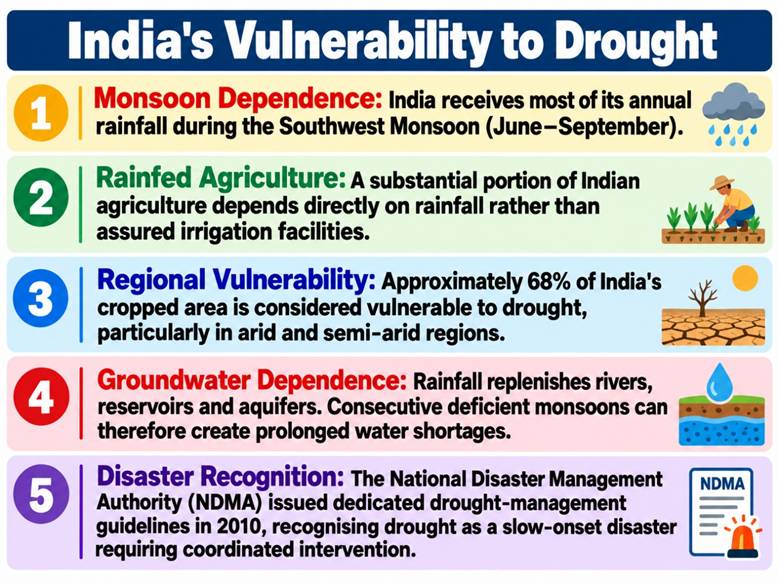
3. Understanding Drought
Drought refers to prolonged water scarcity resulting from inadequate rainfall and declining water availability.
It can develop through four interconnected stages:
- Meteorological Drought: Rainfall remains significantly below normal.
- Agricultural Drought: Insufficient soil moisture affects crop growth.
- Hydrological Drought: Water levels decline in rivers, reservoirs and groundwater.
- Socioeconomic Drought: Water shortages disrupt agriculture, employment, food security and livelihoods.
4. Major Causes
- Climatic: Monsoon failure, prolonged dry spells and El Niño-related rainfall variability.
- Environmental: Rising temperatures, climate change, deforestation and land degradation.
- Human-Induced: Groundwater overexploitation, inefficient irrigation and water-intensive cropping patterns.
5. Consequences
- Agricultural: Crop failures, declining productivity and livestock distress.
- Economic: Farmer indebtedness, reduced rural incomes and food inflation.
- Social: Distress migration, unemployment, malnutrition and increased burden on women.
- Environmental: Groundwater depletion, desertification and biodiversity loss.
6. Drought as a Disaster: Assessment and Relief
Unlike sudden disasters such as earthquakes, drought develops gradually, spreads across large geographical areas and can persist for months or years.
India follows a structured relief mechanism:
- Assessment: States examine rainfall, soil moisture, crop conditions and water availability under the Manual for Drought Management, 2016.
- Declaration: States officially notify affected areas based on drought severity.
- State Relief: The State Disaster Response Fund (SDRF) finances immediate relief measures.
- Central Assistance: An Inter-Ministerial Central Team (IMCT) assesses severe drought losses. Additional assistance may be approved from the National Disaster Response Fund (NDRF).
- Relief Measures: Crop-loss assistance, drinking water, fodder, employment support and agricultural loan restructuring.
7. Way Forward
- Promote drought-resistant crops, millets and micro-irrigation.
- Strengthen rainwater harvesting, watershed development and groundwater recharge.
- Expand crop insurance, early-warning systems and livelihood protection.
- Ensure timely Central assistance and sustainable water management.
Conclusion
Drought management must shift from short-term relief towards long-term climate resilience, integrating sustainable agriculture, water security, social protection and cooperative federalism.
Source: (The Hindu)
La Excellence IAS Academy, the best IAS coaching in Hyderabad, known for delivering quality content and conceptual clarity for UPSC 2026 preparation.
FOLLOW US ON:
◉ YouTube : https://www.youtube.com/@CivilsPrepTeam
◉ Facebook: https://www.facebook.com/LaExcellenceIAS
◉ Instagram: https://www.instagram.com/laexcellenceiasacademy/
GET IN TOUCH:
Contact us at info@laex.in, https://laex.in/contact-us/
or Call us @ +91 9052 29 2929, +91 9052 99 2929, +91 9154 24 2140
OUR BRANCHES:
Head Office: H No: 1-10-225A, Beside AEVA Fertility Center, Ashok Nagar Extension, VV Giri Nagar, Ashok Nagar, Hyderabad, 500020
Madhapur: Flat no: 301, survey no 58-60, Guttala begumpet Madhapur metro pillar: 1524, Rangareddy Hyderabad, Telangana 500081
Bangalore: Plot No: 99, 2nd floor, 80 Feet Road, Beside Poorvika Mobiles, Chandra Layout, Attiguppe, Near Vijaya Nagara, Bengaluru, 560040