
Paper: GS-III, Subject: Economy, Topic: Food Processing and Related Industries, Issue: Food Loss, Resource Efficiency and Circular Economy
Context
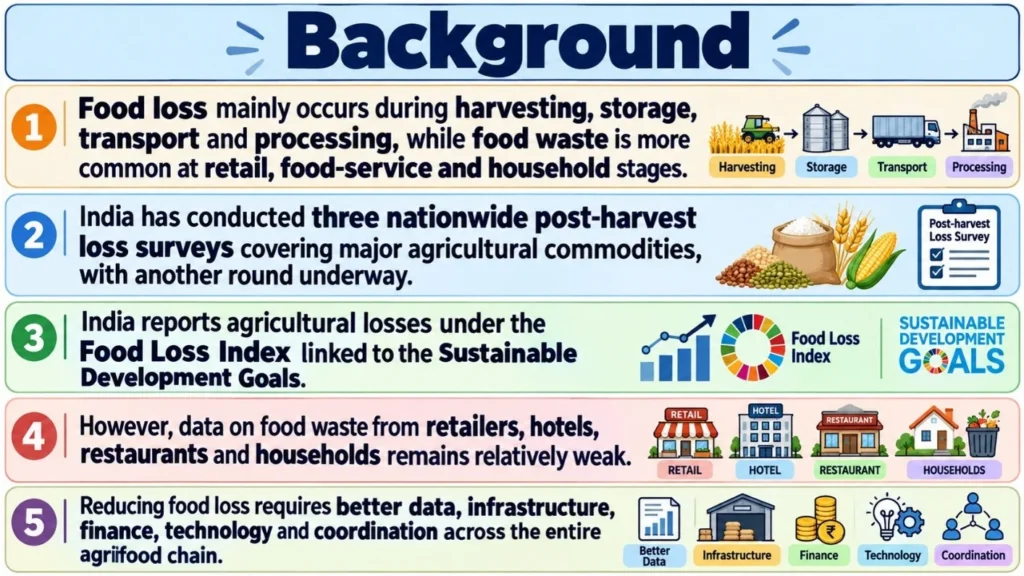
September 29 is observed as the International Day of Awareness of Food Loss and Waste. The occasion highlights the need to reduce food losses across farms, markets and households. For India, tackling food loss can deliver a triple gain – stronger food security, lower pressure on natural resources and reduced greenhouse-gas emissions.
Explanation
1. Why Food Loss Is a Bigger Problem Than It Appears
- When food is lost, the land, water, energy, fertilisers, labour and capital used to produce it are also wasted.
- Lower losses can improve food availability, nutrition and farmer incomes.
- Preventing organic waste from reaching landfills also reduces methane emissions, supporting climate goals.
2. Reducing Loss Across the Supply Chain
Important interventions include:
- Better storage and warehousing
- Scientific drying and moisture management
- Expanded cold-chain and cooling facilities
- Improved food processing and handling
- Digital traceability systems to track food movement and identify loss points
These technologies must remain affordable and accessible to farmers, producer organisations and small enterprises.
3. Wholesale Markets: An Overlooked Opportunity
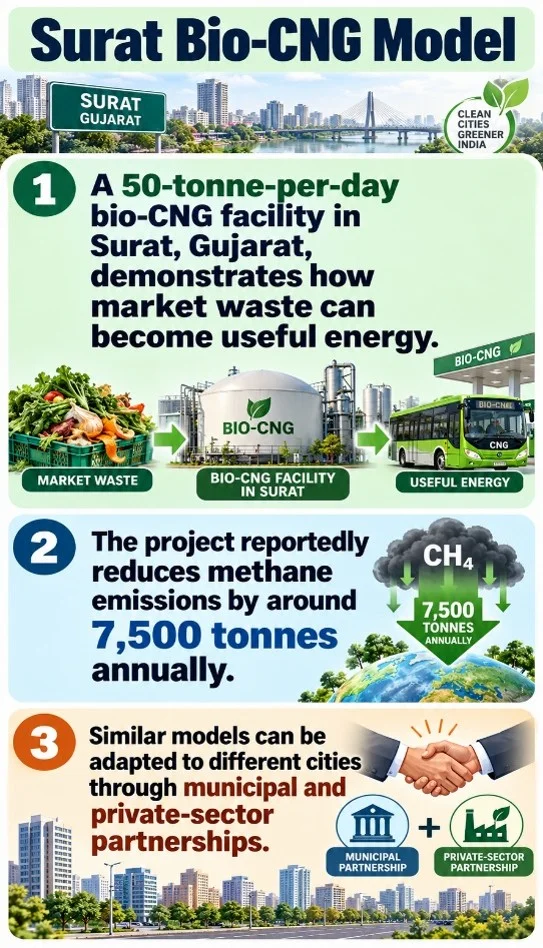
- Large agricultural wholesale markets can generate up to 100 tonnes of organic waste per day.
- Across India, such markets may generate around 3.5 million tonnes annually.
- Instead of being dumped in landfills, unavoidable organic waste can be converted into compost, biogas, bio-CNG or other useful products.
- Better segregation, collection and processing can turn urban food waste into an economic resource.
4. Investment and Circular Economy
- Investment should focus on food-loss hotspots through cold storage, drying, moisture control and energy-efficient infrastructure.
- Surplus edible food can be redistributed, while unavoidable waste can be converted into useful products.
- Financing such technologies can help small businesses participate in a circular agrifood economy.
Conclusion
India needs to move from isolated interventions to an integrated approach linking agriculture, food processing, urban waste management and climate action. Reducing food loss and waste can simultaneously improve food security, incomes, resource efficiency and environmental sustainability.
Source: (The Hindu)
La Excellence IAS Academy, the best IAS coaching in Hyderabad, known for delivering quality content and conceptual clarity for UPSC 2026 preparation.
FOLLOW US ON:
◉ YouTube : https://www.youtube.com/@CivilsPrepTeam
◉ Facebook: https://www.facebook.com/LaExcellenceIAS
◉ Instagram: https://www.instagram.com/laexcellenceiasacademy/
GET IN TOUCH:
Contact us at info@laex.in, https://laex.in/contact-us/
or Call us @ +91 9052 29 2929, +91 9052 99 2929, +91 9154 24 2140
OUR BRANCHES:
Head Office: H No: 1-10-225A, Beside AEVA Fertility Center, Ashok Nagar Extension, VV Giri Nagar, Ashok Nagar, Hyderabad, 500020
Madhapur: Flat no: 301, survey no 58-60, Guttala begumpet Madhapur metro pillar: 1524, Rangareddy Hyderabad, Telangana 500081
Bangalore: Plot No: 99, 2nd floor, 80 Feet Road, Beside Poorvika Mobiles, Chandra Layout, Attiguppe, Near Vijaya Nagara, Bengaluru, 560040