
Paper: GS-II, Subject: International Relations, Topic: India’s relations with major powers, Issue: US-China strategic recalibration
Context
The United Nations is facing growing strain from major-power rivalry, Security Council deadlock, financial pressures and the increasing use of economic and technological coercion outside multilateral institutions. For India, a weakening UN is significant because its global rise depends not only on national power, but also on access to credible and representative international institutions.
Explanation
1. What Did the Xi–Trump Summit Achieve?
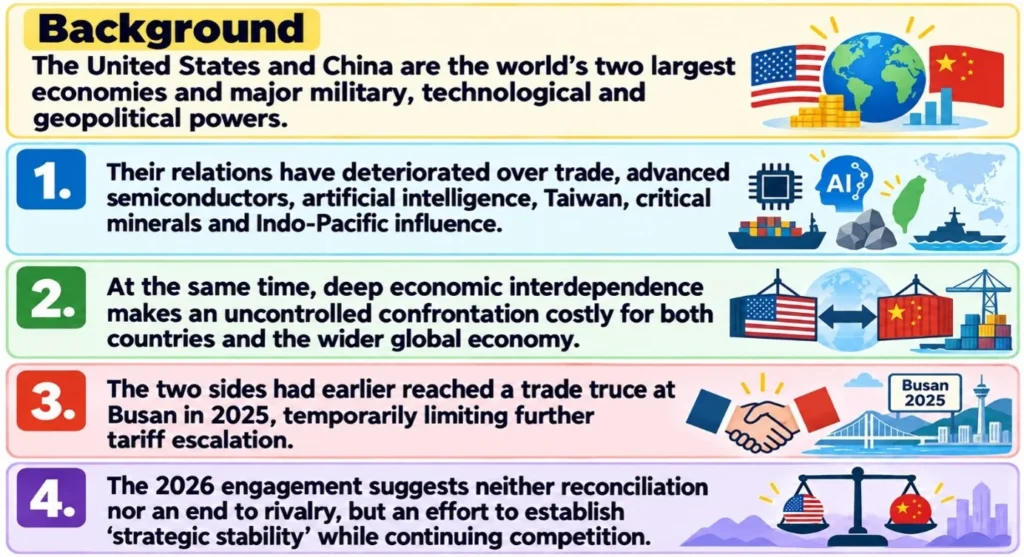
- The existing U.S.–China trade truce was extended by another two months, reducing the immediate risk of renewed tariff escalation.
- Both sides operationalised mechanisms for discussing trade and investment, while continuing negotiations over market access and critical supplies.
- They also established a dialogue on advanced AI-related risks and a communication channel for AI incidents.
- However, fundamental disagreements concerning Taiwan, semiconductors, rare-earth minerals and technological controls remain unresolved.
2. From Confrontation to “Managed Competition”
- Strategic competition means both powers continue competing for economic, technological and geopolitical influence.
- Strategic stability means simultaneously creating safeguards so that this rivalry does not repeatedly escalate into severe economic or military crises.
- Thus, engagement should not be confused with friendship; both sides can compete intensely while keeping diplomatic communication open.
- Growing mutual vulnerabilities also encourage restraint: Washington depends on critical-mineral supply chains, while Beijing remains exposed to American technological restrictions.
3. Technology Is Becoming a Strategic Battlefield
- Advanced AI, semiconductor chips and computing capabilities increasingly affect economic competitiveness as well as national security.
- The U.S. continues restricting Chinese access to certain advanced technologies, while China possesses considerable leverage in rare-earth processing and critical-mineral supply chains.
- The new dialogue can therefore reduce accidental escalation without eliminating the underlying technological rivalry.
4. Why Does This Matter for India?
- India cannot automatically assume that greater U.S.–China rivalry will always translate into greater American strategic support for India.
- Washington may simultaneously cooperate with India in the Indo-Pacific while pursuing selective accommodation with Beijing where American interests require it.
- This reinforces the importance of strategic autonomy, diversified partnerships and issue-based cooperation for India.
- India must also strengthen domestic capabilities in semiconductors, critical minerals, defence manufacturing, AI and resilient supply chains.
5. Trade and Energy Dimension
- A new U.S. law gives the American President authority to impose tariffs of up to 100% on major purchasers of Russian energy, potentially affecting both India and China.
- Meanwhile, the temporary U.S.–China trade truce reduces immediate tariff pressure on Beijing, creating additional uncertainty for Indian exporters and energy policy.
- The tariffs are not automatic, making future implementation and possible exemptions important for India–U.S. economic relations.
Conclusion
The emerging U.S.–China relationship is neither a new partnership nor a return to unrestricted confrontation. It represents a possible equilibrium of competition with selective cooperation. For India, the appropriate response is to preserve strategic autonomy while strengthening economic resilience, technological capacity and multiple international partnerships.
Source: (The Indian Express)
La Excellence IAS Academy, the best IAS coaching in Hyderabad, known for delivering quality content and conceptual clarity for UPSC 2026 preparation.
FOLLOW US ON:
◉ YouTube : https://www.youtube.com/@CivilsPrepTeam
◉ Facebook: https://www.facebook.com/LaExcellenceIAS
◉ Instagram: https://www.instagram.com/laexcellenceiasacademy/
GET IN TOUCH:
Contact us at info@laex.in, https://laex.in/contact-us/
or Call us @ +91 9052 29 2929, +91 9052 99 2929, +91 9154 24 2140
OUR BRANCHES:
Head Office: H No: 1-10-225A, Beside AEVA Fertility Center, Ashok Nagar Extension, VV Giri Nagar, Ashok Nagar, Hyderabad, 500020
Madhapur: Flat no: 301, survey no 58-60, Guttala begumpet Madhapur metro pillar: 1524, Rangareddy Hyderabad, Telangana 500081
Bangalore: Plot No: 99, 2nd floor, 80 Feet Road, Beside Poorvika Mobiles, Chandra Layout, Attiguppe, Near Vijaya Nagara, Bengaluru, 560040