
Paper: GS III | Subject: Economy | Topic: Inflation | Issue: Rising Retail Inflation and Limitations of Monetary Policy
Context: Interest
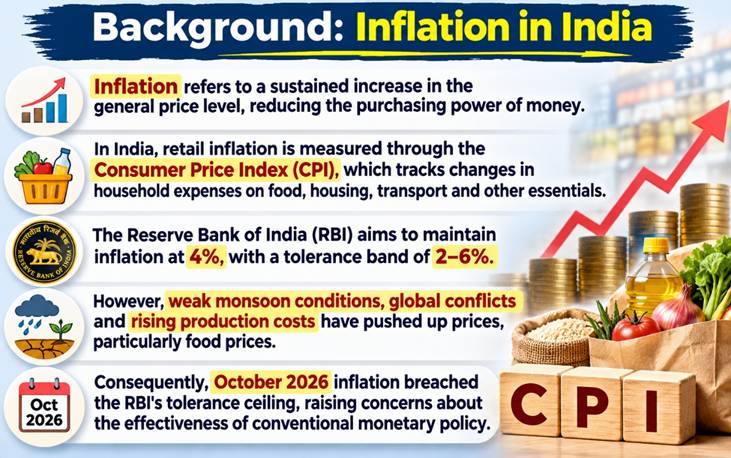
India’s retail inflation rose to 6.09% in October 2026, exceeding the RBI’s upper tolerance limit of 6%. With food inflation reaching 8.94% and price pressures spreading across sectors, economists are debating whether further interest rate hikes can control inflation without harming economic growth.
What Do Recent Inflation Figures Reveal?
- Widespread inflation: Ten of twelve major CPI categories reportedly reached their highest inflation rates under the new series.
- Food inflation: Increased to 8.94%, disproportionately affecting low-income households.
- Rural households: Faced higher inflation at 6.63%, compared with 5.41% in urban areas.
- Real wages: Research by Data for India indicates that inflation-adjusted wages declined by approximately 4% between 2012 and 2024.
Can RBI Control Inflation Through Interest Rate Hikes?
1. Arguments Supporting Rate Hikes
- RBI increases the repo rate, making borrowing costlier for commercial banks and their customers.
- Higher interest rates discourage borrowing and spending, reducing demand and inflationary pressures.
- Some economists favour stronger rate hikes to prevent inflation from becoming widespread and persistent.
2. Why Rate Hikes Have Limitations
- Supply-driven inflation: Food shortages, poor harvests and imported fuel costs raise prices even without excessive demand.
- Higher interest rates cannot directly increase food production or resolve supply-chain disruptions.
- Excessive tightening can discourage investment, reduce consumption and weaken economic growth.
- Chief Economic Adviser V. Anantha Nageswaran therefore cautioned that rate hikes could prove counterproductive against supply-induced inflation.
Way Forward
- Monetary measures: RBI should carefully manage interest rates to contain demand-driven inflation.
- Supply-side measures: Permit low-duty imports of scarce commodities, particularly edible oils and pulses.
- Agricultural reforms: Improve storage, irrigation, logistics and market infrastructure.
- Policy coordination: Combine monetary policy with targeted government interventions.
Conclusion
India requires a balanced approach combining monetary tightening and supply-side interventions. Controlling inflation must not come at the cost of unnecessarily weakening economic growth.
Source: (The Hindu)
La Excellence IAS Academy, the best IAS coaching in Hyderabad, known for delivering quality content and conceptual clarity for UPSC 2026 preparation.
FOLLOW US ON:
◉ YouTube: https://www.youtube.com/@CivilsPrepTeam
◉ Facebook: https://www.facebook.com/LaExcellenceIAS
◉ Instagram: https://www.instagram.com/laexcellenceiasacademy/
GET IN TOUCH:
Contact us at info@laex.in, https://laex.in/contact-us/
or Call us @ +91 9052 29 2929, +91 9052 99 2929, +91 9154 24 2140
OUR BRANCHES:
Head Office: H No: 1-10-225A, Beside AEVA Fertility Center, Ashok Nagar Extension, VV Giri Nagar, Ashok Nagar, Hyderabad, 500020
Madhapur: Flat no: 301, survey no 58-60, Guttala begumpet Madhapur metro pillar: 1524, Rangareddy Hyderabad, Telangana 500081
Bangalore: Plot No: 99, 2nd floor, 80 Feet Road, Beside Poorvika Mobiles, Chandra Layout, Attiguppe, Near Vijaya Nagara, Bengaluru, 560040